by Dr J Floor Anthoni
www.seafriends.org.nz/books/glossary.htm
This glossary contains all the strange
words used in our web site, relating to the (marine) environment. For geology
and soil, refer to the geology glossary. This
word list is updated from time to time, to incorporate the new words of
new sections added.
Each concept is explained in detail such that
the glossary becomes interesting on its own. Also the origin of the terms
is explained.
.
To search this glossary, use the Edit/Find
function of your browser program.
To exit, use the Back button of your browser
or click Home
If you wish to have this glossary handy while
browsing, click at File/New-browser to create two simultaneous windows,
or right-click on the link to this page and select open in new window.
Using the task bar or Window/0,1,2.. , or by using the ALT/TAB
key combination, you can switch from the document you are studying
to this glossary. You can also print this glossary for ease of reference.
When speaking to a Bear of Very Little Brain, remember that long words may bother him.
It is more fun to talk with someone who doesn't use long, difficult words but rather short, easy words like "What about lunch?".
A.B.C.D.E.F.G.H.I.J.K.L.M.N.O.P.Q.R.S.T.U.V.W.X.Y.Z...
click here for rapid access. Use your go back button to return
to this index.
A abrasion= (L: a/ab=towards/ away from; radere=
to scrape) reduction in rock particle size by wearing away.
abundant = (L: a/ab= towards; unda=wave; abundare=to
flow over) plentiful, existing in large quantities.It is a relative measure.
'Snapper are abundant' could mean thousands of them in a vast area, whereas
'Seahorses are abundant' could mean a few dozen in a small area. We often
think of abundance in terms of one species. Even though abundant, the species
depends on a host of other organisms for its living. 'Snapper is no longer
abundant' almost certainly means that a lot of other species have disappeared
as well.
abyssal= (Gk: a=not; byssos=depth; plumbless depth)
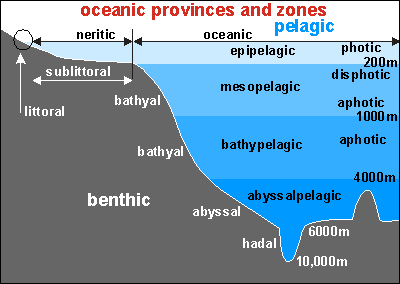
living between 4000-6000m, the abyssal zone. eco04.gif.
acclimatisation= (French: a= to; climat= climate)
the adjustment of an organism to new living conditions.
acquired characters= (L: ac/ad=towards/for; quaerere=seek;
acquirere=
to obtain) variations in an organism caused by environment or activity
but which is not inherited.
adaptation= (L: ad=towards/for; aptus=fit) modification
of an organism wich fits it for its environment. Genetic of phenotypic
response by individuals or populations to an environment, so as to enhance
fitness.
adaptive radiation= the evolution of a group of related organisms
into different types, each fitted for a different way of life.
adipose fin= (L: adipis= fat) small, lobelike fleshy
fin.
aerobic= (Gk: aero=air; bios=life) using free
oxygen in gaseaous or dissolved form, the opposite of anaerobic. In aerobic
exercise or work, the organism takes up as much oxygen from its environment
as it uses for producing the energy. Consequently, aerobic work can be
sustained for long periods. In anaerobic exercise, energy comes
from processes that do not need oxygen, but which get exhausted quickly
aestivate= (L: aestus= heat; aestivare= to sleep
through the summer heat, in a state of torpor) being dormant during summer
or dry season, much like hibernation which is being dormant during
winter.
agar= a polysaccharide obtained from the cell walls of some
red algae. Used much the same as alginates (see below).
age structure= structure of a population determined by the age
of individuals, as in human demographics.
agroecology= (agriculture + ecology) the study
of agricultural land uses and practices in relation to their impact on
soil, water and other resources.
alga/algae= (L: alga= water plant) the simple photosynthetic
plants (uni or multi-cellular, not having specialised organs such as leaves,
stems, and roots), found in seas and freshwater. See microalgae
and macroalgae. Algae= plural; alg or alga=
singular.
alginates= (Malay word) gelatin-like substances extracted from
seaweed. A salt or ester of alginic acid, an insoluble carbohydrate found
in many brown seaweeds. They are used as thickeners, emulsifiers, stabilisers
and gels in a wide range of food, biomedical and industrial products.
allee effect= Warder Allee observed that some species find it
very difficult to breed successfully once the population falls below a
certain number or density. Some species need to congregate in thousands,
before the level of security by numbers, or physical excitement is reached
to start reproducing. Most animals are not sexually active all year round,
but need to be brought up to that state by interacting/courting with many
others. It may explain the sudden demise of the passenger pigeon in the
USA.
alleles= (Gk: allel= one another) alternative forms of
the same gene which can mutate into each other. They lie on the same place
on a particular chromosome and affect the same processes.
allelopathy= (Gk: allel= one another; pathos=
suffering) the chemical inhibition of growth in one organism by another.
allopatric= (L: allo=other; patria= fatherland)
referring to populations, species or other taxa occupying different and
disjunct geographical regions. Allopatric organisms are also referred
to as strays or stragglers. They have arrived by accident,
and do not form breeding populations.
alternation of generations= a form of lifecycle when a generation
with sexual reproduction reproduces, not a similar generation , but an
asexual one. This later then reproduces to give a sexual generation again.
The alternating forms are often very different from one another. Alternation
of generations occurs in both animals (e.g. jellyfish) and plants (e.g.
ferns, seaweeds).
amphipod= (Gk: amphi= both; podos= foot) a small
crustacean with sideways compressed abdomen and two kind of limb, like
sand-hoppers. Common in sediments and seaweeds.
ampullae of Lorenzini=flask-shaped electro-sensory organs that
are found on the heads of sharks and rays, used to detect the weak electrical
fields generated by other animals and by the shark's movement through the
earth's magnetic field.
anadromous= (Gk: ana=up/back/again; dromos=running)
fish running up a river to spawn (salmon). See also catadromous.
anaerobic= (a=not + aeros + bios) see aerobic anal fin= (anal= relating to anus) single, unpaired fin
positioned on the undersurface of a fish between the anus and the tail.
angiosperm= (Gk: angeion= vessel; sperma= seed)
any plant producing flowers and reproducing by seeds enclosed within a
carpel, including herbaceous plants, herbs, shrubs, grasses and most trees.
A plant having its seed enclosed in an ovary. See also gymnosperm.
anoxia= (Gk: a/an= not; + oxygen; oxus=sharp;
-gen=
born of; root of gignomai= being born of) environmental condition
in which there is no free dissolved oxygen.
anthropogenic= (Gk: anthropos= human being; generare=
to make/beget) created or accomplished by humans.
apatite= (Gk: apatit= deceit, referring to its many deceptive
forms) a naturally occurring crystalline mineral of calcium, phosphate
and fluoride, the basis of the bones of vertebrates (and humans), and used
in 'blood and bone' fertiliser. Ca5.(PO4)3.OH
aphotic zone= (Gk; a=not; photos= light) deep
sea area of inky blackness whre photosynthesis is not possible. Many organisms
living here migrate upward during the night to feed from the euphotic and
disphotic zones. eco04.gif.
appendage= any considerable projection from the body of an animal.
Paired appendages occur in, and are characteristic of, almost all vertebrates
and arthropods.
aquaculture = the cultivation or rearing of aquatic plants or
animals. Freshwater aquaculture is very much unlike marine aquaculture.
Organisms are reared in ponds (Carp, Tilapia, Trout, Shrimp, Prawn). Marine
aquaculture almost always happens in the open sea (Salmon, Oyster, Mussel,
Scallops). These organisms prefer clean water. The farmer prefers sheltered
water. Clear sheltered water is disappearing rapidly because of poor sewage
and soil management, made worse by an accelerating growth in population.
Farming salmon is detrimental to the environment and inefficient: a predator
is raised on organic matter obtained from grazing animals (pig pellets);
what rains down needs to be broken down by the environment. Oysters can
grow in murky waters, right in the shallows of an estuary. Mussels need
clean water with a good plankton supply in the current. Both feed on phytoplankton,
thus recycling the nutrients from our sewage effluent and farm run-off.
Mussels and Oysters are not only nutricious but also rich in minerals and
trace elements.
aquifer= (L: aqua= water; ferre= to bear) a layer
of rock that holds water and allows water to percolate through it, horizontally
and vertically.
arboreal= (L: arbor=tree; arboreus= connected
with tree) adapted for life and movement in trees.
artesian water= (French: Artois= an old French province)
a water-bearing stratum lying beneath an impenetrable layer which, when
tapped, rises by hydrostatic pressure. Such a water-bearing stratum is
often lying at an angle.
arthropod= (Gk: arthron= joint; podos= foot) animal
with a hard jointed exoskeleton and paired jointed appendages;
a member of the largest phylum of animals in terms of numbers of species.
Crabs, insects, spiders and centipedes are all arthropods.
ascidian= (Gk: askos= wine skin; askidion= small
wineskin) a group of animals that includes seasquirts (Phylum Tunicata;
Class Ascidiacea)
assimilation= (L: ad=for/toward; similis=like;
absorption) conversion of digested and absorbed food into body material;
growing.
autarchy= (Gk: auto=self; arkho= rule) absolute
sovereignty or despotism.
autarkic= (Gk: auto=self; arkeo= to suffice) self-sufficient,
especially as an economic system.
autochthonous= (Gk: auto=self; chthonos=earth)
sprung from the earth. Native.
autochthons= the original or earliest known inhabitants of a
country; aboriginals, natives.
autotrophic= (Gk: auto=self; trophos=feeder; self-feeding)
independent of outside sources of food. Most plants containing chlorophyll
are autotrophic, and some bacteria. All other (trophic) organisms
depend ultimately on the existence and activity of autotrophic ones. (See
also heterotrophic)
B bacterium= (Gk: baktron=stick; bakterion=little
stick) a microscopic organism of one or more cells, lacking chlorophyll
and of varying shape and form. Bacteria are found everywhere in large numbers
and their activities are of great importance. In soil they are concerned
with the decay of plant and animal tissue; they play an important part
in sewage disposal and some cause serious diseases in animals and humans
(e.g. tuberculosis, diptheria, typhoid, pneumonia); others are sources
of antibiotics.
baleen= (L: balaena= whale) baleen= whale bone. Baleen whale=
any of various whales of the suborder Mysticeti, having plates of
baleen, fringed with bristles for straining plankton from the water. See
enviro/mammals/classification barbel= a fleshy tentacle attached to the head of a fish, usually
beneath the chin, that is used to gather sensory information.
basalt= a fine-grained, sometimes glassy rock of volcanic origin;
it makes up most of the ocean floor.
base rock, basic rock= quartz-free igneous rocks containing
feldspars
with more calcium than sodium compounds.
basic assumptions = elementary acceptance without proof. Common
wisdom can be quite wrong. Many of our assumptions about how the sea works,
are based on what we know about the land world around us. But the sea is
so different that we may as well throw all previous knowledge overboard.
Re-examining our basic assumptions is often necessary to get things right.
batholiths= (Gk: bathos= depth; lithos=stone)
any large intrusive mass of igneous rock.
bathyal, bathypelagic= (Gk: bathos= depth; pelagos=
sea; pelagios=of the sea) living in open water in the lightless
depths between 1000 and 2500m. eco04.gif.
bedding plane= surface parallel to the surface of a deposition
of sediment. In shales, the rocks split along the bedding plane; in some
sandstones however, the split is marked by changes in colour and grain
size.
bedrock = solid rock underlying alluvial deposits (from erosion).
Often this solid rock consists of greywacke, which is a sedimentary rock,
solidified under high pressure. It is a hard rock. Greywacke coasts have
steep drop-offs that wear slowly by waves and wind. Cracks in greywacke
often run vertically, resulting in caves and deep fissures which offer
shelter to marine animals.
benthic= (Gk: benthos= sea depth) living on the seabottom,
in it or immediately above it.
benthopelagic= (Gk: sea depth + of the sea) living close to
the seabottom but not normally resting on it. See also pelagic.
eco04.gif.
benthos= those plants or animals living on the bottom of a sea
or lake. eco04.gif.
biodiversity= (L: bios=life; diversitas= variety)
the variety of living organisms in all their forms and combinations.
biogeochemical cycles= the flow of elements throught he earth's
ecosystems, including various living and nonliving components of the environment.
Physical and biological processes move elements from land to sea to atmosphere
and back to land again, with the potential for some sequestering
on land or in the ocean. Biogeochemical cycles important to the maintenance
of the earth's biosphere are the carbon, oxygen, hydrogen and nitrogen
cycles. Other major cycles include those for phosphorus, sulphur, calcium,
sodium and chlorine.
biogeography= the scientific study of the geographic distribution
of organisms.
biology: (Gk: bios= (human) life; logos= word/reason)
the study of living beings
biome= a grouping of all communities or ecosystems worldwide
having a similar biotic community and occurring in broadly similar environments.
E.g. rain forest, tundra, coral reef. A large naturally occurring community
of flora and fauna adapted to the particular conditions in which they occur.
biomass= the total weight of all the animals and plants living
in a given area. It may relate to only one species.
biosphere= the sumtotal of all organic life living on, in, or
above Earth's surface. The part of the earth (air, water, rock) that supports
life.
biota= all the organisms found in a specific area. The animal
or plantlife of a region or period.
biotic= relating to life or living things.
biotic community= the totality of plants, animals and micro-organisms
in a given area of land or water, characterised by interrelationships with
each other and with the physical environment.
biotope= (Gk: bios=life; topos=place) a geographical
unit of habitat occupied by a species or community.
biotype= (Gk: bios=life; typto= to strike; typos=
impression/ figure) group of genetically identical individuals.
bipartite (life cycle)= (L: bi=two; partire= to
part) consisting of two parts or phases. Marine algae (like ferns and mosses)
reproduce once asexually and again sexually to complete one life cycle.
Lobsters spend their larval stages in the plankton, after which they descend
to the bottom.
black coral = a fan coral that forms a flexible fan of tough
black substance and studded with very fine, almost invisible, white coral
polyps. Dead Black Coral looks black whereas live Black Coral looks white.
Black Corals grow very slowly. They can't compete with plants and they
would be suffocated by fluffy algae growing all over them. Therefore they
occur only in dark places such as deeper than plants can grow. They also
favour plankton-carrying currents.
bloom: a population explosion of plankton, resulting in a visible
discoloration of the water (green, brown, red)
blubber= a thick layer of fatty tissue below the skin, acting
as insulation against heat loss in aquatic mammals, e.g. whales.
boundary effect= see edge effect.
brachiopod= (Gk: brakhion= arm; podos= foot) a
lamp shell of the phylum Brachiopoda, having a two-valved chalky shell
and a ciliated (hairy) feeding arm.
breccia= (Italian: breccia= gravel, broken rock) a sedimentary
rock, particles larger than 2 mm across, with angular rather than rounded
fragments.
breeding ground = A place where marine organisms gather to breed.
Breeding grounds differ for each species: a Crayfish may just seek deeper
water; Snapper congregate in special places; Scallops can breed only 'on
the spot' if densities are high enough. It is wrong to assume that a marine
reserve will become a breeding ground for ALL species.
breeding stocks = All organisms of a species that are capable
of breeding. The word 'stock' is commonly used for only one species; 'stocks'
for multiple species. Organisms can breed only if they have become adults,
if they are healthy and well-fed, if they can pair up, if conditions are
right and if there are enough of them. The bigger specimens do it better
because they have much bigger gonads and they have years of previous experience.
Our methods of fishing disturb the breeding activity more than we like
to acknowledge: We catch 'the big ones' when they are 'abundant' and we
make many 'widows' and 'widowers' that find it difficult to find new partners,
just like humans do.
browser: (French: brost= young shoot) an animal that eats a
little of this and that plant (like a goat), as opposed to a grazer which
eats mainly one kind of plant (like a sheep).
bryophyte= (Gk: bryon=moss; phyton=plant) a group
of plants belonging to the phylum Bryophyta, comprising the true mosses
and liverworts (lichens).
bryozoans= (Gk: bryon= moss; zoia=animals; moss
animals) any aquatic invertebrate animals of the phylum Bryozoa, also called
Polyzoa. Very small coral-like polyps that build fagile coral-like structures.
Some are flat, overlaying seaweed fronds ('sea mat') whereas others are
flexible, waving in the currents. The most beautiful ones form flowerlike
ribbons ('lace coral').
buffer zone= an adjunct to a national park or protected area,
for the purpose of accommodating boundary effects due to migrations in
and out, and of predation.
bulk fishing = fishing appreciable quantities, a synonym for
commercial fishing. Only abundant species can be fished in bulk. Where
one attempts to bulk-fish reef fish with gill nets for instance, one soon
finds that this activity is unsustainable because the reef fish population
declines rapidly. Trawlers catch a large variety of species in bulk even
though many of these would not sustain bulk fishing.
C caatinga= a low grade, dry, semi-deciduous thorny forest in
northeastern Brasil.
calcareous/ calcarious= (L: calx= chalk; calcarius=
of chalk, chalky) composed of or containing lime Ca(OH)2 or limestone CaCO3.
Cambrian= the oldest system of rocks containing fossils; a geological
period between 570 and 500 million years ago. See time
table.
campo= a sub-humid wooded grassland, like savannah.
capillary= (L: capillus=hair) a tube with an internal
diameter like a hair. A delicately branched blood vessel between arteries
(source) and veins (sink).
capillary action= the elevation (or depression) of liquids inside
narrow tubes, due to surface tension.
carapace= (Spanish: carapacho= shield) A hard covering over
part of the body in arthropods e,g, crabs. Also in reptiles and
turtles.
carbon cycle= the circulation of carbon (C) from the atmosphere
through plants and animals and back to the atmosphere.
carbon dating= determination of the age of plant or animal substances
by measurement of their content of radio-active carbon (C14), compared
with non-radioactive carbon (C12). Radioactive carbon is produced in the
upper atmosphere by radiation fromt he sun and it decays slowly.
carbohydrate= a compound of carbon (C), hydrogen (H) and oxygen
(O), playing an essential part in the metabolism of all living thing. Carbohydrates
consist mostly of CH2 chains and are found in sugars, glucose, starches,
cellulose
(wood). Carbohydrates represent stored energy which is consumed by animals
to decompose into energy and wastes. Carbohydrates are the most important
compounds in food chains. Single sugar molecules (e..g. clucose) are monosaccharides;
paired sugar molecules (e.g. sucrose) are disaccharides and polymers of
sugars are polysaccharides (e.g. starch, cellulose)
Carboniferous= (L: carbo=charcoal; fer=bearing)
geological period between 345 and 280 million years ago, so named because
of the widespread occurrence of carbon in the form of coal. See time
table.
carnivore= 1) any animal of the order Carnivora with powerful
teeth, claws, etc designed for eating the flesh of other animals. 2) any
flesh eating plant or animal.
carotenoids/ carotene= (L: carota=carrot) a group of
yellow, orange and red plant pigments which assist in photosynthesis.
They give characteristic colour to many flowers, fruits and vegetables
(e.g. carrot).
carposporophyte= (Gk: karpos= fruit; spora= spore;
phyton=
plant) a small spore-producing phase in the life cycle of some red algae,
developing directly from the female gametophyte following fertilisation.
It is often visible as a small bump.
carrageenan= (Irish: cosainin carraige= little stem of
the rock) an organic molecule obtained from some red algae and used like
an alginate. Named after carrag(h)een, an edible red seaweed (Chondrus
crispus), also called Irish moss.
carrying capacity= the biomass that can be sustained in a given
area.
cartilaginous= (L: cartilago= cartilege) made of cartilage.
Cartilaginous fishes are the sharks and rays. Cartilage or gristle
is a tough protein material found in higher animals and in which hard material
is deposited to form bone. Young fish have cartilaginous bones that later
harden.
catadromous= (Gk: kata=down; dromos= running)
fish that swim down rivers to sea to spawn (eel). See also anadromous.
catalyst= (Gk: kata=down, downwards; luo= to set
free) substance that speeds up a chemical reaction but which is not itself
catchment
area= the area draining into a lake, river or other body of water.
See watershed.
caudal peduncle= (L: cauda=tail; pedis= foot;
peduncle=
stalk) the part of a fish that connects the body to the tail fin.
cautious = (L: cavere= to take heed; cautio= prudence)
careful, prudent, attentive to safety. This word is often used in marine
conservation meaning 'to err on the safe side'. Cautious management allows
for unknown detrimental factors such as sudden natural mortality, seasonal
and other fluctuations, errors in estimating the stock, errors in estimating
the catches and so on. Rather than opting for a minimal sustainable stocking
level, cautious management favours optimal or maximum stocking levels.
cell= (L: cella= store room) the smallest structural
and functional unit of a living organisms, consisting of cytoplasm
and a nucleus, enclosed in a membrane.
cellulose= substance of which plant cells are made; a tough
carbohydrate
with large molecules. See carbohydrate.
central nervous system= the brain and spinal cord of an animal;
it coordinates the animal's activities.
cerebellum= (L: cerebrum= brain; cerebellum= little
brain) the rear part of the vertebrate brain, particularly concerned with
the coordination of complex muscular movements.
charting = mapping the coast and sea. Charting is the very first
measurement one does with a new place. Charting consists of measuring the
sea and coast for the purpose of safe navigation. It does not take account
of the existing marine habitats. Where the chart shows 'rock' or 'sand'
or 'broken shell', this is to assist in anchoring safely or to help in
trawling for fish. Charts are extensively used for fishing and exploration
of the sea, including marine research. So charting is a very important
first step.
chemosynthesisers= organisms that convert chemical energy into
living tissue. Compare with photosynthesisers.
chemotrophic= (Gk: chemia=art of transmuting metals (alchemy);
trephos=
to feed) obtaining energy by chemical reactions, independent of light.
Some bacteria are chemotrophic. See also autotrophic and heterotrophic.
chitin= (Gk: chiton=a long woollen tunic) a polysaccharide
forming the hard exoskeleton of arthropods and parts of many
other invertebrates; it is also found in some fungi. See carbohydrate.
chiton= marine molluscs of the phylum Mollusca, class Polyplacophora,
limpet-like but having 8 overlapping plates heldf together by a girdle.
chlorophyll= (Gk: chloros=green; phyllon=leaf)
a green pigment found in algae and all higher plants. It picks up the energy
of sunlight for use in photosynthesis.
chloroplast= Gk: chloros=green; plastos=shaped)a
small organelle (plastid), containing chlorophyll, found in plant cells
undergoing photosynthesis.
chordate= (L: chorda= cord) an animal from the phylum
Chordata wich includes lancelets and all of the vertebrates, animals with
a backbone (notochord) in some stage of their lives.
chromosome= (Gk: chromos/ chromatos= colour; soma=
body; referring to the coloured part in a transparent cell) a microscopic
thread-shaped body which carries genes. Numbers of chromosomes occur
in the nucleus of each plant and animal cell and their number and
form are usually constant for every species of organism. Chromosomes are
usually visible only during cell division. the molecular unit of inheritance
in living organisms (a chromosome is a very large molecule). Each species
has a characteristic number of chromosomes (e.g. 48 for humans), identical
in each cell of an organism. It carries all the genetic information for
that organism.
circadian: about once a day (L: circa=about and dia=day).
Circadian rhythm is a rhythm occuring once a day
circalittoral: (L: circa=about; litus/litoris=shore)
the habitat zone beneath the plant (photic) infralittoral zone.
eco03.gif.
classification= (L: classis= assembly) the grouping of
organisms into categories to reflect their relatedness; the subject matter
of taxonomy.
clastic rock= rock containing fragments or particles of older
rocks.
climax= a more or less stable community which is in equilibrium
with the existing natural environment, e.g a forest. The culminating stage
in the ecological succession or evolution of a plant/animal community that
has attained stability (equilibrium) and is self-perpetuating.
clone= descendants produced asexually from a single plant or
animal. They have exactly the same genetic makeup as the parent, unless
mutation occurs.
cmidarian= () an animal from the Phylum Cnidaria, a diverse
group including jellyfish, hydroids and corals. They possess stinging cells
and many are flower-shaped.
coastal policy = a course of action for our coast. A coastal
management plan. The Resource Management Act which does not apply to fisheries
(!!!) does apply to local bodies, the Department of Conservation and the
New Zealand public. It aims to conserve our resources for sustainability.
The act requires DoC to produce a coastal policy.
coastal waters = a vague term denoting the seas adjacent to
the land mass. Our territorial sea extends 11 Km out (the reach of a cannon
at the time) but the Extended Economic Zone extends 200 sea miles or about
370 Km. The sea under direct influence of sewage and run-off from the land
is only 0.1-3 Km wide. This is the coastal water worst affected by humans.
In this water we find all our coastal habitats and coastal fisheries and
marine farming. Most of our marine bio-diversity is found here.
cockle flats = the wind-swept sandy flats inside an estuary
between mid and low tide levels. Cockles are bivalves with thick shells,
about 2-3cm across, that live in clean estuaries. Higher up the shore one
finds small ones whereas towards low tide level, the big ones are found.
Cockle banks contain millions of specimens. They grow rapidly and provide
a reliable source of food. Cockles can filter the water so efficiently
that the outgoing tide is often much cleaner than the incoming tide.
coevolution= (com + evolution; evolving together)
(coadaptation) Reciprocal and interactive evolutionary change in
two or more species living in the same area.
collagen= a fibrous animal protein which on boiling yields gelatin.
collecting = gathering. The word has been used here in a cynical
way because collecting specimens is the very first step done when studying
the biology of a new area. In earlier days collectors were fanatical because
each newly discovered species gave them more standing amongst their colleagues
and it gave them the right to name the species. The name of the collector
was then added to the scientific name. Today the science of collecting,
classifying and naming (taxonomy) has lost its charm, mainly because very
few spectacular new species are found and because genetic tests may one
day completely revise the present classifications.
colonisation= (Gk: colon=limb) the occupation of empty
space by free-floating larvae. Because marine organisms are prolific breeders,
empty space on the bottom is soon occupied. Colonists are the first
to invade newly created habitat.
commensal= (L: com= with/together; mensa=table;
dining together) a species living in close association with another species.
One organism benefits, the other does not, but neither is harmed. For example,
the Remora (Shark Sucker) attaches itself to a shark without harming it,
and scavenges the left-overs from the shark's meal)
commercial fishermen = those who fish for a living. The word
is used to separate this class of fishermen from those who do it for fun,
the recreational fisherman. But the notion goes deeper. In the old days
when the catch could not be conserved, the fisherman caught only what he
and his neighbours could eat that same day. He was not driven to fish more
than that. However, now that fish can be frozen and conserved and processed,
fishermen are driven by a sense of greed for direct profit. Thus catches
are no longer limited in a natural way. This has resulted in the depletion
of many fish stocks. But a commercial fisherman (who fishes for profit)
will stop fishing when costs exceed profits, whereas a recreational fisherman
won't.
community / biological community= (L communitas=common,
shared) all the creatures living in a specific locality. This notion is
now used to denote the creatures living in a specific type of locality
or habitat. Such type localities or habitats can be found in many places
and more often than not, the same creatures are found there in about the
same ratios. So the word community is often used synonymous to 'habitat'.
complex = a composite consisting of related parts, but also
meaning complicated. A building complex is a compound consisting various
rooms. This word is not commonly used in marine biology where the synonym
'system' is more in vogue.
congeners= a group of species that belong to the same genus
conglomerate= a sedimentary rock with rounded or abraded
particles larger than 2 mm diameter. Modern pebble accumulations (e.g.
beaches, river beds) may become conglomerates when cemented by time.
connective tissue= an animal tissue comprising fibres, cells,
fluid, blood and lymph vessels, scattered through an amorphous matrix.
conservation= (L: con= with/together; servare=
to keep; to keep together) judicious use and management of nature and natural
resources for the benefit of human society and for other reasons (ethical,
historical, cultural, etc).
conservationist = supporter or advocate of environmental conservation.
As we become more and more aware of how important a healthy environment
is for our wellbeing, environmental conservation becomes increasingly more
fashionable. The reason that industrialists and businessmen are often found
opposing environmental conservation is that they fear an 'unfair' increase
in operational costs. Conservationists often blame industry for the damage
it causes, conveniently forgetting that the goods produced are necessary
for and wanted by our society, conservationists included.
container port = a port for container vessels. Container transport
is very efficient. Loading and unloading a ship can be done in a matter
of hours. Container ports need deep water and a lot of open-air storage
with good access for trucks and trains.
continental drift= a geological theory proposed to account for
the shape of Earth's surface. It presumes that the present continents were
originally one large land mass which broke up and which have drifted to
their present positions. Since 1975 so much evidence in support of this
theory has been found that it is no longer questioned.
continental shelf= the part of the sea floor that adjoins a
landmass; over the continental shelf, the water is less than 200m deep.
The outer margin of the continental shelf is marked by the continental
slope which runs down to the abyssal region. eco04.gif.
convergence= (L: cum/com/con=with ;vergere= to
incline) 1) (of rocks): occurs when two types of rock, initially different,
become similar in content through metamorphism. (of sediment): when two
layers become close together through the thinning of the intervening strata;
2) (in evolution): when two groups of living things come to look alike
because they have adapted to the same mode of life, not because they are
related (e.g. sharks and dolphins).
copepods= (Gk: kope= oar handle; podos= foot;
oar-footed) lobsterlike crustaceansof the sub-class Copepoda, living permanently
in the plankton, like euphausids (krill). These are important components
of the food web because they serve as a source of food for small fish,
and even whales.
coral = (L: corallum; Gk: korallion) a hard limestone
structure (fan, ball, brain, whip, antler, table, tupe, cup -shaped) built
by many flowerlike organisms that have very thin skins but are often beautifully
coloured. Corals live in the clearest of oceans where the water is no less
than 23 degrees Celsius. Coral polyps can catch animal plankton but there's
very little of it. Fortunately corals have algal cells in their skins that
produce organic matter from sunlight, CO2, water and nutrients. These algal
cells (zooxanthella) produce food for the corals. Thus corals abound
in the bright light close to the surface but cannot grow in the darker
depths, unlike common filterfeeders such as sponges. See also hermatype.
coralline algae: red algae of the order Corallinales with calcium
deposits in their shell walls. Calcareous, stony or coral like algae, typically
appearing pink. The encrusting forms are called pink paint and the turfing
forms pink turf. Coralline algae are important reef builders in temperate
to tropical seas.
corridor= (It; correre= to run; ) a more or less continuous
conection between adjacent and similar habitats, such as roads, hedgerows,
streams, irrigation ditches and so on.
crab = a spiderlike eight-footed crustacean with jointed legs
and two pincers but with its tail bent underneath its carapace. It forms
a very compact and robust shape.Crabs usually grow fast and mature early.
Crabs are not caught commercially in NZ. apart from incidental catches
of the estuarine Paddle Crab.
crayfish = a lobsterlike crustacean. The word is commonly used
for freshwater lobsters but here in New Zealand it has stuck to the Spiny
Lobster or Langouste as it is known by Frenchmen. The Crayfish has no pincers.
It grows to over 40 years old and matures slowly. Crayfish has always been
an important commercial coastal species.
crepuscular= (L: crepusculum= twilight; of twilight)
descriptive term for an animal which is active in the twilight but sleeps
during the middle of the day and night.
Cretaceous= (L: creta=chalk) a geological period from
136 to 65 million years ago, marked by estensive deposits of limestone.
The Cretaceous closed the period of the dinosaurs as the super continent
Pangea broke apart. It heralded the evolution of modern plants and animals.
See time table.
crinoid= (Gk: krinon= lily; krinoides= lily-shaped)
a featherstar of the class Crinoidea; a suspension-feeding echinoderm with
long, branching arms.
crustacean= (L: crusta= shell, crust) a member of a large
subphylum Crustacea, most of which have a hard external skeleton, segmented
body, jointed limbs, two pairs of antennas and compound eyes. Crayfish,
lobster, shrimp, crab, barnacle, isopod, amphipod, copepod.
crustose algae= thin, crust-like algae growing flattened against
the underlayer (substrate)
cryptic= (Gk: kryptos= hidden) concealed. Cryptic coloration=
coloration designed to conceal.
ctenoid scales= (Gk: ktenos=comb) scales in which the visible
rear margin is comblike or serrated. See cycloid un-serrated scales.
currents = The steady movement of seawater.Currents come in
a number of qualities. The fastest, most destructive ones are caused by
waves. These water currents go to and fro on the shore but move in a circular
fashion before the wave breaks. Their force diminishes rapidly with depth.
The twice daily tides cause currents four times a day, which also move
to and fro but in certain places only in one direction. The heat from the
equator and the cold from the polar regions drive slow currents that rotate
in gigantic gyres on both Northern and Southern hemispheres. These global
currents influence our climate. They also cause the net transport of water,
solid particles and nutrients. They rinse our coasts. When such currents
stagnate, as is the case in 'El Nino' years, the basic composition of our
coastal waters changes and this can have a disastrous effect on many marine
creatures.
cyanobacteria= (Gk: kuanos= dark blue) blue-green algae.
Prokaryotic organisms found in many environments, and capable of photosynthesising.
cycloid scales= (L: cyclus, Gk: kyklos= circle)
scales in which the visible rear margin is a smooth curve. See ctenoid cyto-, -cyte= (Gk: kytos=vessel) relating to a cell.
cytoplasm= (Gk: kytos= vessel; plasso= to shape;
plasma=form,
mould) all the contents of a cell, except the nucleus.
D de-= (Latin) down, off, away from. Before verbs, reversal of
that verb.
deciduous= (L: de-=down/away ; caedere= to cut/
fall; decidere to cut/decide) shedding leaves annually. As a survival
strategy for harsh conditions, many plants are able to shed their leaves.
Winter-deciduous trees do so to hibernate through winter, and summer-deciduous
trees do so to estivate through drought.
decomposition= (opposite of composition) the breakdown of dead
organic material into simpler molecules. Bacteria and fungi are the
primary decomposers of the biosphere.
deep water fauna = the animals living in deep water. The term
'deep' is often used for as little as 20m depth, or more precisely, where
brown and green algae can no longer live through lack of light. Here the
rocks are covered with animals that filter the water for food (filter feeders).
Some catch plant plankton (sponges, seasquirts, bivalves) whereas others
catch animal plankton (anemones, soft corals, bryozoa). Another important
group feeds on detritus (dead organisms) that rains down from above (seastars,
seacucumbers, worms). The predators and scavengers complete the list (seastars,
several fish species). eco04.gif.
delta= (Gk: daleth= triangle; the Latin and Greek capital
letter D is named delta and drawn as a triangle) a triangular alluvial
plain at the mouth of a river where the river divides into a series of
channels before entering the sea or lake.
deme= (Gk: demos= people) a discrete population of interbreeding
individuals.
demersal= (L: de=down; mergere= to plunge/dip)
living near but not upon the seabottom of the continental shelf. Large
demersal fishes are often fished commercially.
demography= (Gk: demos= the people; graphia= writing)
the study of birth and death rates and their consequences on the density
or abundance of a population. The study of the statistics of birth and
death.
Department of Conservation (DoC) = It is DoC's task to preserve
the natural environment. It is an immense task for which not enough resources
are available (lack of money). Most resources go in maintaining the conservation
'estate', our parks, reserves, tracks, huts and so on. Much attention is
paid to 'firefighting', trying to save almost-extinct species such as the
Black Robin. But it is everyone's task to relieve the pressure that humans
exert on the natural environment. We cannot live without shampoos and two
showers a day and consuming an unnecessary amount of food. Recycling is
considered 'uneconomical' and the amount of waste produced by every human
being increases rapidly as the economy grows. If we all co-operated, DoC's
task would be much easier.
detrital (rock)= minerals or rocks derived from existing rock
by weathering or erosion. Some detrital minerals are economically important,
like gold found in riverbeds.
detritivore= an animal that eats detritus (dead organic material).
A large detritivore, while feeding on detritus, may also ingest small living
organisms, such as bacteria.
detritus= (L: tritus= wearing, friction; detritus=
wearing down) debris of any kind, produced by erosion, decay, rubbish,
waste. Organic debris from decomposing plants and animals. In the ocean,
dead (and alive) plankton organisms rain down to the sea bottom to make
up the detritus found there.
Devonian= geological period of 50 million years duration, extending
from 395 to 345 million years ago. See time table.
diatom= (Gk: di= two; temno= to cut) a microscopic
unicellular alga with a siliceous cell-wall, found as plankton, and forming
fossil deposits. Diatoms are constructed like pill boxes, one half covering
the other. As they divide, one part always becomes smaller.
dimorphic= (Gk: di=two; morphe=form) a species
that occurs in two forms that are physically different, either in colour
or in form or both.
dinoflagellate= (Gk: deinos= terrible; flagellum=
whip) a protozoan with whipping hair(s) which enable it to swim. Part of
the ocean plankton community.
dioecious= (Gk: di=two; oikos=house) unisexual-
the male and female reproductive organs are borne on different individuals.
(monoecious on same individual)
diploid= (Gk: diplous=double; eidos=form) (of
the number of chromosomes): the double, or complete number of chromosomes
found in the body sells, compared witht he single number (haploid=single)
found in sex cells.
dispersal= (L: dis/des= not/negation/reversal ; spargere=
to scatter; Gk: diaspora) To send in different directions. The distribution
of an organism by sea currrents.
disphotic zone= (L: dis=not; photos=light) the
area underneath the euphotic zone. It is so poorly lit that respiration
exceeds photosynthesis (80-700m, depending on clarity). eco04.gif.
disposal = the act of getting rid of. This word is used to 'place
in order' things we don't want, such as sewage, refuse, poisons. Ironically,
all things we want to dispose of, are or have been at one stage, expensive
resources. During production processes and the act of living, these expensive
resources have somehow become too diluted or too scattered or they occur
in the wrong form to be 'economically useful' or 'recyclable'.
diurnal= (L: dies=day) (of animals): active by day. (of
plants): altering condition between day and night. See nocturnal.
diversity = (L: diversitas) variety, number of species,
functions, habitats, etc. It is an important measure of the health of a
community. As more and more pressure is exerted on a community, an increasing
number of species disappears. The community becomes less diverse and its
functioning is affected. The place of the losers is taken by those who
remain, and who then may become more numerous. So abundance of numbers
as opposed to diversity of species is not necessarily a measure of good
health. alpa-diversity= an ecological measure of the intrinsic number
of species within a community. beta diversity= an ecological measure
of the turnover of species along an environmental gradient. gamma diversity=
an ecological measure of the species turnover rate with distance between
sites of similar habitat. The rate at which additional species are encountered
as geographic replacements within a habitat type in different localities.
dormant= (French: dormir= to sleep; L: dormire)
in a resting condition; the organism is alive but relatively inactive in
metabolism, and no growth occurs (see also hybernating, aestivating)
dorsal fin= (L: dorsum= back) single, unpaired fin on
the upper surface of a fish's body.
dyke/dike= (Dutch: dijk= sea wall) 1) a sheet-like body
of igneous rock which cuts across the bedding or structural planes
of the host rock. 2) a long wall or embankment built to prevent flooding.
E echinoderm= (Gk: ekhinos= hedgehog, sea urchin; derma=
skin; the prickly skinned) an animal belonging to the phylum Echinodermata
which occur exclusively in the sea. They have an internal calcium carbonate
skeleton and a water vascular system with canals and tubefeet. Sea urchins,
sea stars, sea cucumbers.
ecology= (Gk: oikos=house, logos=word, reason)
the branch of science dealing with the relationships of organisms to one
another and to their physical surroundings. The study of the relationships
of animals and plants to their animate and inanimate surroundings. 2) the
study of the interaction of people with the environment.
economic activity = activity for profit or for a living. Economic
activity relating to the sea has very many aspects: freight, transport,
ferrying, charter boating, boat repair, fishing, marine farming, living,
building, sightseeing, ecotourism, diving and so on.
economy= (Gk: oikos=house; nemo=manage; -nomia=distribution)
1) the wealth and resources of a community in relation to production and
consumption. 2) the careful management of resources.
ecosystem = (Gk: oikos= house; syn= with, together,
alike; histemi=to set up; organisation, structure) a biological
community of interacting organisms and their physical environment. The
biological community consists not only of producers (grazers), predators
and scavengers but also of cleaners and decomposers such as bacteria and
fungi. Every ecosystem has closed loops (chains or webs) for nutrients
(Nitrogen, Phosphorus, Calcium, Potassium, Sodium, etc), matter or energy
(Carbon, Oxygen) and trace elements (Sulphur, Iron, Cobalt etc.). If an
ecosystem is not self-sustaining, it is called an 'open' ecosystem, which
derives some of the necessary components from elsewhere.
ecotone= (Gk: oikos= house; teino= to stretch;
) a landscape boundary which exists between two or more adjacent communities
or habitats, also known as edge.
ecotype= (Gk: oikos= house; typos= impression)
a genetically differentiated subunit within species that represents ecological
adaptation to certain local environments.
ectoparasite= (Gk: ektos= outside) an organism living
parasitically on the outside of another (e.g. flea).
edaphic= (Gk: edaphos= floor) relating to soil or topography
rather than climate.
edge effect= processes that characterise habitat fragmentation
and the resulting creation of habitat edges.
emerge/ emergence= (L: emergere= to appear; ex=out
of; mergere=to dip) come into view, when previously conceiled. In
science, an emergence is a new way of thinking coming into view when looking
in at a complex issue, from a distance. Computers are but electronic circuits,
but programming emerged from them, and from that artificial intelligence.
emergent (zone)= the bits of the land above water. Usually it
refers to the marine environment that becomes apparent during low tides.
Often the underwater world can be predicted by looking at the emergent
bits. It reveals clues about the substrate (rock), the wave exposure, currents,
water clarity, water temperature and more.
endangered (species): used for species that are in danger of
extinction and whose survival is unlikely if the causal factors continue
to exist. Included are species whose numbers have been reduced to a critical
level or whose habitats have been so drastically reduced that they are
deemed to be in immediate danger of extinction. Small populations may cause
breeding to collapse due to the lack of genetic diversity.
endemic: (Gk: en=in/into/onto; demos= the people;
native) found only in a certain region. (see also native, indigenous,
local, sympatric, parapatric and allopatric)
energy flows = (Gk: en=into; ergos= work; capable
of work) the flow of potential energy in a food chain or food web. Body
tissue can be converted into energy. Hence it is equal to potential energy.
In order to grow, plants need solar energy which is used to bind carbon,
oxygen and water molecules into carbo-hydrates. Grazers eat the plants
and use their potential energy to grow and to live. Predators eat the grazers
and use their potential energy to grow and to live. All this can be expressed
in terms of energy equivalents, hence the term 'energy flow'.
environment: (Fr: environ= encircled, surround; en=in
+ viron=circuit) conditions or circumstances of living. All the
conditions which surround and affect an organism.
enzyme= (Gk: en=into; zyme= to leaven/layer) a
protein catalyst made by living cells, and helping to carry out
a chemical process or reaction, without being consumed by it. Enzymes are
so critical to the chemical reactions within cells that these would not
occur without them. Enzymes can be likened to chemical ratchets, levering
heat energy (Brownian movement of molecules) to diminish chemical barriers
and to make chemical bonds that are stronger than the surrounding heat
energy.
ephemera= an insect of the order Ephemeroptera (mayfly).
ephemeral= (Gk: epi-=upon ; hemera=day; ephemeros=
lasting one day) short-lived, transitory. Lasting only one day.
epipelagic= (Gk: epi=above; pelagos=ocean) living
very close to the surface in the open ocean, to about 100m. eco04.gif.
epiphyte= (Gk: epi=upon; phyton= plant) a non-parasitic
plant growing on trees and possessing aerial roots having the ability to
absorb moisture from the atmosphere.
epistemology= (Gk: episteme= knowledge; logos=
word, reason) study of knowledge, especially with regard to its methods
and validation.
equinox= (L: equi=equal; noce=night) the time
when the length of day equals night. The vernal equinox is on 21
March, and the autumnal equinox about 22 September.
erosion= (L: ex=out of; rodere= to gnaw) the wearing
away and lowering of the land surface by wind, water, sand and ice.
estivate= see aestivate.
estuary = (L: aestus= tide) an almost enclosed part of
the sea with an opening to the sea through which the tide enters and at
the other end one or more rivers. Estuaries are the places where the runoff
from the land, carried by the rivers, mixes intensively with the salt water
from the sea. In summer the estuaries are warmer than the sea but in winter
they are colder. Because of their high nutrient content, estuaries breed
dense blooms of phyto plankton, which is the most important food source
there. Each estuary has its own, unique character, depending on its topography,
orientation, depth, exposure to wind, type of land-use, size of catchment
area and more. Some estuaries are refreshed by the sea almost completely
with each tide cycle whereas others may take months to do so. We don't
know precisely how important estuaries are for the health of the sea but
we do know that many fish species are hatched there.
ethnobotany= (Gk: ethnos= nation; botane=plant)
the discipline within botany which examines the interactions between human
societies and the plant species important to their culture.
eukaryote= (Gk: eu=well; karuon= kernel) an organism
consisting of a cell or cells in which the genetic material is contained
within a distinct nucleus.
euphotic zone= (Gk: eu= well, easily ; photos=
light; well-lit) the area in the sea closest to the surface, receiving
enough light for photosynthesis (0-80m, depending on water clarity).
eutrophic= (Gk: eu= well; trephos= to feed; overfed)
a term describing water, well supplied with nutrients and too highly productive
of organic matter. Eutrophication may be a problem when water becomes
so rich that plant organisms cause problems to other organisms. It often
results in an ecosystem 'flip', changing the living community in a drastic
way to one that is much less varied.
eutrophication= the process of nutrient enrichment of an aquatic
ecosystem leading to increased biologic production. As eutrophication proceeds,
there are a number of consequences, including excess production, increased
decay, reduced oxygen, and decreased biodiversity.
evapotranspire/ transpiration= the process by which a land plant
(with roots, stems and leaves), moves water into the roots, up the stem
and into the leaves, from which it then evaporates into the air.
evolution= (L: ex=out of; volvere= to roll; to
evolve)
1) the concept that life comes only from existing life, and that living
things change, giving rise to new life forms. 2) gradual development from
a simple form to a more complex one.
evolutionary convergence= the development of superficially similar
characteristics and habits by totally unrelated species living under comparable
ecological conditions, but in isolation from each other.
exoskeleton= a skeleton covering the outside of the body, or
lying in the skin, and supporting and protecting the soft body parts. Many
invertebrates have exoskeletons (insects, starfish). Most higher organisms
have an endoskeleton.
exotic species= nonnative species that have established viable
populations within a community, where they were previously absent.
exploit= (L: ex=out of; plicare=to fold) make
use of; derive benefit from.
exploited species = the fishes we catch (commercially). Species
are exploited because there are many of them and they are easy to catch.
Whalers preferred the big ones because they provided the most profit for
the least effort. While targeting successively smaller species, the smallest
whales, the Minke and Pilot whales, escaped the wholesale slaughter. Their
numbers are now embarrassingly high and may prevent the big whales to recover.
The Sperm Whale also survived reasonably well because it fought back and
was rather risky to take.
exploitive uses = taking from the sea. If we could classify
the ways we use the sea in exploitive (taking), non-exploitive (leaving
as it is) and restorative (putting back in), which one would deserve highest
priority?
extinct: (L: ex=out of; stinguere= to quench;
extinguere=squeeze
out) used for species which are no longer known to exist in the wild after
repeated searches of the type localities and other known likely places.
The species may still exist in captivity or cultivation.
extirpation= (L: exstirpare; ex=out; stirps=
stem; to root out) the process by which an individual, population or species
is totally destroyed.
extrusion= (L: ex=out of; trudere= to thrust)
a lava flow which has come out onto Earth's surface.
ex situ (conservation)= (L: ex=out; situs= site;
out of place) the conservation of plant and animal taxa or their biological
materials (seeds, embryos, DNA) away from their natural habitat, as in
zoological parks and botanic gardens.
F facies= (L: face= face/features) the sum total of features,
such as rock type, mineral content, fossil content, which characterise
a sediment as having been deposited in a given environment.
fault= a fracture in rocks, along which the layers have become
displaced by slipping past each other.
fauna= (L: Faunus=Roman god with goattlike features,
like the Greek god Pan) the animal population present in a given
place or at a given time in the past.
feeding grounds = the places where an animal feeds. Usually
an animal lives on its feeding ground, thus saving energy while feeding.
Some reef fishes may live and sleep on or about the reef, only to forage
far afield. Little is known about feeding habits, let alone feeding grounds.
But we do know that a host of species and conditions must be maintained
to provide for food.
feldspars/felspar= the most important group of rock-forming silicate
minerals. See geologic dictionary.
filamentous algae: (L: filare= to spin; filum=
thread) algae comprised of a linear group of cells joined at their end
walls, forming thread-like strands.
filter feeding= a method of feeding (found only in the water)
by which an animal moves water past some structure, capable of filtering
particles within a certain size range. Those particles, which include the
animal's preferred food, are the ingested. Examples: barnacles which filter
very small plankton from the water, and baleen whales which filter plankton
krill.
finger sponge = a number of sponge species which grow long or
short fingers in brown, red, orange, yellow or purple colours.
fire-climax= a stable vegetation resulting from frequent burning.
firn= (?) the imperfectly consolidated granular snow found on
glaciers.
fisheries interest = a vague term denoting either those who
are interested in fishing or the kind of interest arising from fishing.
Thus in order to manage fisheries, one needs to be interested in where
the fish are, how many there are and so on.
fisheries policy = a course of action for fishing. A policy
is a general plan whereas a management plan spells out the detail. So a
fisheries policy would be to maintain stocks for sustainability, whereas
the management plan which spells out quotas, could unknowingly be in direct
conflict with it. In order to manage our fisheries, MAF has the following
options: restrictions by area, seasonal restrictions, exclusion zones (marine
reserves), net specifications, mesh sizes, minimum fish size or age.
fishing pressure = the pressure on our fishing stocks caused
by the demand (the market), greed, economy of scale, employment (we have
to make a living).
fissure eruption= an eruption of lava through a linear crack
or vent in Earth's surface.
flagellate= (Gk: flagellum= whip) planktonic organism
having flagella or hair-like whips. Flagella are thought to be individual
species that have become part of the host species.
flash flood= a sudden flood of water down a normally dry river
bed, caused by a rainstorm some distance upstream. The chance timing of
spatially separated rainstorms over a catchment area, may add up to an
unpredictable flash flood where rivers meet.
flood plain= a flat tract of land bordering a river and consisting
of alluvium deposited by the river. When the river floods, it deposits
sediments on the banks and in the river channel, thus raising the channel
above the level of the flood plain. The raised banks are known as levees.
flora= (L: flos, floris = flower, named after the goddess
of flowers) the plants of a particular region or period. A work systematically
listing and describing such plants.
fluvial= (L: fluere= to flow; fluvius=river) pertaing
to or produced by a river.
flyway= the route followed by migratory birds.
food chain/ food web= the chain of organisms in any natural
community, through which energy is transferred. Each link in the food chain
feeds on and thus obtains energy from the one preceding it, and is then
itself eaten, providing energy for the next organism in the chain. The
beginning of the chain is plant matter (plant - grazer - carnivore - superpredator
- detritus - nutrients - plant). Most food chains are more complicated
than this simple model and now the term food web is prefered. The
food webs in the sea have many tiers because the plants in the phytoplankton
are so small.
foraminifera= (L: foramen= an opening/hole; fera=bearing;
ferre=
to bear) are small single-celled marine organisms with perforated shells
made of lime. They are important in forming chalk deposits and deep-sea
oozes.
Protozoans of the order Foraminifera, having perforated chalky shells through
which amoeba-like pseudopodia emerge. Foraminifers usually live on the
sea bottom where they can form deep layers of chalk.
fossil= (L: fodere=to dig; fossil=dug up) the
remains of an organism, or the direct evidence of its presences, preserved
in rocks. Usually only the hard parts are preserved.
Fossilisation
is the process by which fossils are formed. See time
table.
founder effect= nonselective changes in the genetic makeup of
a colonising population during its establishment by a few founding
individuals.
fragmentation= the process by which habitats are increasingly
subdivided into smaller units, resulting in their increased insularity
as well as in losses of total habitat area. See also edge effect,
allee
effect.
fucalean= (L: fuco= false, counterfeit) one of two types
of large brown algae within the class Phaeophycea, the other being the
laminarians
or true kelps. Often referred to as sea wracks, bladder weeds or stringy
seaweeds, these are the most abundant algae in NZ.
full marine reserve = a non-exploitive marine reserve, a no-take
reserve. The Marine Reserves Act allows for a variety of marine reserves,
even allowing for extraction of some kind. Many people believe that reserves
are about sustainabiltity, thus allowing for managed extraction (USA, Australia).
But history has shown that there's something wrong with the way we manage.
So there's a definite place for a no-take reserve, which would not be influenced
by our mistakes. However, this concept assumes that the reserve will automatically
get better over time (no putting in). Many of our marine reserves are deteriorating
and with some this deterioration is even accelerating! (Long Bay, Leigh)
The biggest threats to our marine environment comes from runoff. If we
want to save the reserves, we have to improve our land management, at least
in the areas affecting the reserves. The term 'full marine reserve' should
be set aside for those reserves that we have targeted to become pristine
wilderness areas, akin to our concept of 'paradise'. For those reserves
we have to do more than just nothing.
fundamental processes = essential, natural series of steps.
Science is involved in understanding the natural processes. Starting from
the fundamental ones, it builds further upon these to understand less fundamental
ones. However, in the sea, science has missed a few steps. The sea is very
inaccessible and experiments cannot be controlled. Hence our understanding
of even fundamental processes in the sea is incomplete. For instance we
don't know how the main nutritional cycles work. We can't put a finger
on the most important creatures of all, the sub-microscopic plankton. And
all else depends on these! Of most creatures in the sea we don't know what
they eat, what eats them or even how old they grow.
G gallery forest= a long, narrow strip of forest bordering one
or both banks of a river.
game fishing = sportfishing for big fish. It is done for the
fight and the adrenalin and the honour obtained. For sharks, a boat trawls
a burley bait (mashed bait in a leaking bag) through the water. When a
shark arrives, the real bait is thrown in. Depending on the species of
shark, there'll be a small or a big fight. Marlin fights harder but is
not attracted by burley. Several lures are trolled behind the boat. The
Marlin can strike any of these.
gamete= (Gk: gamos=marriage) a mature germ cell able to unite
with another in sexual reproduction. Gametes are formed during meiosis
when the germ cell splits its chromosones. Thus gametes have only half
the normal number of chromosomes. The union of two such cells (egg and
sperm) forms a normal cell which is a unique individual.
gametophyte= (Gk: gamos= marriage; phyton= plant)
the gamete-bearing phase in the life cycle of some algae.
gastropod= (Gk: gaster/gasteros= stomach; podos=
foot; belly-footed) an animal of the class Gastropoda in the phylum Mollusca,
which move along on a muscular foot: snails, slugs, limpets and abalone.
gene= (Gk: genea=race) a unit of the material of inheritance,
the basic unit of heredity. Numbers of genes occur on each chromosome in
the cell nucleus. Each gene controls one or more traits in an organism,
and the way they are inherited.
genetic diversity= the variety and frequency of different genes
and/or genetic stock.
genetics= the study of inheritance of living things.
gene pool= all the genes in a population. Some animals within
a pool of one species, have slightly modified genes, which at a given time
may prove better suited to changing conditions. In that manner, the species
is saved from extinction, being able to adapt. As a species' gene pool
diminishes (e.g. by there being fewer individuals), its chance for survival
also diminishes.
genus= (L: genus= birth, race, stock) a group of species
that are closely related (plural genera). In taxonomic classification,
the genus is the first grouping of species, sometimes divided in subgenus/subgenera.
general insurance = a general measure to provide for a contingency.
The idea is that we don't know what could possibly happen to a fish stock,
a community or habitat. If we had several places in the sea that were safe
from human greed or error, then these places might survive against all
odds. From the survivors, the stocks could rebuild themselves in the course
of time. It is an idea that has not been tested. Dr Ballantine thinks that
having ten percent of everything, could protect against a major disaster.
The reality is, however, that also marine reserves are not free from natural
disasters (or deterioration in water quality).
genuine priority = a proper interest having prior claim to consideration.
Consciously or unconsciously we give priority to actions. We often do things
because we CAN or because we've always done so, but not because we thought
carefully about them. When considering all facts, we should genuinely give
more consideration to non-exploitive uses as opposed to exploitive uses,
because non-exploitive uses don't use up the resource.
geophysics= the study of physical phenomena bearing on the structure,
physical conditions and evolutionary history of Earth. Branches of geophysics
include the study of earthquakes, magnetic fields, gravity, etc.
geosyncline= a major structural and sedimentational unit of
Earth's crust. It consists of an elongated basin filled with sediment which
causes the floor to subside. Subsequent earth movements may produce a mountain
chain from the geosynclinal structure.
gorgonian: (Gk: Gorgon= each of the snake-like sisters
that formed the terrible Medusa) a type of flexible horny tree-like coral
of the order Gorgonacea with eight-armed polyps.
grazer: a herbivore that eats whole plants and mainly one or
a few species. See also browser.
grazing capacity= the optimum number of animals that can be
supported on a particular pasture or range. See also carrying capacity.
grazing succession= a sequence of grazing by different species,
each of which tending to make the habitat suitable for the next.
greywacke= (German: grauwacken; grau= grey; ) is a hard and
durable grey rock with no structure (like layers). It was re-formed (metamorphosed)
from sedimentary rock (with layers) under pressure and heat, between 65
and 270 million years ago. It forms the foundation of many ranges and shores
of NZ. It is now also called turbidite, believed to have been laid
down by deep sea turbidity currents.
groundwater= water that has accumulated beneath the surface
of the soil above the first impenetrable layer. The soil is at field
capacity if more rainwater can no longer be absorbed by the soil. Sometimes
deep groundwater can be tapped as if it were an aquifer, providing integrated
water storage to bridge periods of drought.
groundwater forest= a forest, watered by seeepage, located in
an arid area.
H habitat = the natural home of an organism. It is the typical
place (and community) where an organism lives. What makes one habitat different
from another are usually physical factors such as temperature, salinity,
clarity, wave action, currents, amount of light, quality of the light,
substrate, topography and less important ones. Once a community establishes
itself, it often changes its surroundings, just like humans do.
hadal (zone)= (Gk: Hades= the God of the underground) the
zone of ocean deeper than 6000m, usually associated with the deep troughs.
See also abyssal. eco04.gif.
haemoglobin/ hemoglobin= (Gk: haima=blood) (haematin
+ globulin) pigment concerned with respiration, found in the red blood
cells of vertebrates and in some invertebrates. It is an iron-containing
pigment closely related to chlorophyll.
halophyte= (Gk: hals, halos=salt) a plant able to grow
in a salty environment or salty soil.
halogen= (Gk: halos= salt; gignomai= to be born,
become) any of the group of non-metallic elements, like fluorine, chlorine,
bromine, iodine, which form halides by simple usnion with a metal (like
sodium chloride= salt).
hanging valley= a tributary valley in a mountainous region,
which joins the main valley by a sudden sharp descent caused by glacial
erosion.
haploid= (Gk: haplous= single; eidos=form) haploid
organisms have a single set of chromosomes. See diploid.
hemisphere = (Gk: hemi=half; sphaira= sphere)
half sphere. If one looks at the world from space, only a hemisphere is
seen. But this hemisphere could be centred anywhere. When centred on the
vast Pacific Ocean, the 'water' hemisphere shows far more sea than land.
NZ happens to lie in that region. When centred above NZ, the hemisphere
shows much water.
herbivore= (L: herba= plant; vorare=to devour)
an animal that eats plants. Grazers, browsers.
heritage = anything that is inherited. The word is also used
symbolically: young people 'inherit' the world as it was 'handed down'
to them by the grown-ups. Kauri trees and Kiwi and the Waikato River are
part of the heritage of all New Zelanders. But so is the underwater world
with species that live only here in NZ waters: Spotty, Seahorse, Kahawai,
Toheroa ... The list is long.
hermaphrodite= (Greek mythology: Hermes the god of commerce,
and Aphrodites the goddess of love, had a son named Hermaphrodites. He
became joined in one body with the nymph Salmacis, becoming both female
and male within one body.) Hence an animal which is both male and female,
either at the same time or at different times in their lives. See protandrous
and protogynous.
hermatype: (as above, meaning two bodies in one) corals are
hermatypic
if their tissues contain algal cells (zooxanthella). This turns
them into the most metabolically efficient animals on Earth, since they
derive food direct from the algae in their bodies, which derive it direct
from sunlight. Furthermore, they do not need to spend energy for grazing,
hunting or catching food. The wastes of the coral animal are immediately
reused by the algae. An animal with an inbuilt food chain.
heterocercal= (Gk: heteros=other; circa= round,
all around) a tail fin with unequal upper and lower lobes. See homocercal heterotrophic= (Gk: heteros= other; trophos= feeder;
other-feeder) requiring a supply of food from the environment. All animals
and a few plants are heterotrophic. (opposite: holophytic, autotrophic,
phototrophic)
heuristic= (Gk: heurisko= to find) allowing or assisting
to discover; finding out for oneself; learning by trial and error.
hibernate= (L: hiems= winter; hibernus= wintry;
hibernare)
to spend the winter in a dormant state.
hierarchy= (Gk: hieros= sacred; arkhes= ruler)
a system in which grades or classes of status or authority are ranked one
above the other, as in organisations, governments, religions. Being able
to rank objects in a certain order helps scientific thinking.
holdfast= a thing or place that holds something secure, a sucker-like
root that secures a seaweed to the rock.
holiday home owners = people who own a holiday home away from
where they work and live. The beachside 'bach', a small shed with the slightest
of comfort, was traditionally New Zealander's 'getaway'. Such a holiday
home is built in an area that is rich in space and nature but devoid of
people. However, as time passes by, more and more holiday homes are built,
which changes the character of the place. Those who notice so most, are
the 'locals', reason for some animosity between the two groups. Both can
be loud objectors against a marine reserve in their area, even though the
reserve is going to safeguard the things they value most (a pristine area
to enjoy outside the daily rat-race).
holistic/wholistic= (Gk: holos= whole) treating the whole
rather than the symptoms.
holophytic= (Gk: holos=whole; phyton=plant) feeding
like a green plant, by making organic compounds from inorganic ones, and
using energy from the sun by means of photosynthesis.
holoplankton= (Gk: holos=whole; + plankton) plankton
organisms which exist as plankton all their lives, like dinoflagellates,
diatoms, etc. Other planktonic organisms such as fish and crab larvae,
spend only their early youth as plankton.
holotype= (Gk: holos=the whole; typos=figure,
type) the species used for naming and describing a species. Holotypes are
carefully stored in museums around the world, because they are the ultimate
reference for any named species.
holozoic= (Gk: holos= whole; zoios= animal) feeding
like an animal, i.e. heterotrophic.
homocercal= (Gk: homos=the same; circa= round,
all around) a tail fin with equally sized upper and lower lobes
hormone= (Gk: hormao= to impel; hormon= impelled)
an organic substance produced in minute quantity in one part of an organism,
then transported to other parts of the organism where it exerts a profound
effect. Hormones can act as messengers between one part of an organism
and others.
host= the organism in or on which a parasite lives.
hydrology= (Gk: hydros=water; logos=word/reason)
the study of all water on or in Earth.
I igneous= (L: ignis=fire) a descriptive term for rocks
formed by the solidifying of magma on or beneath Earth's surface.
Igneous rocks are usually crystalline.
indeterminate: this word is used in grading the severity of
threat to an endangered species. When graded 'indeterminate', the species
is under severe threat but adequate data is unavailable.
indigenous: (L: indi=in; gen=born; indigena=born
into) originating naturally in a region; not introduced. But it may also
occcur naturally in other regions.
individual = a single member of a class. A specimen.
infralittoral= (L: infra=below/beneath; litus/litoris=
shore) the photic plant habitat zone below low tide. eco03.gif.
interpret = to explain the meaning of. There's a difference
between explaining and interpreting. The word is now also loosely used
for what a tour guide does.
invertebrate= the general term for an animal without a backbone.
The group of invertebrata includes one-celled animals, sponges, jellyfish,
worms, snails, starfish, insects and so on.
irruption= (L: in=in; rumpere= to break; forcible
entry) a spontaneous migratory movement occasioned by an animal population
suddenly increasing and outgrowing its food supply, thereby creating conditions
that no longer support life.
island biogeography= the theory developed by R H MacArthur and
E O Wilson in 1967, which proposes that the number of species inhabiting
an island is a function of island area and distance from the mainland,
and is determined by the relationship between the rates of species immigration
and extinction.
isolate = (L: insula= island) to keep apart, to exclude.
An isolated island like the Kermadec's Raoul Island, was a hard place to
live. It was hard to get to in the first place, then to land on it, let
alone to do any trade with.Thus it was spared somewhat.
isopod= (Gk: isos= equal; podos= foot; equal-footed)
a crustacean of the order Isopoda with flattened bodies and 7 pairs of
legs of nearly equal length: slaters, sea lice. Many lead a parasitic life.
isostacy= (Gk: isos=equal; stasis= station) the
tendency for the Earth's crust to maintain a state of near-balance. For
instance, when erosion of a mountain area occurs, or when a large ice sheet
melts, compensation in the form of new uplift occurs. It explains variations
in relative levels of sea and land.
J jellyfish= a marine coelentherate of the class Scyphozoa having
an umbrella-shaped jelly-like body and stinging tentacles.
Jurassic= a geological time period extending from 195 to 136
million years ago. See time table.
K kai-moana = Maori word for seafood. Kai=food; Moana=sea. The
Maori blame the Pakeha for the sad state of our fisheries. It is true that
the white man with his technology has been dominant in our fisheries. But
the true reason for overfishing comes from the sheer number of people (locally
and overseas) demanding seafood and exports. The pressure of demand has
pushed caution out of the way. Maoris also pride themselves that they have
always practised conservation. But archaeological finds show clearly that
this was not the case.
kaitiaki=
keartin= a tough fibrous protein, containing much sulphur, occurring
in the vertebrate skin and also in hair, horn, feathers, hoof, etc.
keystone species= a species on which a large number of other species
depend (feed).
L lacustrine= (L: lacus=lake) pertaining to a lake. Living
in or growing by a lake.
lahar= (Javanese) torrential flow of water and debris from a
volcano.
Often lahars are caused by the sudden melting of snow tops by volcanic
eruptions.
laminarian: (L: lamina= scale, thin layer) the true kelps
of the order Phaeophycea: giant kelp, stalked kelp
landscape ecology= a new branch of ecology dealing with the
processes that determine pattern and function on a landscape scale.
larvae = (L: larva= ghost, mask) the just hatched marine
organisms. Unlike land animals, sea creatures are born from very small
eggs and have to fend for themselves while often millions of times smaller
than adult size. Although born in astronomical numbers, very few survive
the first year. Those who do are called 'recruits'. The death of all these
larvae is part of the ecosystem - they serve as food for other organisms.
In the cause of its life, a snapper larva may grow a million times its
birth weight, changing diet often, according to its new size. Larvae are
usually markedly different from later stages such as the juvenile or adult.
lateral line: (L: latus= the side; lateral= of
the side) a sensory organ of fishes that appears as a line running along
the side of the body. It consists of a canal studded with sensory organs
and connected to the outside by pores through scales. The lateral line
detects low frequency vibrations and pressure differences.
lava= (L: lavare=to wash) rock that has flowed in liquid
form from a volcano or a fissure in Earth's crust. Pillow lava occurs when
lava flows out under water, and the outer skin is rapidly chilled, forming
a balloon-like or tunnel-like shape.
leaching= the washing out of soluble substances from soil or
rock, by water percolating through.
learning curve = a hypothetical curve of knowledge (vertically)
against time (horizontally). In the beginning, knowledge increases slowly
but exponentially until it can't go any faster. Then it proceeds at a constant
rate, until most is known and only the difficult bits need to be found.
Then it flattens out. When training rats in a maze, indeed a similar curve
is obtained from zero percent to hundred percent performance. Fast learners
follow a steeper curve than slow learners.
leptocephalus= (Gk: leptos=fine, small, delicate; kephale=head;
small-headed) the leaf-shaped larval form of all eels.
levee= (French: lever= to rise; levée=
risen up) a natural or manmade embankment along a river or canal.
Life cycle= the cyclical sequence of different stages through
which organisms pass during their lives. Stages usually include egg, larva,
juvenile and adult. Adults reproduce to create the next generation of eggs,
thus completing the cycle.
life history= the significant features of the life cycle
of an organism.
limestone= a sedimentary rock consisting essentially of carbonates
(CO3). Organic limestone is produced from shells and skeletons of
animals secreting calcium carbonate (CaCO3). An example of this form of
limestone is chalk.
lipids= (Gk: lipos=fat) any of a group of organic compounds
that are insoluble in water but soluble in organic solvents, including
fatty acids, oils, waxes, and steroids.
lithosphere= (Gk: lithos = stone) the crust of Earth,
inside which is the mantle and the core.
littoral: (L: litus= shore) pertaining to the shore of
a lake, sea or ocean. The intertidal zone. The environment between the
highest and the lowest tide levels. Littoral faunas and floras have special
characteristics enabling them to survive their continuously changing conditions.
supralittoral=
above the intertidal zone. See also infralittoral, below the littoral
zone. eco03.gif.
eco04.gif.
longliners = fishermen using longlines. A longline is a long
fishing line (100-1000m) baited with many hooks. It is laid down above
the bottom from one weighted buoy with a flag on top, to another. Several
small weights and floats may be used to keep the longline near the bottom.
Fish caught by longline are of high quality. They have not been crushed
in a net. They arive on board in good condition and are rapidly killed
by spiking the brain in the Japanese 'ike' way, then they are rapidly cooled
in brine (ice and salt).
M macroalgae= (Gk: makros=long/large; + alga) seaweeds,
including the larger plants of the sea that grow attached to the bottom,
from high tide level on the shore down as deep as sufficient sunlight for
photosynthesis penetrates. There are three classes of algae: green, brown
and red algae. Large algae such as sea weeds, kelps, seagrass.
macrobenthos= (Gk: makros=large; + benthos= sea
depth) organisms larger than 1mm, found on the sea/lake bottom. See also
meiobenthos
and microbenthos.
magma= (Gk: masso=to knead; magma= kneaded) molten,
fluid rock, charged with gases and formed within the crust or upper mantle
of the Earth. It may solidify into igneous= (L: ignis= fire)
rock. Extruded onto Earth's surface, it becomes lava.
maintaining diversity = maintaining variety. Since each species
lives in its own habitat, maintaining diversity also involves maintaining
diversity of habitat.
mandible= (L: mandere= to chew) one of two horizontally
apposed teeth-like appendages on the underside of the head of a crustacean,
used to crush and tear prey. Also used to denote the jaw, especially the
lower jaw in mammals and fishes.
mangroves = an area with mangrove trees. The mangrove trees
in New Zealand are flowering trees that have adapted to standing in the
tide. This tree has overcome many problems relating to keeping salt out
of its tissues while also being able to 'drink' salt water through its
roots. The mangrove trees grow only in the Northern half of the North Island,
being sensitive to cold. They grow in the upper reaches of an estuary where
the mudflat habitat is found. Although the mudflats are assisted by mangrove
trees, they don't depend on them. So mudflats are found in estuaries all
over NZ.
mantle= the portion of the Earth lying betweent he crust and
the core, from a depth of 35 Km to 2900 Km.
marina = specially designed harbour with moorings for pleasure
craft. Many people have boats and these need moorings. In marinas they
are moored such that they take up the least amount of space. Marinas are
built in sheltered places, always near where people live. Marinas represent
a non-destructive use of the water but they have to be built first. Fortunately
the disturbed underwater communities recover quickly. Even so, marinas
evoke heavy opposition from locals.
marine biologist = a graduate trained in the biology of the
sea. To become a marine biologist, one must follow a university course.
During the course one gets trained in the basic biology of plants and animals.
A certain amount of mathematics, physics, chemistry and biochemistry is
also learned. In the last years the study focuses on marine subjects. A
marine biologist is trained to follow a study through with field work,
laboratory work, mathematical analysis and precise reporting.
marine farms = the cropping or rearing of marine organisms.
(Oysters, Mussels, Salmon and recently also Paua). Each species has its
own preferred method of farming.
marine industries = industries involved with the sea, ranging
from boat building to fisheries.
marine laboratory = a building fitted out for experiments relating
to the sea. A marine laboratory must have a circulating saltwater system.
Salt water is pumped from the sea and circulated through experimental and
holding tanks. A gravity-feeding salt water storage is kept in case of
pump or power failure. A marine laboratory also has access to an area in
the sea that is protected for the sake of conducting marine experiments
in the sea. It also has one or more boats and an array of diving equipment.
marine snow= organic aggregates of living and dead matter and
jelly/mucus, to which bacteria may adhere. Marine snow is much larger (0.5-2cm)
than the microscopic organisms living on it, so that it can easily be caught
by larger fish living in the dark deep zones.
maritime = connected with the sea or seafaring.
market = a demand for a commodity or service. A market-driven
economy (as NZ has become in recent years) is driven by the demand for
its products or services. The demand is in turn created and increased by
'marketing', and advertising. The overriding profit motive is insensitive
to conservation.
medusa= (Greek mythology: Medousa is a Gorgon with snakes
instead of hair) free-swimming bell- or umbrella- shaped form of a coelenterate
(e.g. jellyfish). The medusa produces sexually and the fertilised eggs
grow into polyps.
meiobenthos= (Gk: meion= less; benthos= sea depth)
benthic (bottom-living) organisms in size between 0.1 and 1mm; the larger
microbes, consisting of foraminiferans, turbellarians, polychate worms,
filling the roles of nutrient recylers, decomposers, primary producers
and predators.
meristem= (Gk: meros=part; merizo= to divide;
meristos=
divisible) a region of actively growing cells in algae. From the meristem
new fronds grow.
meroplankton= (Gk: meros= part/partial; + plankton) plankton
organisms which spend only part of their lives in the plankton, like the
larvae of many sessile benthic organisms (sea squirts, sponges, oysters,
etc) and free moving ones (snails, crabs, lobsters, etc.).
mesopelagic= (Gk: mesos=middle; pelagos= ocean)
living in the open sea between 200 and 1000m depth
Mesozoic= (Gk: mesos=middle; zoion= animal) the
geological era from 225 to 65 million years ago. It comprises the Triassic,
Jurassic
and Cretaceous periods. The most spectacular elements of the mesozoic
fauna were giant reptiles such as dinosaurs. See time
table.
microalgae= (Gk: mikros= small; + alga) the microscopic
plants (single-celled or colonies of cells) of the sea that are found wherever
there is enough light for photosynthesis. They include a high diversity
within the taxonomic classes: green, yellow-green, yellow-brown, golden-brown,
brown, red, and blue-green algae.
microbe= (Gk: mikros= small; bios= life) a minute
living being, a micro-organism.
microbenthos= (Gk: mikros= small; + benthos= sea
depth) benthic (bottom-living) organisms smaller than 0.1mm, including
diatoms (producers), bacteria (decomposers and producers) and ciliates.
microbial symbiont= a micro organism (bacterium, protozoan,
yeast) living in a symbiontic relationship in or on a host organism. Like
those inside the rumen (stomach) of cattle to digest cellulose. See also
symbiosis.
migration= (L: migrare= to move/travel) moving actively
from one place to another by crawling, swimming, flying. The extent of
the ocean horizontally is vast, and places which differ in temperature,
are located far apart. Horizontal migrations (transoceanic migrations)
are done most successfully by large organisms (enjoying economics of scale),
which also have sufficient reserves to survive long periods of famine.
Many organisms in the sea migrate vertically from the dark aphotic
zone lacking food to the sunlit zone where food abounds. Such migrations
take only 100-800m each day.
mimicry= the adoption by one species of animal of the colour,
habits or structure of another species to gain protection or camouflage.
Mimicry is particularly common among insects.
Ministry of Agriculture and Fisheries = (MAF) the department
charged with the interests in agriculture and fisheries. It has been split
up into MAF, the Ministry of Agriculture and Forestry, and MoF, Ministry
of Fisheries.
Miocene= the geological epoch from 26 to 7 million years ago.
See time table.
mitigation= (L: mitis= mild; mitigare) to make
milder or less intense or severe; to moderate.
mitochondrion= (Gk: mitos= thread; chondros= granule;
chondrion=
small granule) a thread-like body, several of which occur in every living
cell. Mitochondria are associated with enzymes, especially those to do
with cell respiration. Mitochondrial DNA is quite separate from nucleus
DNA and is passed only from mother to offspring. Measuring the many (harmless)
mutations in mitochondrial DNA, scientists are able to substantiate kinship
between groups of organisms and thus influence their ranking in the taxonomic
classification of living things.
mollusc/ mollusk= a member of a large phylum of invertebrate
animals (Mollusca), characterised by soft, unsegmented bodies and usually
having a calcareous shell. Shells, snails, slugs, clams, octopus, squid,
etc.
monocotyledon= (Gk: monos= single; kotule=cup;
kotuledon=
cup shaped cavity) a flowering plant characterised chiefly by a single
seed leaf (cotyledon) and by an endogenous (growing from within) mode of
growth. See also dicotyledon.
monoculture= the intensive or protracted culture of a single
species of plant or animal.
monoecious= (Gk: monos= single; oikos=house) having
both male and female reproductive organs on the same individual. See hermaphrodite
and dioecious.
monogamous= (Gk: monos= signle; gamos= marriage)
having only a single mate. See also polygamous.
monotypic= a genus comprising only one species, or a species
not divisible into subspecies.
mucilaginous: (L: mucus = slime) secreting slime.
mutation= (L: mutare=to change) a sudden change in a
gene, caused by a change in the molecules of DNA. The gene so changed can
reproduce itself in the usual manner. If the mutation occurs in the DNA
of sex cells, the mutant gene can be inherited by the offspring.
mutualism= (L: mutare= to change/revert; reciprocal)
a symbiontic relationship between different organisms in which both partners
benefit.
mycorrhizae= (Gk; mykes= mushroom; rhiza=root)
a largely symbiotic relationship between fungi and vascular plants giving
the plant increased uptake of water and nutrients (nitrogen), in return
of sugars and carbohydrates for the fungus.
mysid= () a small shrimp-like crustacean belonging to the order
Mysidacea. They carry their eggs in a pouch.
N nacre= (Spanish: nacar) the mother-of-pearl from any
shelled mollusc. Many molluscs make shells consisting of limestone (calcium
carbonate, CaCO3), but they cover the insides of their shells in a much
harder substance, which protects them against shell-boring worms and attacks
from outside. It also gives them a much better surface to attach their
bodies to. However, both forms of limestone dissolve in acids like hydrochloride
stomach acid (HCl). Boring whelks use this acid for drilling round holes
into the shell, entering the shell through this hole with their long proboscis
(trunk). Fragments of nacre are often found in the sea sand. Mother-of-pearl
has long been commercially valuable. It has been used for ornamentation,
in the manufacture of buttons, and in the inlay for various works of art,
particularly those made of wood and silver. People of many island cultures
have bartered mother-of-pearl for other goods. Today, mother-of-pearl is
commonly used in making jewellery, such as pearl necklaces, and for decorative
pocketknife handles, etc.
native= a local inhabitant, born there. Not necessarily synonymous
with endemic (e.g. Cabbage Trees and Pukeko are also found in Australia).
natural population level = the population level attained in
a natural way. Central to this concept is the notion that there exists
such a thing as 'a population level'. Indeed in complex communities of
many species, population levels remain somewhat constant. But in disturbed
communities (such as exploited ones), population levels can oscillate quite
profoundly.
natural process = natural course, as opposed to human-made or
human-induced series of changes.
natural refuge = a natural shelter from pursuit or danger. It
could be said that the sea has no more natural refuges. Where could one
hide from exploitation? Isn't the sea accessible and fishable and exploited
everywhere? Hence the need for marine reserves.
nauplius= (Gk: Nauplios is the son of the god of the
sea, Poseidon or Neptune for the Romans) the first larval forms of many
crustaceans (naupliosoma).
nekton= (Gk: nekho= to swim; nektos= swimming)
animals that swim actively in the water, including fishes and whales. Free
swimming plankton organisms like krill, are called either micronekton or
macrozooplankton.
nematocyst= (Gk: nema= thread; nematode= thready
thing; cystis= bladder) a cyst like structure of nettle cells in
cnidaria,
comprising a poisonous barbed thread discharged on touch.
nemertian= (Gk: nema= thread) a predatory worm belonging
to the Phylum Nemertea. These roundworms range from a millimetre to 30m!
Those found in Antarctica are some of the largest.
neoclassical economics= (Gk/L: neos=new; classis=
assembly) the dominant school of economic thought, is founded on the idea
of economic man: individual producers and consumers who behave predictably
because they make calculated decisions according to their consciously developed
“objective function” to maximize profits or utility, respectively.
neritic= (Gk: Nereus is the sea god; Nereis his
daughter) inhabiting the sea over the continental shelf (Neritic
province).
niche= (French: cove, cell, cubby-hole), an ecological term
for the role an organism plays in a community and environment, including
the habitat it occupies and the food it eats. Niche organisms are not the
mainstream organisms making up the bulk of the food web, but their existence
is incidental although they may depend on some mainstream organisms. Nich
organisms add considerably to biodiversity.
nivation= (French. nive=snow) the disintegration of rocks
around a patch of snow, brought about by alternate freezeing and thawing.
nocturnal= (L: nox=night; nocturnal= of the night)
(of an animal): active at night and resting during the day.
nomenclature= (L: nomen= an ancient Roman's second name;
calare=
to call; name call) the scientific naming of species and other scientifically
recognised categories of animals and other organisms in which they are
classified.
non-destructive use = having one's cake by not eating it. Examples
of non-destructive use are: education and eco-tourism. Is sustainable use
destructive use?
non-target species = species that were not targeted in the fisheries.
By-catches. While fishing for Orange Roughy, with a quota for this 'target'
species, also other species are found in the nets. Since non-target species
are also caught in the process of fishing for others, we cannot get a clear
idea of their natural population levels.
no-take = non-extractive. To leave things alone and not even
disturb them.
nucleus= (biol): a ball of dense material bounded by a membrane
and containing the chromosomes. Nuclei are found in the cells of all living
organisms except viruses, and they are the controlling mechanisms of the
cells.
O observation = the act of noticing.Scientists need to
be able to make observations that are not disturbed by the actions of others.
oceanic (province)= the area of the oceans outside the continental
shelf. eco04.gif.
odontoceti= (Gk: odont= tooth; ketos= whale) see
toothed whales.
offshore = synonymous to 'away from the mainland'. The further
offshore a place is, the harder it is to get there to exploit it.
Oligocene= a geological epoch lasting from 38 to 26 million
years ago. See time table.
omnivorous= (L: omni=all/ of all things; vorare=
to devour) eating both plant and animal food. Omnivores are not specific
to any food source, and this gives them ecological resilience, while spending
little energy on foraging. It allows them to inhabit many biomes.
ontogeny= (Gk: on,ont=beings; geny= production/development/forming)
the whole course of development of an individual's life history.
Ordovician= a geological period lasting from 500 to 440 million
years ago. See time table.
organism= (Gk: organon=tool; Fr: organisme= living
being) an individual living creature
orogeny= (Gk: oros=mountain; geny=forming) a period
of mountain building which could last for millions of years. orogenesis
is the process of mountain building, such as folding, faulting and thrusting
of the earth's surface.
osmosis= (Gk: osmos=to push) the transport of molecules
in a liquid through a semi-permeable membrane into a more concentrated
solution, until the concentration of molecules on both sides of the membrane
are the same. Osmosis plays a decisive part in controlling the water distribution
in living things. In diffusion, molecules travel from a more concentrated
solution to a less concentrated one.
ostracod= (Gk: ostrakon= shell; shelly thing) a small
relative of the lobster resembling bivalved shellfish but having crustacean
legs in the shell. They are common in sediments and often swim at night.
otoliths= (Gk: otos=ear; lithos=stone) the internal
earbones of a fish, often sectioned to show growth rings that can be used
for estimating age.
outdoor education = education outside the classroom in outdoor
pursuits.
ovoparous, oviparous= (L: ovum=egg) a form of reproduction
in which eggs are produced and hatched outside the female's body. See viviparous
and ovoviviparous.
ovoviviparous= a form of reproduction in which eggs are produced
and stored inside the female's body so that the young are born fully developed.
P palaeobotany= (Gk: palaios= ancient) the branch of palaeontology
relating to fossil plants.
palaeontology= (Gk: palaios= ancient; on/eimi=
being/to be; logos= reason) the science of forms of life existing
in former geological periods, as represented by fossil plants and animals.
paleocene epoch: (Gk: palaios= ancient; cainos=
new) between 54.8 and 65 million years ago. See time
table.
paleozoic era: (Gk: palaios= ancient; zoion= animal)
248 to 570 million years ago.
palustrine= (L: palus= marsh) relating to a marsh.
panarchy= (Gk: pan= all/ the whole of; arkes=ruler;
ruled by all) describes the evolving nature of complex adaptive systems,
encapsulating how novelty and change coexist in a context of persistence
and stability. It resolves the paradox of change and stability.
paradigm= (Gk: para=beside/ past/ beyond ; deiknumi=show)
an example or pattern (set) of thinking. By looking at a problem from a
distance, often new insight can be gained.
parapatric= (Gk: para= biside/beyond; patria/patrius=
fatherland) referring to populations with contiguous but not overlapping
geographic ranges. See also sympatric and allopatric.
parasite= (L/Gk: para= beside, past, beyond; sitos=food;
parasitos=
someone who eats at someone else's table) an organism living in or on another
organism, the
host, at the latter's expense, and without being of
use in return.
parthenogenesis= (Gk: parthenos=virgin; genesis=
origin/formation) the development of an ovum, without being fertilised,
into a new individual. Reproduction by a male gamete without fertilisation,
as is normal for invertebrates and lower plants.
pathogen= (Gk: pathos= suffering; genes= born/become/kind;
of the suffering kind) disease-causing micro-organism, bacterium or virus.
pectoral fins= (L: pectus= breast; pectoris= of
the breast) paired fins on the front part of a fish's body, usually below
or immediately behind the gill slits. (breast fins)
pelagic= (Gk: pelagos=ocean) living in the open sea,
and not normally associated with the bottom. eco04.gif.
pelvic fins= (L: pelvis=basin, hipbone) paired fins on
the lower surface of a fish's body, either near the anus or immediately
below the gill slits. (hipfins)
peneplain= (L: paene= almost) a tract of land reduced
almost to a plain by erosion.
Permian= geological period lasting from 280 to 225 million years
ago. See time table.
petrification/ petrifaction= (Gk: petros=stone; petra=rock)
the gradual replacement of a dead organism by an inorganic substance (usually
lime) so that the original is apparently 'turned to stone'. A form of fossilisation.
pharyngial teeth= teeth in the pharynx pharynx= part of the gut immediately behind the mouth cavity,
which in fishes is usually muscular and armed with teeth to crush and cut
up food items.
phenotype= (Gk: phaino= shine, show; phainomai=
to appear; typus= impression) individuals genetically grouped together
by similar traits such as form, function or behaviour (as opposed to chemical
or DNA properties).
photic: relating to light. The photic zone in the sea is where
light is strong enough to enable plants to photo-synthesise. Because some
plants are more sensitive to light than others, it is difficult to say
to which depth the photic zone extends. This is further complicated by
plankton organisms migrating up and down and by water masses being mixed
by currents. eco04.gif.
photophores= light-emitting organs possessed by some fishes
photosynthesis= the process by which plant cells make glucose
from carbon dioxide, water and sunlight, using chlorophyll as catalyst.
during the process, solar energy is stored in the carbohydrate molecules.
This energy becomes available to animals eating and digesting the plant
material, and to organisms which break down dead material.
phototroph= (Gk: photos=light; trophos= feeder;
feeding off light) single-celled bacteria and protists in the sea ranging
between 0.5-1.0 micrometre producing most of the ocean's primary production.
These ultra small organisms grow fast, providing food to the smallest of
planktonic heterotrophs (other-feeders). See also autotroph=
self-feeder.
phyllosoma= (Gk: phyllon= leaf; soma= body; leaf-bodied)
the second and subsequent larval stages of a crayfish when it looks like
a leaf rather than a crayfish.
phylogeny= (Gk: phylon=tribe; genesis=origin)
evolutionary history of an organism; racial history.
physical environment = material conditions affecting the life
and growth of plants and animals. Temperature, salinity, dissolved nutrients,
suspended particles, topography, substrate and so on.
physiology= the study of the chemical processes occurring in
living things.
phyto-plankton = (Gk: phyton=plant) suspended microscopic
plant organisms, ususlly drifting in the sunlit surface waters.
pioneer species= the first species to colonise a barren area,
beginning a new successional sequence.
placoid scales= (Gk: plax/placos=flat plate) small scales
consisting of a hard base and a tooth-like backward projection, embedded
in the skin of sharks.
plankton= (Gk: planktos= wandering/ drifting) a collective
term for the small plants and animals which float and drift in surface
waters. Phytoplankton is the plant component and zooplankton
the animal component. Netplankton is the plankton caught in a 70
micron mesh (a hair's width) and is easily visible under a good microscope.
Nannoplankton
comprises much smaller forms of plankton visible only with a very high-powered
microscope, usually a scanning electron microscope (SEM). In geology nannoplankton
is very important in correlating the oldest sedimentary rocks. Picoplankton
is even smaller.
pleiomorphism= the occurrence of an organism in a number of
different forms.
Pleistocene= a geological epoch lasting from 2 million to 20,000
years ago. See timetable.
pleuston= (Gk: pleura= side of the body) living on the
surface of the water. Some jellyfish like the by-the-wind sailer and Portuguese
man-of-war, and some snails live just underneath or on top of the ocean's
surface.
plutonic= (Gk: Plouton, L: Plutonius, Pluto god
of the underworld) geological term describing rocks formed deep in Earth.
polder= (Dutch) a tract of low-lying land, reclaimed from the
sea, and protected by dykes. The Dutch reclaimed land by building a dyke
around a lake or sea arm, and a ring canal on its outside. Water was then
pumped from the lake into the ring canal (by windmills), and discharged
into rivers or sea. The dried up lake then became a polder. Many Dutch
live in polders beneath sea level.
policy = a course or principle of action (course, rule, plan,
scheme).
pollution= (L: polluere= to defile, contaminate) the
contamination of a natural ecosystem by wastes from human activities. The
contaminants may be nutrients, that initially stimulate growth of primary
producers, or they may be chronic toxins.
polyandrous= (Gk: polloi= many; andros= man) characterised
by a single female having more than one male partner. See also polygynous.
polygynous= (Gk: polloi= many; gyne=woman) characterised
by a sinlge male having more than one female partner. See also polyandrous.
polyp= (L: polypus= many-footed) one of two basic body
forms in the Phylum Cnidaria (stinging flower animals), the other being
the medusa. Some cnidarians are exclusively polyps whether solitary (anemones)
or colonial (corals). Others are solely medusae (some planktonic forms)
and still others alternate between polyp and medusa (many hydroids and
most jellyfish).
population = (L: populus=people; populare=to inhabit)
the inhabitants of a place, usually meaning the number of specimens of
one species. It is often very difficult to estimate the population of a
species: obscurity, migrations, occurring in few but dense patches and
so on.
population viability= (L; vita= life) the concept of
a minimal number of individuals representing the threshold between survival
versus extinction.
precipitation= (L: prae=before; caput=head; praecipitare=
to throw head-long) atmospheric condensation appearing in the form of mist
or fog or falling as rain, snow or hail.
predator= (L: praeda= booty/plunder) an animal whose
way of life is based upon killing other animals for food.
primary production= the production of new organic material by
photosynthesis; the basis of the food chain.
principle = (L: principium= source, foundation) fundamental
truth or law as the basis for reasoning.
process = (L: pro=for/forward ;cedere= to go;
procedere=
to go forward) the progress or course of something. A natural or involuntary
series of changes. Growing old is a one way process. Most natural processes,
however, have a cause and an effect. The effect is usually the cause of
another process such that natural processes are intertwined in complicated
ways.
production = (L: pro=for/forward; ducere=to lead;
to lead toward) the act or an instance of producing; the process of being
manufactured. Mankind has often seen extraction from the sea as a form
of production. But extraction from the sea is like harvesting without seeding.
Nature does the growing and the nurturing whereas mankind does only the
harvesting. It is more akin to hunting.
productivity= the rate of biological production in an ecosystem.
Primary productivity is the rate of transformation of solar or chemical
energy to living material (biomass). Production refers to the amount produced,
whereas productivity is the rate of production.
profit = (L: pro=for/toward; facere=to do; for
doing) financial gain. Not so long ago before refrigeration and global
marketing, people took from the sea as much as they needed. Once their
hunger was stilled, the need for fishing subsided. It was a process with
negative feedback, which led to stability. But fishing for profit has changed
all that. Now it is a process with positive feedback: the more profit,
the more need for more fishing. It leads to instability and overfishing.
prokaryote= (Gk: pro=for/ in favour; karyon= kernel)
an organism in which the chromosomes are not separated from the cytoplasm
by a membrane (bacterium). See also eukaryote.
pronk= to make stiff-legged leaps high into the air. Certain
mountain goats pronk.
prosimian= (L: pro= before; simia=ape; simus=
flat-nosed) a suborder of primates (the highest order of vertebrates, which
includes monkeys, apes and man) that accommodates the three shrews, lemurs,
lorisers, tarsiers, bushbabies, and their relatives.
protandrous hermaphrodite= (Gk: protos=first; andros=man/male)
animal that starts life as a male but later changes sex. See also protogynous
and hermaphrodite and simultaneaous hermaphrodite.
protista= unicellular organisms of the kingdom Protista.
They have a distinct internal cellular structure. Examples: protozoa and
unicellular algae, but NOT bacteria and blue-green algea, which are more
primitive.
protogynous hermaphrodite= (Gk: protos=first; gyne=woman;
gynos=female)
animal that starts life as a female but later changes sex.
protozoa= (Gk: protos= original/first; zoion=
animal; first animal) a group of single-celled protista, which require
an organic food source because they cannot synthesise food from nutrients
and sunlight. Therefore they are often considered more animal-like than
plant-like.
pseudopod (-ium)= (Gk: pseudes= false; pseudos=
falsehood; false, purporting to be + podos= foot) a temporary protusion
of citoplasm for movement, feeding, etc.
public democratic process = the writer means 'in a democratical
way'. The public should have a say in how we are exploiting our natural
resources. Unfortunately the pendulum has swung far towards free enterprise
and exploitation for short term gain. Through the imperfections in our
democracies, vested commercial interests often have it their way.
public domain = belonging to the people as a whole; not subject
to private interest or copyright. Check out what has happened to our forests,
fisheries, energy generation, fresh water supply, waste water treatment,
oil and gas reserves.
public meeting = a meeting to inform the public about plans
that may affect them, in order to obtain feedback. For the establishment
of marine reserves it is important that people give their support. People
oppose a marine reserve because it may restrict them in what they used
to do. They are often misinformed and fearful.
public-spirited = having a willingness to engage in community
action.
puerulus= (L: puer= boy; puerilis= immature, childish)
the transparent, non-feeding post-larval stage of a crayfish that swims
back inshore in search of a suitable settlement habitat. It already looks
like a miniature crayfish.
pyroclastic rock= (Gk: pyr=fire; klastos= broken
in pieces) fragments of volcanic material blown into the air during an
explosion. Some are thrown out of the volcano as solid fragments (rocks);
others (e.g. pumice, scoria) are made from liquid globules, which have
solidified in the air and landed on Earth as solids.
Q Quaternary= the most recent geological era, from 2 million years
ago to present. The Quaternary consists of Pleistocene and
Recent
periods. See time table.
questionnaires = a formulated series of questions, especially
for statistical study. The problem with questionnaires (and referendums)
is that it is assumed that the reader has been informed objectively and
that widespread discussion has preceded the questionnaire. Questionnaires
by their very nature are not meant to inform.
R radiolarians= (L: radius= spoke (in a wheel); radiolus=
small spoke) any marine protozoan of the order Radialaria, having a siliceous
skeleton and radiating pseudopodia.
rain shadow= the leeward side of a mountain range receiving
little or no rain owing to the prevailing rain-bearing winds having already
deposited it on the weather side. Furthermore, falling winds compress
and warm up, thereby becoming dry.
raised beach= a wave-cut platform, withor without covering of
beach deposits, raised above the present sea level.
range= the distributional area in which a species occurs.
raptor= (L: rapere= to seize; rapt= seized; raptor=
ravisher/plunderer) bird of prey, like owl, falcon, etc..
rare: used for species that are neither endangered nor vulnerable
but may be at risk because of low populations and low densities. In 1980
Rabinowitz described seven classes of rarity, depending on abundance, habitat
specificity and geographic distribution.
recent= the geological era from 20,000 years ago to present.
receptacle= (L: capere= to take; recipere= to
recieve; receiving end) the part of an alga bearing reproductive structures.
reclamation = to bring under cultivation what was under water.
The shores of sheltered harbours are shallow and flat, ideal for expanding
the city.
recruitment= (L: crescere= to grow; recrescere=
to grow again) appearance of new organisms in a population. In fishery
it means the entry of fishable individuals.
reef fish = the fish living on or around rocky or coral reefs.
In the narrow fringes around our coast live the highest number of marine
species (most bio-diverse). These species are threatened by industrial
pollution, sewage and land erosion, particularly near dense human populations.Although
varied, reef fish are seldom numerous and reproduce slowly. They are thus
very sensitive to overfishing.
refugium/refugia= (L: re= again, anew; fugere=
to flee) refuge, sanctuary. A shelter from pursuit or danger or trouble.
In an ecological sense, a refuge is an important quality of an ecosystem.
It enables threatened species (by humans or predation) to shelter and survive
in their niches. From here they can multiply. Refuges provide resilience
against wholesale predation. A refugium is an area which has escaped
from major climatic changes that have occurred all around (e.g. 'just missed
the glacier').
regional park = a park managed by a regional authority. Regional
parks are usually found around big cities and they are important recreational
assets for the city dweller. A regional park is a kind of reserve that
is protected in some way or other. It stands to reason then to consider
the marine environment adjacent to an existing regional park urgent candidate
for conservation.
relict= (L: relinquere= to leave; relict= left
behind) remnant pockets of plants or animals which are all that remains
of once much larger populations. A geological or other object surviving
in its primitive form. An animal or plant known to have existed in the
same form in previous geological ages (relictual species).
remnant = (French: remenoir= to remain) a small remaining
quantity. A joke asks how to end up with a small fortune? To start with
a big fortune. Likewise, mankind has interfered so much with his environment
that all our coastal environments are but remnants of the richness that
once was.
representative reserves = a reserve typical of a common environment.
We are inclined to protect the exceptional, thereby doing injustice to
the typical. Typical environments such as plain sandy or muddy seabottoms
are equally worthy of protection.
representing = being typical of.
residence = an abode, a place where people live. Residential
dwelling is accompanied by major changes to our environment: landscaping,
roading, reticulation. It is cheaper to house people close together in
a city-like environment. This also concentrates the problems.
resilience= (L: re= again; salire= to jump; resalire=
to rebound; springiness) the degree to which an (eco) system's structure
and functioning can be disturbed and yet rebound to its original state.
elasticity,
flexibility.
resource= (L: re-, red- = again, anew; surgere=
to rise) 1) the means availabe to fulfil an end, to fulfil a function 2)
stock or supply that can be drawn on.
Resource Management Act = an act of the NZ parliament that spells
out policies towards sustainable use of all resources.
RMA=Resource Management Act
respiration= L: re= again, repeatedly; spirare=
to breathe) breathing air. The process of taking in oxygen and giving off
carbon dioxide by living things. The term is also applied to the act of
breathing in higher animals.
restoration ecology= (Gk: stauros= paling, palisade,
fence of posts; L: restaurare= to restore, rebuild) the study of
theoretical principles and applications in population and community ecology
aimed to restore and rehabilitate highly disturbed or degraded ecosystems
to their more natural state.
rhetoric= (Gk: rhetorike) The art of effective or persuasive
speaking or writing by logic, intuition, art, music, poetry, revelation,
metaphor, story-telling, myth, exaggeration, and even illogical means.
Language designed to persuade.
riparian= (L: ripa= bank) pertaining to the bank of a
river or lake.
rocks = a hard material of the earth's crust. Seaweeds and sitting
(sessile) organisms need to attach themselves to a secure base material
(substrate). Rocks can be depended on because they wear slowly. But there
are several kinds of rock, each inviting different lifeforms and providing
different topography: granite (very hard and smooth), greywacke (hard with
vertical cracks and caves), sandstone (layered soft stone with deep undercuts
and overhangs) and so on.
rugose= (L: ruga=wrinkle; rugosus= wrinkled) wrinkled
or corrugated.
run-off = an amount of rainfall which is carried off an area
by streams and rivers. Runoff contains dissolved chemicals (nutrients,
fertiliser, pollution) and suspended particles from soil erosion. Run-off
is New Zealands biggest threat to its marine environment.
S salinisation= (L: sals= salt) the process by which soluble
salts accumulate in or on the soil.
salinity= concentration of salt in water, usually measured in
parts per thousand (ppt). Seawater salinity is about 37 or 3.7%.
salp= any free-swimming oceanic tunicate (seasquirt)
sandstone= a sedimentary rock with more than 50% of sand-sized grains
of minerals or rock. Can have a silt or clay matrix or a carbonate cementing
the grains together.
saprophyte= (Gk: sapros=putrid; phyton=plant)
an organism depending on dead organic remains for its food, e.g. mushrooms
and many forms of bacteria. The activities of
saprophytic bacteria
are immensely important, as they make available to living organisms much
of the content of the dead matter in an acceptable form. Part of the plankton
is also saprophytic but very little is known about it.
scallop dredges = apparatus to scoop up Scallops. Scallops are
clams that lie flat on their convex (round) side, burrowed slightly in
the sea bottom. A Scallop dredge has combed teeth (tines) that scrape through
the bottom to bring the Scallops to the surface and into the trailing catch
bag. In doing so, it ploughs the seabottom, causing environmental changes
similar to ploughing land.
scenario= (L: scena= tent, stage, scene) a postulated
sequence of future events.
schist= a metamorphic rock in which most of the minerals
are arranged in a parallel fashion; the rock splits along the parallel
lines and has a characteristic striated appearance.
schlerophyll= (?) plants with thickened and tough leaves.
scoria= (Gk: skor=dung; skoria= refuse) slag-like
fragments of pyroclastic material that have been ejected from a
volcano in liquid form. Piles of scoria can form cones or mounds (Rangitoto
Island).
seabed = the ocean floor.
seaweeds = any of various algae growing in the sea. Plants form
the basis of all foodwebs. Seaweeds can be likened to the forests and pastures
on the land. But there are major differences. Most marine plantlife is
found in the phytoplankton drifting in the top layer of all oceans. On
land no such equivalent exists. Seaweeds don't need roots to tap moisture
and nutrients from the soil. They soak these up with their flat thin fronds.
sedentary= (L: sedere= to sit; sedentarius= sitting)
those animals that live attached to the substratum but may be able to move
somewhat like anemones. See also sessile.
sediment = (L: sedere=to sit; sedimentum=deposition)
matter that is carried by wind or water and is then deposited on the surface
of the land or the sea bottom.
sedimentary rock= rock formed by consolidation of sediments.
sediment-dominated = mainly sediment.
semi-permeable membrane= a membrane that allows not all of a
liquid to pas through it, but only some of the substances dissolved in
it. The permeability of different membranes varies.
semi-transparent layer = partly allowing light to pass through.
Run-off in the Milford Sounds contains very little clay (sediment) particles
but dissolved tannins (like tea water). The clear layer of 'tea' acts like
a colour filter, changing the quality of the light and thus the most important
requirement for plant life. Sessile organisms such as Black Coral which
normally live much deeper, are found within diving depth inside these sounds.
sequester= (L: sequestrare= to commit for safekeeping)
to set apart. Sequestrate= to chemically bind an ion so that it
cannot react. Carbondioxide sequestration= the permanent binding of this
gas, taking it our of circulation.
sessile= (L: sedere= to sit) fixed, not mobile. Sessile
animals include barnacles and corals.
settlement= the process by which a larva or juvenile leaves
the pelagic environment and adopts a benthic existence.
sewage scheme = a systematic plan to treat sewage. Sewage contains
half-fermented food that needs to be broken down further by bacteria. In
the process much oxygen is needed. Hence the requirement of vast shallow
ponds, usually reclaimed from an estuary.
shallows = the marine environment located close to the surface.
Here the influences of waves, wind, tides, sun and cooling are most pronounced.
Yet in these exacting circumstances an amazingly rich community is found,
which is easy to study.
shell banks = shells heaped up by currents and winds.
sial= the upper part of Earth's crust, composed mainly of silica
(Si) and aluminimu (Al). The SIAL lies above the heavier SIMA, in which
silica and magnesium predominate.
sill= a horizontal sheet of igneous rock found between
other rocks, and formed whent he molten igneous rock forced itself into
cracks and crevices.
silt= (Norwegian: sylt) sediment deposited by water.
siltation= the deposition of fine-grained sediments (mud and
sand). The finer the sediment, the longer it takes to settle or strand,
and the more readily it is disturbed.
Silurian= geological period from 440 to 395 million years ago.
See time table.
simultaneous hermaphrodite= an animal that is at the same time
a functioning male as well as a funtioning female.
slough= (?) (say: sluf) a tract of soft muddy ground.
A marshy or reed-covered pool, pond or inlet. To slough= to collapse or
slide into a depression.
solstice= (L: sol= sun; stare= to stand) the two
occasions when the sun is furthest north or south of the equator. Summer
solstice is 21st June, winter solstice is 22nd December, for the Northern
Hemisphere.
sorus/sori= (Gk: sorus= heap) a group or patch of reproductive
structures (usually sporangia) on the blade of an alga.
source = a place or thing from which something originates (like
a spring).
speciation= the process by which new species are formed.
species= (L: specere=to look; species= appearance,
kind, beauty) a natural group of organisms, the members of which interbreed
to give similar offspring. The smallest unit of classification commonly
used. The abbreviation for the singular is sp. for the plural spp.
The definition of species not only specifies that all members interbreed
but also that they can not interbreed with other species. Where subspecies
are recognised, these could physically interbreed but are geographically
separated.
species diversity= the number of species in a region.
speciation= the formation of one or more species from a common
ancestor.
species list = a list of species encountered in an area. This
is the most basic scientific observation: just checking off which plant
and animal species are found. One level further is also recording abundance:
the number of encounters of each species. A further level still is describing
communities. Most of our knowledge of the sea has not gone further than
species lists.
specimen = an individual taken as an example of a class, especially
when used for scientific examination. See also holotype.
spiracle= (L: spirare= to breath) the first gill slit
in many fish, usually closed up in the adult. In higher animals the spiracle
becomes part of the middle ear. The spiracle developed in a dorsal opening
into the gill cavity of sharks and rays that enables water to be drawn
through the gills when the mouth is closed or when lying on the bottom.
sponge = aquatic animal of the phylum Porifera, with pores in
its body wall and a rigid skeleton. Sponges are very primitive animals,
colonies of individuals, that evolved early in the history of the earth.
They are attached to the substrate and filter the water for phyto plankton.
spore= a reproductive body or bundle of cells which becomes
detached from the parent and grows into a new individual. A spore is usually
very small and has a thick, resistant wall. Spores may be produced in large
numbers to increase the population; however, some organisms may form resting
spores during unfavourable conditions. Spores are produced by all groups
of plants, by bacteria and by protozoa. A sporophyll is a leaf bearing
a spore-producing organ. A sporophyte is the spore-bearing stage
in the life cycle of some plants. A spore may contain half the number of
chromosomes of its parents (similar to a reproductive cell), and grow into
an alternative form of that species. This alternate form then produces
sexual reproductive cells (gametes) that fuse to produce an individual
of the original spore-producing type. This latter type of life cycle exhibits
alternation
of generations, which is typical of many plants (ferns, mosses) and
algae.
sporangium/sporangia= a uni- or multi-cellular structure in
which spores are produced and may be contained.
stability= (L: stare= to stand; stabilis= stable,
firm) the ability of an (eco) system to retain its structure and functioning
in the presence of disturbances. See also resilience.
starfish = an echinoderm of the class Asteroidea with five or
more arms.
stipe= (L: stipes= log, tree trunk) the stalk that keeps
the fronds of large brown algae off the reef, particularly noticeable in
the stalked kelp and bullkelp.
stochastic= (Gk: stochos= aim, guess; stochazomai=
to aim at; to guess) determined by a random distribution of probabilities.
Random, haphazardly.
stock refuge = a place where stock can shelter from pursuit
or danger or trouble. How would this work in the sea?
stock support = to keep stock from falling or failing.
stratum, strata= (L: stratum= a bed cover, blanket, pavement)
a layer of rock laid down on top of another.
Stratigraphy is the
study of stratified rocks, especially their sequence in time.
stress= an environmental factor that has a negative effect on
an organism, a species or a community.
stromatolite= (Gk: stroma= framework/ cover; lithos=
stone) a calacareous fossil frame made by many ancient reef-building algae.
sub-antarctic = regions immediately North of the antarctic circle.
sub-tidal = the area beneath low tide level. eco03.gif.
eco04.gif.
succession= (L: sub= under/close to/ toward; cedere=
to yield/go) alternating populations of life forms after a large disturbance
in the ecosystem. Fast growing organisms (opportunists like weeds), also
reproduce fast while living short. They are well suited for occupying space
rapidly. These organisms often change the environment (like soil) to prepare
colonisation by other slower growing species. Various populations of species
succeed one another before a stable equilibrium is reached.
supra-littoral= the zone between neap high tide and spring high
tide. eco03.gif.
suspended organic matter= floating particles derived from the
breakdown of seaweeds, plankton, fish and other organisms, typically occurring
with bacteria and other micro-organisms.
suspension feeding= filtering food suspended in the water, like
sponges and seasquirts do.
sustainability= (L: sub=under/toward; tenere=
to hold; keeping toward) activity maintained continuously over a long period.
Sustainability is an ambiguous word, since it is used for economic sustainability=
paying its way, but not necessarily forever. Environmental sustainability=
maintaining the environmental but not necessarily composition and quality.
Sustainable development= see above.
sustainable development= development with a view of being sustainable.
It is an ambiguous (double-meaning) expression, since development involves
increased or new exploitation, which is not sustainable because the Earth
is limited.
sustainable yield= the number of animals of the amount of plant
material that may be periodically removed from a population without affecting
total supply. The amount of exploitation that can be sustained.
sustaining the stocks = maintaining the stocks.
symbiosis= (Gk: syn=with, together, alike; bios=life;
living together) the living together of two different organisms to their
mutual advantage. The term is applied especially to situations where one
organism lives inside the other. (e.g. algae living inside a fungus, together
forming a lichen) (e.g. algae living inside coral polyps).
sympatric= (Gk: syn=with; patria/patrius= fatherland,
native land) referring to populations, species or other taxa that occur
together within the same geographical area and with the potential of gene
exchange and competition. (opposite: allopatric, parapatric).
synanthropes= (Gk: syn-= with/together/alike; anthropos=
human) the species living together with humans, like rats, fleas, lice.
syncline= (Gk: syn= with; klino=to lean) downward
fold int he rocks of Earth's crust.
system = (Gk: syn=with; hystemi= to set up; systema)
a set of processes and things working together. A complex whole of organised
material and immaterial things.
systematics= the study of the classification of living things,
with particular emphasis on their evolutionary relationships.
T tannins = a group of complex organic compounds found in certain
tree barks, used in leather production and ink manufacture.
taxis= the movement of a whole organism in response to a directional
stimulus. Thus geotaxis is movement in response to gravity; phototaxis
is movement in response to light; chemotaxis is movement in response
to a chemical substance.
taxon/ taxa= (Gk: tasso= to arrange) any group of organisms
representing a particular unit of classification. In ascending order of
inclusiveness, the taxa are: species, genus (plural genera), family, order,
class, phylum, kingdom.
taxonomy= (Gk: tasso=to arrange; -nomia=distribution)
the study of the classification of living things, with emphasis on the
identification and naming of specimens.
tectonics= structural geology.
tectonic plates= the vast semi-rigid plates making up the Earth's
surface and which move slowly.
terrestrial= of or living on the land.
territory= the area of a habitat occupied by an individual or
its social group.
tertiary= a geological period lsting from 65 to 2 million years
ago.
tetrasporophyte= (Gk: tettares= four; phyton=
plant) a spore-producing thallus (Gk: thallos= green shoot) in the
life history of some red algae in which the sporangia, called tetrasporangia,
produce tetrads (clusters of four) of spores.
theory= (Gk: theoros= spectator) a supposition or system
of ideas explaining something, especially one based on general principles
independent of the particular things to be explained. Scientific theory
is derived from observations, and it is able to predict other outcomes.
A (minimal but adequate) set of rules explaining the general. A theory
allows one to think in abstract terms, independent of the examples.
tides = the periodic rise and fall of the sea due to the attraction
of the moon and the sun.
toothed whales= (see odontoceti) carnivorous sea mammals
possessing individual teeth, like dolphins, killer whales, pilot whales,
etc.
topography = (Gk: topos=place; graphia=writing)
a detailed description of natural features.
trace element= an element which is essential to the continuing
health of an organism, but needed in only small amounts.
transect= (L: trans=across/beyond; secare=to cut;
sect=cut;
cross-cut) a line or strip of vegetation selected for monitoring communities
and how they change over time.
translocation= (L: trans=across; locus=place;
locare=
to place; to place across) a conservation technique whereby individuals,
populations or species are moved to another area with similar habitat.
(introduction, reintroduction)
trawlers = fishing boats that catch fish by trawling nets. Trawling
is a very efficient method of fishing but it is indiscriminative and fish
are crushed in the net, resulting in low and short-lasting quality. Traditionally,
nets are trawled directly over the sea bottom to catch bottom (benthic)
species but modern trawlers can catch fish in mid water by using clever
electronic fishfinders.
Triassic: a geological period from 225 to 195 million years
ago. See time table.
trophic= (Gk: trophe=nourishment; trephos= to
feed) pertaining to nutrition. Trophic level= the position of an
organism in the food chain, determined by the number of transfers of energy
that occur between the nonliving energy source and that position. Trophic
levels include producers (photosynthesisers and chemosynthesisers)
and several levels of consumers (animals eating plants, animals
eating animals, etc.)
tsunami= (Jap: tsu= harbour; nami=wave) a seawave
or waves caused by an earthquake.
tube feet= slender, flexible, often suckered tubes extending
from the internal systems of canals that make up the echinoderm water vascular
system. They are used for locomotion and feeding. Some are sensitive to
flavours and smell.
tubercle= (L: tuber= lump, swelling; tuberculum=
small lump) a small knoblike process in the skin of an animal.
turbidity current= the rapid movement, down an underwater slope,
of a mass of sediment and water. The sediment deposited as a result is
called turbidite.
turfing algae= small algae that form meadows of dense 'lawns'
on rock surfaces, and are fed on by grazing animals.
U ultrabasic rock= an igneous rock consisting essentially
of ferromagnesium minerals, to the virtual exclusion of quartz and feldspar.
See glossary of geologic terms.
understorey= the species and assemblages found beneath a forest
canopy such as formed by large brown algae.
underwater surveys = a scientific method to qualify and quantify
marine life. A marine scientist makes use of transect lines, quadrats and
collecting devices. Much of this work could be done by trained amateurs.
ungulate= (L: unguis= nail/claw/hoof; ungula=
small hoof/claw) a hoofed mammal.
univalve= a shell composed of a single piece (snails, limpets,
etc.)
upwelling= area in the ocean where nutrient-rich bottom water
surfaces. It produces blooms of phytoplankton and with it dense populations
of fast-reproducing fishes, preyed upon by carnivores, sea mammals and
sea birds. The productivity of upwellings compares to that of estuaries,
and is typically ten times higher than that of the continental shelf. Upwellings
off Chile once supported 10% of the total world fishery.
urea= the main excretion product of protein breakdown in mammals;
it also occurs in some plants. Uric acid is the excretory product
of birds, reptiles and insects. Urine is the fluid, containing urea
or uric acid, made by vertebrates.
V vascular plants= plants with specialised tissues for transporting
water, minerals and other nutrients from roots to leaves, and with
tissues for transporting synthesised sugars from leaves to stems and roots.
Seagrasses are vascular plants, but otherwise all marine plants are nonvascular.
This is not surprising, since plants growing submerged in water do not
have much need for special mechanisms to transport liquids within their
bodies.
vegetative reproduction= (vegetative propagation) asexual reprocuction
in plants by the detachment of some part of the plant body, and its growth
into a separate plant (as in plant cuttings). In animals vegetative reproduction
is uncommon and occurs only in simple animals such as anemones, some starfish,
etc. It is usually referred to as asexual reproduction.
veliger= a free swimming larval stage in molluscs.
ventral fins= an alternative name for pelvic fins, on
the underside of the body.
vicariance= (L: vicinus= neighbouring; vicarius=
a substitute, interchange) the existence of closely related taxa or biota
in different geographical regions that have been separated by the formation
of a natural barrier to dispersal.
virtually = almost, to all intents and purposes.
virus= (L: virus= slimy liquid, poison) a disease-producing
agent, parasitic in an organism, unable to multiply outside its host. A
virus is very small and is visible only under an electron-microscope (after
enormous effort). Some viruses can be crystallised without losing their
ability to infect. A virus is a package of DNA without the cell machinery
to metabolise or reproduce. For this it relies entirely on a very specific
host. By commandeering the host cell's machinery, the virus is capable
of reproducing rapidly (because it is so small), burst out of the host
cell and infect many others. Virus infections are therefore always 'hostile'
and experienced as a disease. Taxonomists do not know where to put viruses
in the systematic classification.
visual barrier = impossible to see through.
viviparous= () a form of reproduction where the young are nurtured
by a placenta within the female's body and are born fuly developed. See
ovoviviparous
and ovoparous volcanic activity = activity produced by a volcano. Volcanic
activity produces fresh, uneroded rock, home to sea creatures. Volcanic
activity may hinder fishing and thus effectively protect underwater life.
Anchoring on the sheltered side of a volcano places oneself in the smoke,
which could be life-threatening.
vomer= a narrow bone on the roof of the mouth. Vomerine teeth=
teeth on the vomer
vulnerable: used for species that are likely to become endangered
in the near future if the cause for their stress continues. This includes
over-expoited species whose populations are in decline.
W waterfront = the part of a town facing the harbour or river.
watershed= the ridge or crestline separating two drainage areas.
(Hence the turning point in affairs)
weather side= the windward side of a mountain. As rising winds
cool, their moisture precipitates as rain or snow. See also rain shadow.
weathering= the process by which rocks are broken down and decomposed
by the action of factors such as wind, rain, ice, sunshine and also by
plants and bacteria. Weathering can alter a rock's form, texture and composition.
(erosion, abrasion)
web of food chains = first there were food chains, then food
webs and now webs of food chains. We are discovering that the natural world
is not simple. The concept of a food chain is essentially that of 'recycling'
by nature: nutrients feed the phytoplankton which feeds the zooplankton
which feeds fish larvae which feed bigger and bigger fishes. All dead organisms
are consumed by bacteria which produce the nutrients to feed the plants.
The cycle is closed. There are many interrelating cycles.
wintering ground= an area in which animals spend the winter.
X xerophyte= (Gk: xeros=dry; phyton= plant) a plant
adapted to living under arid conditions.
Y
Z zonation= community stratification. Physical factors like wave
exposure and light vary with depth. Species and assemblages then occupy
bands (zones) according to where they survive best, which is usually a
compromise between optimal living conditions and competition with other
species, and predation. eco03.gif. eco04.gif.
zooplankton= small, sometimes microscopic animals that drift
in the ocean. It includes protozoa, crustaceans, jellyfish and other invertebrates
that drift at various depths in the water column. Compare with phytoplankton.
zooxanthella= (Gk: zoion= animal; xanthos= yellow;
+cell) algal cells embedded in coral tissue. See coral.
zygote= (Gk: zygos=yoke) the fertilised egg cell, formed
by the fusion of a male and female sex cell.