by Dr J Floor Anthoni (2005)
www.seafriends.org.nz/niue/fishtree.htm
Here are the most common fishes of Niue arranged
in the way scientists prefer. From necessity, this list may never become
complete because Niue is rich in species and there are many yet to be discovered.
This list gives the classification, genus and species name, common name
and local Niuean name where possible. Where we have a drawing or photograph,
we have linked the species to a thumbnail picture of it. The list was composed
from known fish species by their Niuean names and from own observations.
Many still remain to be discovered.
.
First we composed a classification tree for the most likely families
of fishes to be found in temperate to tropical seas. We then consulted
the Niue language dictionary Tohi Vagahau Niue
for Niuean names for fishes, assuming that this would cover the most common
fishes found in the area. We then also added our own observations from
photos taken in the sea around Niue. In this manner we are certain that
the fish species listed here are indeed found around Niue. But of course
many remain unmentioned and may never find their way here. The author is
grateful for any reliable fish observations and photos that may augment
this list, and he is also grateful for corrections. Can you identify the
unidentified species? Where a scientific name is underlined, it links to
a photo of the species. Use the back button
of your browser to return to this page.
A significant addition to photographed and observed fish species was
provided by Hickson Ferguson in 2010/2011, here marked by [HF].
Use the Edit/find option of your browser to quickly find what
you want.
In June 2011 we received images from Hickson Fergusson, acknowledged
with [HF]. Many thanks.
For comments, suggestions and improvements, e-mail
the author. Read tips for printing.
-- seafriends home -- Niue
index -- sitemap -- Rev20051004,20110605,
Do you know these fishes and their Latin names? Let us know.
Help to make this information better.
Class
Order
Family
[subfamily, sometines]
Genus - species,common name (local name).
[more optional information]
Agnatha - Jawless fishes
Eptattetridae - hagfishes. hagfish.
Geotriidae - lampreys: lamprey
Chondrichthyes - Cartilaginous fishes
Selachiformes - sharks and dogfishes
Brachaeluridae - blindsharks: Long nasal barbels and both dorsal
fins placed between beginning of ventral and anal fins. Usually black or
dark brown.
Rhiniodontidae - whale sharks: whale shark
Cetorhinidae - basking sharks: basking shark,
Stegostomatidae - zebra sharks: Small nasal barbels, very long tail.
Ridges along upper body. Juveniles have zebra-like black and white banding,
becoming spotted in adults. Leopard shark
Heterodontidae - horn or bullhead sharks: Blunt head with crest
above each eye. Identically shaped dorsal fins but second fin slightly
smaller, each headed by a venomous spine. Small mouth positioned low and
behind. Port Jackson shark,
Lamnidae - mackerel sharks: Porbeagle shark, mako shark, great white
shark,
Parascylliidae - collared catsharks: Slender shape, small head with
nasal barbels and grove joinign nostrils to mouth. Mouth reaching no further
than below eye. Ventral, dorsal and anal fins alternate in position along
body.
Scyliorhinidae - catsharks: snout pointed, sometimes very. Mouth
under head, below eyes. First dorsal fin behind ventral fin and 2nd dorsal
just behind anal fin. In some species all fins placed over rear end of
body. Carpet shark, Dawsons catshark, deepwater catshark
Orectolobidae - wobbegong sharks, carpet sharks: Long barbels on
snout and head has many skin flaps. Body is flattened and mottled as in
a carpet. Wobbegong
Carcharinidae - requiem sharks, whaler sharks: streamlined body,
thickest under first dorsal fin. School shark, tiger shark, blue shark,
bronze whaler shark,
Squatinidae - angel sharks: body flattened, long fins but lacking
anal fin. Superficially resembling rays except that the fins are not attached
to the head.
Rhinobatidae - shovelnose rays: thick and elongated body and snout,
head depressed and breastfins small and part of it.
Rhynchobatidae - sharkfin guitarfishes: very much like shovelnose
rays but rear end more shark like.
Rajiformes - skates and rays
Torpedinidae - electric rays, torpedo rays: round, thick, flabby
body. Head often blunt with kidney-shaped electric organs sideways. Tail
with one or two dorsal fins. Colour from sandy grey to almost black. Electric
ray
Narkidae - blind electric rays: blind electric ray
Urolophidae - stingarees: Disc greatly flattened and usually rounded.
Tail with two venomous spines and mall tailfin. Eyes raised with large
spiracles right behind.
Rhinopteridae - cownose rays:
Myliobatididae - eagle rays: angular disc with whiplike tail. Head
only slightly raised and eyes viewing sideways. eagle ray
Mobulidae - manta rays, devil rays: manta ray
Callorhynchidae - elephant fishes: sharklike body and fins but fleshy
proboscis on snout. Single pair of gill slits, lacking a spiracle. elephant
fish
Chimaeridae - ghost sharks: dark ghost shark, pale ghost shark
Anguillidae - freshwater eels: longfinned eel, shortfinned eel
Muraenidae - moray eels: thick skinned round body, flattened towards
the end. Single median fin beginning behind and above the small gill opening,
all the way around the tail to the anus. Mouth often with large long jaws.
Rhinomuraena quaesita, ribbon eel. A small blue moray eel with yellow
jaws and dorsal fin. It has fan-shaped nostrils. Often found in pairs burrowed
in the sand. Very shy. Males can change into females who are lighter blue
with yellow backs. Juveniles are jet black with a yellow dorsal fin and
sideways compressed.
Echidna nebulosa, clouded moray, snowflake moray. White snout and
flowered body. Lives in shallow reefs and rockpools, hunting for crabs.
70cm. Very shy and fast.
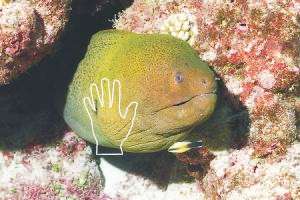
Gymnothorax javanicus: giant moray. Brown-yellow
with irregular spots. Black blotch on gill opening. Large and fat, to 240cm,
40kg. The one encountered in Niue was about 5m and perhaps 200kg.
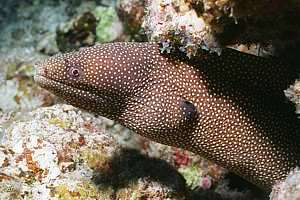
Gymnothorax meleagris, white-mouth moray.
Dark brown with numerous small round spots. Inside of mouth and tail tip
white. 120cm.
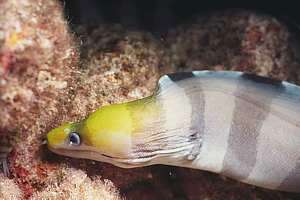
Gymnothorax rueppellii, yellowhead banded
moray. Body banded white/grey through dorsal fin. Head yellowish. Small
solitary moray to 80cm. In the photo about to pounce on a small fish at
night. Fully exposed.
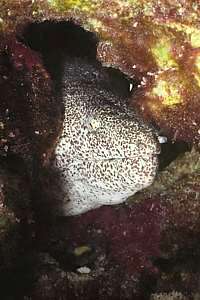
Siderea picta, peppered moray. Pale to
white with small brown to black spots. Lives in shallow water, rock pools
and preys on crabs. Large 100cm.
Siderea thyrsoidea, white-eyed moray.
Small moray (65cm) with distinctive large white eyes, light body colour
with faint mottling and light snout. Lives in shallow water and rockpools.
Enchelycore schismatorhynchus, bentjaw
moray. Light tan to grey with white margin on fins. Jaws with many daggerlike
teeth. Nocturnal. Medium sized to 120cm.
Nemichthydiae - snipe eels:
Synaphobranchidae - cut-throat eels:
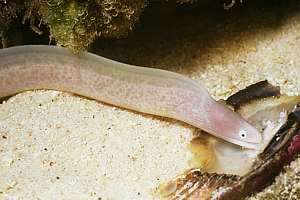
Ophichthidae - snake eels: long tubular bodies with pointed snout.
snake eel, longfinned worm eel.
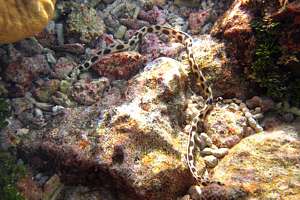
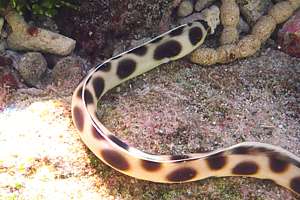
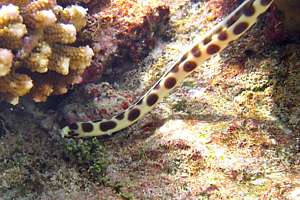
Myrichthys maculosus, spotted snake
eel. yelllowish with dark spots. Overhanging jaws and long tubular nostrils.
Solitary, mostly nocturnal. 2, 3,
[HF]
Congridae - conger eels: common conger, northern conger, silver
conger, umbrella conger, swollenhead conger, hairy conger, garden eel
Heterocongridae - garden eels: very long and thin eels standing
upright out of their sandy burrows. Very shy.
Clupeiformes - herrings, sardines, sprats.
silvery fishes with extendable mouths and fine gill rakers, capable of
catching plant plankton.
Clupeidae - herrings, pilchards, sardines: silvery fishes with weakly
attached scales. A single centrally placed dorsal fin, large extensible
jaws with tiny teeth and numerous elongated gill rakers. Fins are short
at the base and entirely soft-rayed. sprat, pilchard
Sardine (satini)
Engraulididae - anchovies: elongate silvery body with blunt protruding
snout and weakly attached scales and soft-rayed fins. Anchovy,
Siluriformes - catfishes
Plotosidae - eeltail catfishes: elongate tapering bodies and barbels
around mouth.
Galaxiidae - whitebait: giant kokopu, koaro, dwarf kokopu, banded
kokopu, dwarf inanga, inanga, alpine kokopu, shortjawed kokopu, longjawed
kokopu, river kokopu, brown mudfish, canterbury mudfish, black mudfish
Salmonidae - salmon and trout: sockeye salmon, quinnat salmon, rainbow
trout, Atlantic salmon, brown trout, brook char, mackinaw
Stomiiformes -
Aulopiformes -
Aulopidae - sergeant bakers: salmon-like with large head and jaws
with several rows of fine teeth. Eyes above end of mouth. Fins soft-rayed.
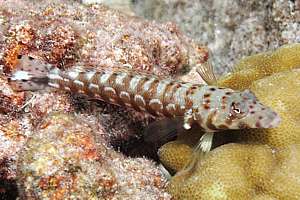
Synodontidae - lizardfishes: torped-shaped bodies with exceptionally
large mouth and eyes placed above it. Fins short-based and soft-rayed.
A tiny fatty fin above the anal fin. Lizardfish, deepsea lizardfish
Harpadontidae - grinners/sauries: similar to lizardfish but with
numerous rows of needle teeth. Ventral fin with a feeble spine and 8 rays.
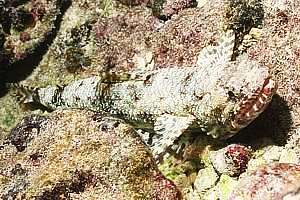
Saurida nebulosa, blotched grinner. As
S. gracilis but has shorter breastfins and is smaller to 20cm. Photo2.
Saurida gracilis, slender grinner. Medium sized to 28cm with 3 dark
or diffused bars on rear of body, line pattern on lips and visible teeth
when mouth is closed. Solitary on sand or silt in calm water.
Paralepipidae - barracudinas:
Myctophiformes - lanternfishes
Myctophidae - lanternfishes:
Ophidiiformes - lings
Ophidiidae - lings:
Gadiformes - cods
Moridae - morid cods, beardies: elongated tapering body with tiny
cycloid scales, a large head with chin barbels and hipfins placed forward
as feelerlike filaments. ahuru, red cod, northern bastard red cod, southern
bastard red cod, rock cod,
Gadidae - true cods: southern blue whiting, rockling,
Merluciidae - hakes: hake, hoki,
Lophiiformes - anglerfishes
Antennariidae - anglerfishes: modified first dorsal fin with lure.
3rd dorsal spine greatly enlarged.
Cypselurus sp., flying fish (mahave, ika lele- ika)
Cheilopogon sp., flying fish (mahave, ika lele- ika)
Hemiramphidae - halfbeaks, garfishes: long, thin silvery fishes
with greatly extended lower jaw. Ventral fins placed far back. piper, garfish.
Belonidae - needlefishes, longtoms: as halfbeaks but with very long
equal-sized jaws with numerous needle teeth. Needle fish, long tom, crocodilefish
Tylosurus crocodilus, crocodile needle
fish or longtom (aku pa, aku tagata). Silvery, extrmely slender with elongate
upper and lower jaws. Forked tail with larger lower lobe.
Strongylura incisa, reef needlefish. Practically identical to crocodile
needle fish but with wavy tail margin.
Atherinidae - hardyheads: schooling fish with slender body and broad
silvery lateral band. Large eyes, moderate scales.
Isonidae - surf sardines: schooling fish with greatly compressed
body and keel-like abdomen. Silvery and highly reflective.
??Scomberesocidae - silver sauries: saury
Lampriformes
Lampridae - opahs: moonfish,
Lophotidae - crested bandfishes: crested band fish
Beryciformes -
Anomalopidae - flashlightfishes:
Monocentrididae - pineapple fishes: prominent light organ on sides
of lower jaw, used at night to locate prey. Yellow body with black markings
resembling a pineapple.
Trachichthyidae - roughys, sandpaperfish: body compressed and deep.
Scutes (scales with sharp ridges) placed on rear side of belly. Can make
buzzing or clicking sounds. common roughy, slender roughy, orange roughy,
silver roughy
Bericidae - alfonsinos, nannygai, red snapper: predominantly red
sideways compressed bodies with moderately large ctenoid scales. Deeply
forked tailfin. Most school in great numbers. Golden snapper, alfonsino
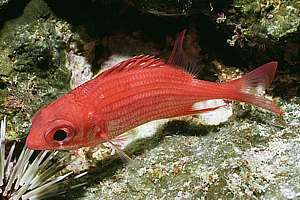
Holocentridae - squirrelfishes: prominent, sometimes poisonous spine
on lower corner of gill cover. squirrelfishes and soldierfishes
Holocentrinae - squirrelfishes:
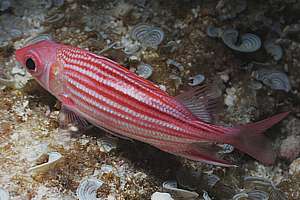
Sargocentron cornutum, three-spot squirrelfish, (ika ta - ika).
7 alternating red and white stripes, white edge around eye, black spot
on tail base. 18cm.
Sargocentron microstoma, fine-lined squirrelfish.
Small 19cm fish with fine red and white lines. Black markings on front
of first back fin. Long white margin on anal spine.
Sargocentron punctatissimum, peppered
squirrelfish. 20cm. Pink back gradating to silver belly with fine spotting
in silver stripes, dorsal fin with white base.
Sargocentron spiniferum, long-jawed sabre squirrelfish (ta gutuloa
- ta). Large (45cm) with yellowish fins and long cheek spine below gill
cover.
Neoniphon argenteus, clearfin sliver squirrel fish. A small (19cm)
solitary fish with silver body and fine red lines. Dorsal fin clear with
white tips. Soft fins not yellow.
Neoniphon sammara, spotfin silver squirrelfish.
A solitary fish with silver body and fine red lines. Soft fins red in front,
faint yellow behind. Dorsal fin with white tips and black spot. Large 32cm.
Myripristinae - soldierfishes: as squirrelfish but with smaller
gill cover spine and having blunter heads.
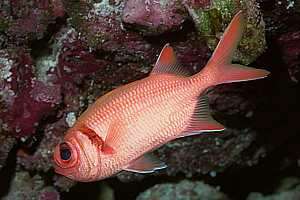
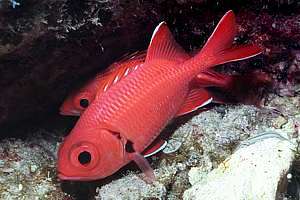
Myripristis berndti, bigscale soldierfish.
Myripristis kuntee, epaulette soldierfish
20cm, with dark band behind eye and white first rays.
Myripristis pralinia, scarlet soldierfish.20cm.
Shading gradually from red back to white belly. Small dark margin behind
upper gill cover. White-tipped fins.
Myripristis violacea, purple soldierfish (selekihi, ta matapula).
20cm. silvery scales with purple margins. Light red band behind gill cover.
Myripristis vittata, white-tipped soldierfish. 20cm. Orange with
white dorsal fin tips and first rays of all other fins.
Zeiformes - dories
Zeidae - dories: very sideways compressed, round bodies with extendable
oblique mouth. john dory, mirror dory, capro dory, silver dory
Aulostomidae - Trumpetfishes: long tubular or flattened body and
long trumpetlike mouth. Dorsal fin has small separate spines, each followed
by a triangular membrane, the soft part of which is large and situated
near the tail.
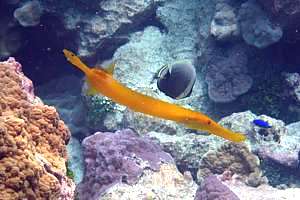
Aulostomus chinensis, trumpetfish
(haohao). Long, compressed body with long, trumpetlike snout and small
mouth. Colour highly variable from yellow to brown and pale with dark tail
saddle. Yellow tail with 2 black spots. Golden variety uncommon.
Fistulariidae - flutemouths: long tubular bodies with extremely
long snout but small mouth. Soft-rayed fins.
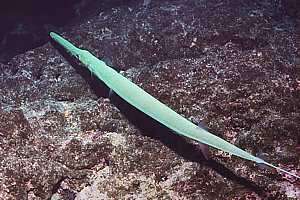
Fistularia commersonii, smooth flutemouth,
cornetfish. Long slender silvery tubular body with olive back. Long snout
with small mouth. Tail fin with whip-like filament. Solitary or in small
schools, to 150cm.
Centriscidae - shrimpfishes: in small schools, swimming nose down.
Pegasidae - sea moths: body encased in rigid plates and tail encircled
with bony rings. Ventral fins reduced to pairs of slender structures for
crawling. Breastfins wing like.
Solenostomidae - ghost pipefishes: head is pipefish like with a
long tubular mouth but body is short and compressed, protected by bony
plates. 2 separate backfins and large ins all round. Enlarged anal fin
is opposite second dorsal.
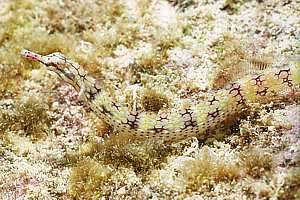
Syngnathidae - pipefishes and seahorses: body protected by bony
plates, arranged in rings. Long tubular snout with small toothless mouth.
No ventral fins. anal and tailfins lacking.
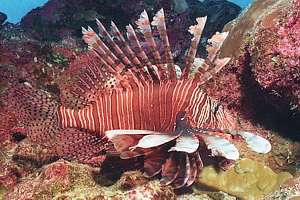
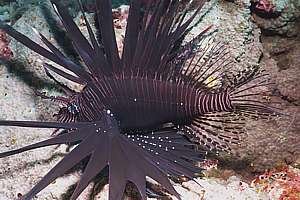
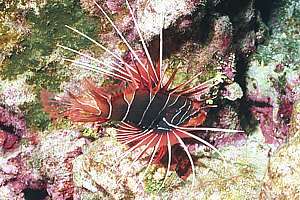
Pterois radiata, white-lined lionfish,
clearfin lionfish. 24cm. ~6 brown bands with white outlines on a brick-orange
body. Long filamentous white pectorals with small transparent connecting
tissues near its base.
Scorpaenopsis diabolus, devil scorpionfish.
Pronounced hump on back, highly variable in colour, generally drab shades
blending with surroundings. Lives on rubble or weed bottom of coastal,
lagoon and seaward reefs. closeup.
Scorpaenopsis macrochir, flasher scorpionfish. Similar to devil
scorpionfish but much smaller (15cm). Shorter snout and less pronounced
hump on back. Colour variable. Lives on rubble, weed and rocks.
Synanceia verrucosa, reef stonefish (nofu). Globular shape appears
as algae-covered stone with prominent warts and skin flaps. Eyes far apart
with deep pit in between. Venomous fin spines are deadly.
Pataecidae - prowfishes: compressed bodies, no swimbladder, long
dorsal fin which begins over the fromt of the ehad. Ventral fins absent.
Tough skin instead of scales.
Gnathaanacanthidae - red velvetfishes: no swimbladder, long round
fins all around. Well developed ventral fins with membrane attached to
abdomen. High dorsal fin with deep notch. skin covered with fleshy projections,
giving a velvety feel in adults.
Tetrarogidae - waspfishes:
Gongiopodidae - pigfishes: southern pigfish,
Triglidae - gurnards: red gurnard, spotted gurnard, scaly gurnard
Dactylopteridae - flying gurnards: like gurnards but with exceptionally
long breastfins.
Platycephalidae - flatheads: head greatly depressed with bony ridges
and
large pungent spines. Large breast fins and ventral fins immediately underneath.
Cottidae - sculpins:
Perciformes -
Percichthyidae - temperate basses: hapuku, bass,
Serranidae - groupers and sea perches: Most have tiny scales and
an indistinct lateral line. All have 24 vertebrae and body outline rounded
including fins.
Serraninae - groupers & cods: rockcods, groupers
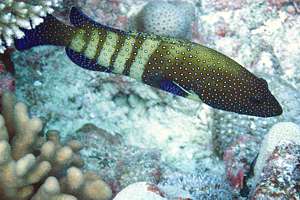
Cephalopholis argus, peacock grouper
(loi). Brown-green with blue-purple fins and blue-ringed spots. 55cm.
Cephalopholis miniata, coral grouper (malau pokoahu). Yellow to
orange from front to back, with blue dots.
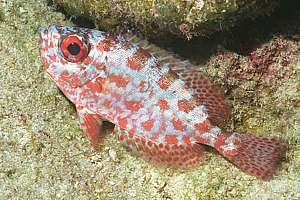
Cephalopholis sonnerati, tomato grouper (kaupatuo). Orange-red with
dense network of red spots on head and fainter spots on body. Fins slightly
blue-fringed.
Cephalopholis spiloparaea, strawberry
grouper. Small (22cm) solitary grouper with even reddish orange colour
and some mottling or lighter spots. Blue to pale outline on tail.
Cephalopholis urodeta, flagtail grouper (mataele). Orange with white
diagonal lines across tail.
Epinephelus fasciatus, black tipped grouper (talaao)
Epinephelus hexagonatus, hexagon grouper,
spotted rock cod (gatala). Small 26cm grouper with whitish undercolour,
closely packed in hexagonal orange to red spots. On its back these spots
merge into 5-7 blotches. Solitary.
Epinephelus merra, honeycomb rockcod (gatala).
Epinephelus morrhua, snakeskin cod (palu pusi).
Epinephelus puerra, rock cod (gutuvai)
Epinephelus retouti, grouper (gutukafu)
Epinehelus tauvina, greasy grouper (gatala). Similar to honeycomb
grouper but with vertical blotches.
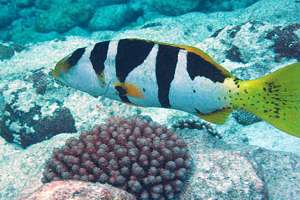
Plectropomus laevis,
blacksaddle coralgrouper. Whitish with 4 black saddles and black band above
eye. Fins yellow. Can be grey-speckled with white belly.
Plectropomus leopardus, coral trout (kiega). Red with small white
spots.
Anthiinae - basslets & seaperches: very colourful small fish,
very difficult to photograph
Pseudanthias olivaceus, olive anthias,
olive to dark grey with yellow spots on scales of lower body or bands.
Yellow stripe behind eye.
Pseudanthias pascalus, purple queen.
Grammistinae - soapfishes: gold ribbon groper
Grammistes sexlineatus, sixlined
soapfish, sixlined perch. 27cm. Black with thin yellow lines on sides.
Skin mucus poisonous.
Centropomidae - barramundi: concave snout and head with large mouth.
Long-bodied. Dorsal fin deeply notched. Large scales.
Pseudochromidae - dottybacks: slender and colourful fishes. body
elongated, head long and eyes large with elongated pupil.
Plesiopidae - longfins, blue devils: like pseudochromidae, with
larger fins and iridescent lines or blue spots. Blue devils.
Priacanthidae - bigeyes: very large eyes and mouth. Compressed,
elongated body. Ventral fins connected to body by a membrane.
Heteropriacanthus cruentatus, blotched
bigeye, glasseye (kaene). Variable red to silver with variable bars.
Fins lightly spotted or mottled. Tail slightly rounded. Solitary to 32cm.
Acanthoclinidae - rockfishes, spiny basslets: as Pseudochromidae
with more dorsal & anal fin spines but ventral fins with only one or
two rays. rockfish
Glaucosomatidae, pearl perches: Deep-bodied and silvery as adults,
often with lines as juveniles. Long filaments sometimes trailing from median
fins.
Terapontidae - trumpeters and grunters: Small ctenoid scales, extended
into sheaths along dorsal and anal fin bases. A prominent spine on opercle
and strong spines in fins. Generally marked with longitudinal stripes or
spots.
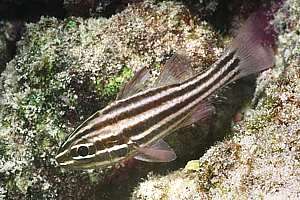
Apogonidae - cardinalfishes: small elongate live-bearing fishes
with separate angular backfins, torpedo body shape, large mouth and eyes.
Two spines in anal fins.
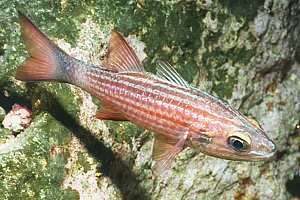
Apogon cookii, Cook's cardinalfish. 5
alternating white and black bands, with two white stripes through eyes,
but no tail spot. Lives in very shallow water and rock pools. 10cm.
Apogon fraenatus, bridled cardinal fish (gu)
Apogon menesemus, cardinal fish (palu gu - palu)
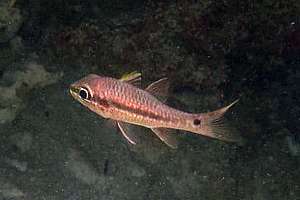
Apogon kallopterus, iridescent
cardinal fish (ulumula). Pale pinkish brown with dark side stripe and yellow
first dorsal. [HF]
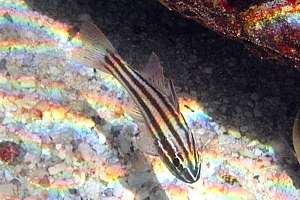
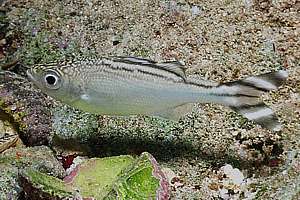
Apogon taeniophorus, white lined
reef-flat cardinalfish. Alternating white and black stripes but not on
tail. Looks like blackstripe cardinalfish A. nigrofasciatus, but
lives in shallow reef flats.
Dinolestidae - longfin pikes: long cylindrical bodyand pointed head.
LMany soft rays in dorsal & anal fins and one spine in anal fin.
Malacanthidae - tilefishes and blanquillos: blenny-like fishes swimming
in the open
Pomatomidae - tailors: body streamlined with smooth scales and a
large tail. Jaws with small compressed sharp teeth in single rows.
Rachycentridae - cobias: a unique shape, snout bent upward.
Labracoglossidae - knifefishes: blue knifefish, grey knifefish
Echeneidae - remoras: have a unique sucker on their heads. Body
long and slender. shark sucker, slender remora, grey marlinsucker, hardfin
marlinsucker
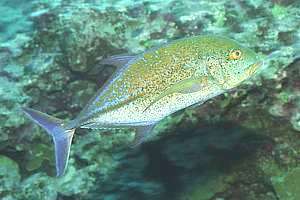
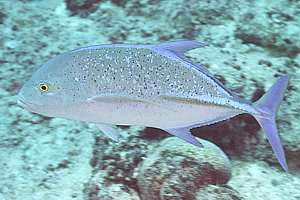
Caranx melampygus: bluefin trevally (aheu).
Silvery iridescent blue to green with dense spotting on upper part of body.
Blue fins. solitary or in small schools. Large 100cm. Photo2.
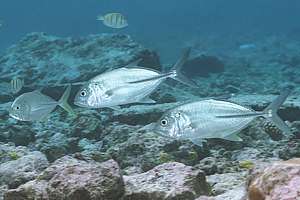
Caranx sexfasciatus: bigeye trevally
(ulua). Silver bodies but males can turn black when courting. Small black
spot on upper gill cover. White tips on anal and back fin. Can form large
schools. Large to 100cm.
Gnathanodon speciosus, golden trevally (gutu uli)
Trachinotus baillonii, small-spotted dart, black-spotted swallowtail
(lai). Silvery flat body with long swallow tail and bakc&anal fins
long and pointed like swallow tails. Small black spots along sideline.
Caesionidae - fusiliers: bodies oval, compressed and streamlined
with a forked tail and small mouth.
Pterocaesio tile, blue streak fusilier fish (ulihega iua - ulihego)
Sciaenidae - jewfishes: moderately elongate bodies, somewhat compressed
and small scales. Backfin is deeply notched and has a long soft section.
Short anal fin base.
Leiognathidae - ponyfishes: Deep compressed bodies with slimy skin,
shiny sides and tiny scales. Mouth very extendable. A series of small spines
along the dorsal and anal fin bases.
Gerreidae - silverbellies, mojarras: similar to ponyfishes in looks
and behaviour but distinctly scaled.
Kuhliidae - flagtails:
Kuhlia mugil, barred flagtail. small
silver fish with horizontally banded tail, living in shallow reefs from
plankton.
Haemulidae - sweetlips: Heavy bodies & large lips. Most go through
elaborate colour changes in their life and the young are often plain with
small spots or lines and large tails.
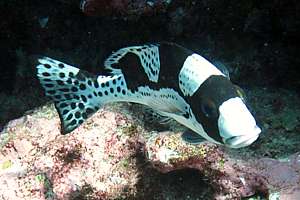
Plectorhinchus picus, dotted sweetlips. Whitish with profuse small
black dots covering head, body and fins. Black margin on gill cover. Juvenile.[HF]
Lethrinidae - emperors - coral breams: distinctly scaled and fins
large with a spinous section. Sloping heads & tapered bodies.
Monotaxis grandoculis, humpnose bigeye
bream, large-eyed bream (fotuo). Black to grey, silver or brown with light
belly. Often with yellow tinge on head. Black spot on base of breastfin.
Large black eye.
Nemipteridae - spinecheeks and whiptails: spinecheeks have a prominent
spine below the eye.
Emmelychthyidae - bonnetmouths: red bait, ruby fish
Sparidae - seabreams: oval shaped and shiny bodies with moderate
scales. Mouth placed low and jaws have conical teeth and anterior canines.
snapper,
Lutjanidae - true snappers, coral snappers: perch-like with an elongated
scaly body and a single dorsal fin with hard section. Identification is
easiest by their colours although the young may differ.
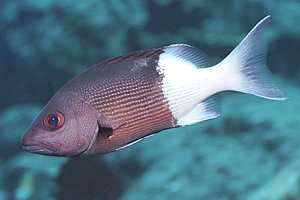
Lutjanus bohar, red snapper (fagamea) or twinspot snapper. Juvenile
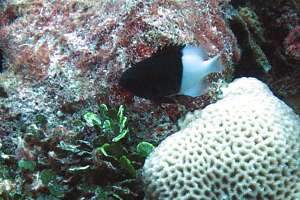
mimicking Chromis iomelas.
Lutjanus kasmira, blue-lined snapper (fouigo)
Lutjanus monostigma, one-spot snapper (hiku ila - hiku)
Aphareus furca, smalltooth jobfish (palu
po - palu). Slender, blue-grey, large mouth, forked tail, long pectoral
fins. Solitary or in small groups.
Aphareus rutilens, red jobfish (palu gu).
Aprion virescens, green jobfish (palu monega, utu)
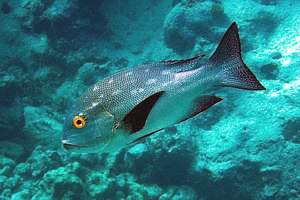
Macolor macularis, midnight snapper.
Olive-grey with golden spot on each scale, fading to gold belly. Golden
iris. Blue line and markings on head.
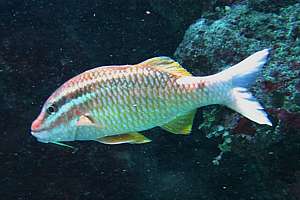
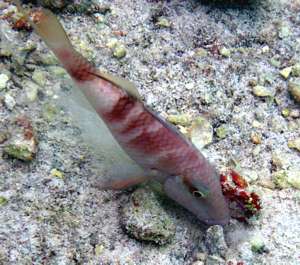
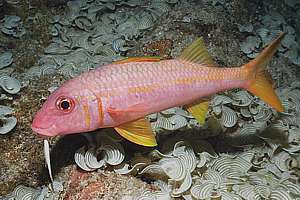
Mullidae - goatfishes: elongate tapering body with medium scales
and well separated dorsal fins. Mouth has barbels on chin. Tailfin deeply
forked. Most can change colour quickly. goatfish, red mullet,
Parupeneus barberinus, dash-dot goatfish (hafulu)
Parupeneus bifasciatus, double-bar goatfish
(talakave). A medium sized (35cm) goatfish, white to purple with orange
spots on scales, black patch around the eyes and two dark saddles. They
can change colour rapidly.
Parupeneus ciliatus, Whitelined
or Cardinal Goatfish. Light red or purplish to yellowish. 2 horizontal
white bands extend from snout to halfway. Often with darkish saddle on
tail base. Solitary.
Parupeneus multifasciatus, banded
goatfish (talakave), manybar goatfish. Light grey to brownish or purplish
with about 6 black and white bands on body. Black smudge behind eye. Solitary.
2,
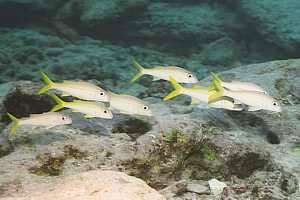
Mulloides flavolineatus, yellow stripe goatfish (kaloama motua -
kaloama). Silvery white with light yellow stripes and black spot on side
under back fin, which can fade rapidly. This fish reproduces so well in
Niue that between December and March the sheltered side of the island dense
schools of juveniles can be found in shallow water and rock pools.
Pempherididae - bullseyes: rounded head, straight backs and rounded
bellies, very sideways compressed. Large eyes above oblique mouth. Mostly
nocturnal. bigeye
Pempheris oualensis, copper sweeper,
copper bigeye. 22cm. Copper brown, leading edge and tip of first dorsal
fin blackish, black spot on pectoral fin base. Solitary or in pairs under
ledges and in caves.
Monodactylidae - silver batfishes: silvery fishes with deep bodies
and small deciduous scales.
Scorpididae - sweeps: highly compressed oval bodies, silvery blue
with reduced fin spines. Rear fins are slightly elongated and tailfin is
forked. Blue maomao, sweep,
Kyphosidae - drummers: same shape as sweep but larger. Teeth fused
in a single row. drummer, parore, bluefish,
Kyphosus vaigiensis, brassy drummer. Small
school.
Kyphosus cinerascens, topsail drummer (nue). Like brassy drummer
but with high second dorsal fin.
Girellidae - blackfishes: resemble drummers but bodies more compressed.
Microcanthidae - stripeys and mado: oblong compressed bodies with
strong spines in dorsal, anal and ventral fins. Teeth are close-set and
brush-like. Mado.
Pentacerotidae - Boarfishes: head large and encased in bony plates,
concave as a pig's head. Body deep elongate, very compressed and tall vertical
fins. long-finned boarfish, giant boarfish, striped boarfish,
Ephippidae - batfishes:bodies disc shaped with tall fins. Juveniles
have extremely tall fins above and below the body, resembling leaves rather
than fish.
Scatophagidae - scats:
Chaetodontidae - butterfly fishes, bannerfishes: very deep compressed
bodies and pointed snouts. Teeth typically brush-like, slendear and close-set
with recurving tips. Fin spines large and solid. Most species very colourful.
Chaetos=bristle;
dont=tooth.
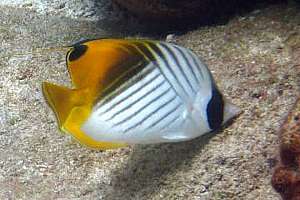
Chaetodon auriga, threadfin
butterflyfish. 23cm. White body with yellow rear and chevron pattern on
side. Black eye saddle. Yellow thread trailing from dorsal fin.
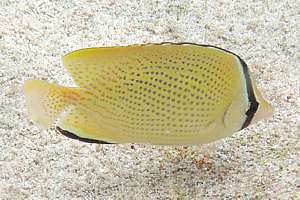
Chaetodon citrinellus, speckled citron butterflyfish
[HF] Pale yellow to whitish with many rows of faint bluish spots, black
eye stripe and thin black edge on anal fin.
Chaetodon ephippium, saddled
butterflyfish. 23cm. Blue-grey with blue lines on lower body. Large white-bordered
black patch on upper rear. Orange-yellow from snout over belly fins. Red
margin on tail base and dorsal fin rear. Yellow thread trailing from dorsal
fin. [HF]
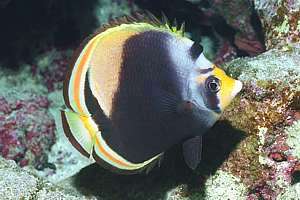
Chaetodon flavirostris, black yellowsnouted
butterflyfish. Dark with yellow rim around rear edge. Yellow snout. Large
adults (to20cm) develop hump on forehead. Usually in pairs.
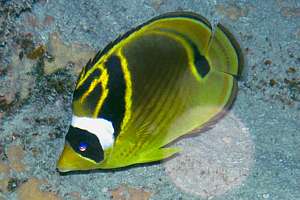
Chaetodon lunula, raccoon
butterflyfish. 21cm. Yellow-orange with dusky back and thin dark diagonal
bands. Black eyeband with white eyepatch behind and 3 yellow lines over
dark skin to middle of dorsal fin. In pairs or aggregations. [HF]
Chaetodon mertensii, yellowblack
butterflyfish. 12cm. White with chevron markings. Broad yellow-orange band
over rear body and tail. Black eyestripe. Solitary or in pairs. [HF]
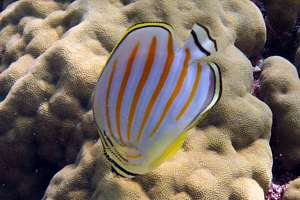
Chaetodon ornatissimus, ornate
butterflyfish. 18cm. Bluish white with 7 orange bands. Yellow-black edge
all around. In pairs. [HF]
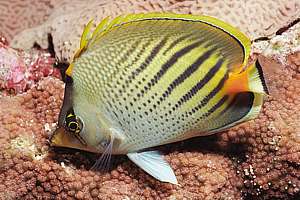
Chaetodon pelewensis, dot & dash
butterflyfish. Small 12cm fish with yellow body and diagonal lines of dots
that become bands on upper body. Orange tail stock. Black spot on nape.
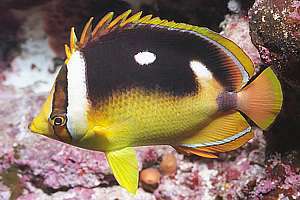
Chaetodon quadrimaculatus, fourspot butterflyfish.
Yellow-orange body, darkening to black above. Two white spots on back.
Small 16cm and usually in pairs, feeding on Pocillopora corals.
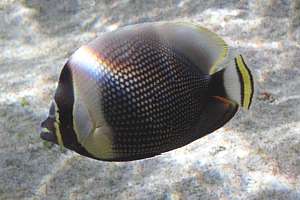
Chaetodon reticulatus,
reticulated butterflyfish. 16cm. Scales grey with black edges on a whitish
body fading to dark belly. Black head band and yellow margin over eyes
and on fins. [HF]
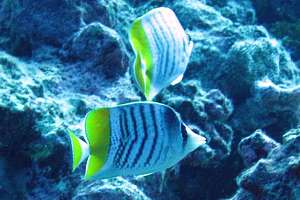
Chaetodon ulietensis,
Pacific double-saddle butterflyfish. 15cm. White body with bright yellow
rear. Faint saddles on back. Fine waving vertical stripes. Black eyeband.
[HF]
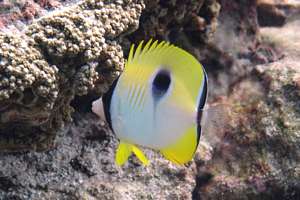
Chaetodon unimaculatus, one-spot
or tear-drop butterflyfish (tifitifi tua ila - tifitifi). 20cm. White with
bright yellow dorsal and anal fins. Black tear-shaped spot on middle back.
Black band front and rear. [HF]
Forcipiger flavissimus, long-nose butterflyfish.
22cm. Yellow with black upper head and white below. Elongate snout but
shorter than big longnose butterflyfish. Spot on anal fin below tail base.
Solitary or in pairs.
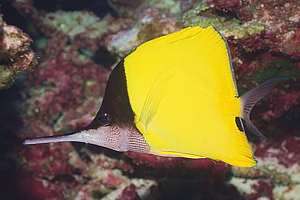
Forcipiger longirostris, very-longnose
butterflyfish. 22cm. Yellow with black upper head and white below. Extremely
elongate snout. Black spots on breast. Spot on anal fin below tail base.
Solitary or in pairs.
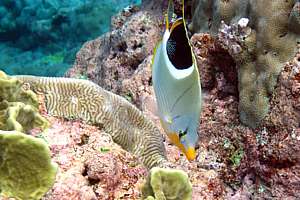
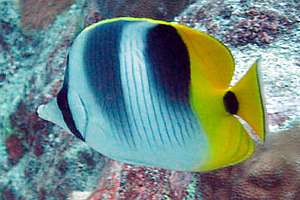
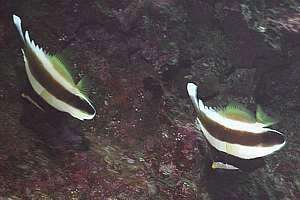
Heniochus chrysostomus, pennant bannerfish.
18cm. White with black band on head, mid body and rear. Yellow upper snout.
Tallest dorsal spine like a feather. Solitary or in pairs.
Pomacanthidae - angelfishes: body more elongate than butterflyfishes
but also colourful. Prominent spine on lower corner of operculum.
Centropyge flavissimus, lemonpeel angelfish
[HF]. 14cm. Bright yellow with blue cheek spine, blue eye margins and blue
margin on gill cover.
Centropyge heraldi, Herald's angelfish or yellow pygmy angelfish.
Centropyge loricula, flame angelfish.
10cm. Brilliant red to red-orange with about 5 black bars. Blue markings
on rear edge of dorsal and anal fins. Solitary or in small groups. [HF]
Pomacanthus imperator, emperor angelfish.
38cm. Striking pattern of blue, black and yellow with dark eye band. Their
young look entirely different: blue bodies with white lines and rings.
Makes a loud drumming sound when alarmed.
Pomacentridae - damselfishes, humbugs, anemonefishes & scalyfins:
deep rounded compressed bodies with rounded rear fins and forked tails.
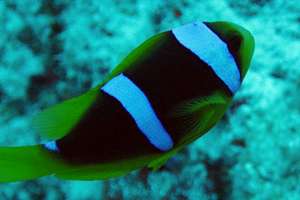
Small mouths. demoiselle, sea swallow, anemone fish, sergeant-major,
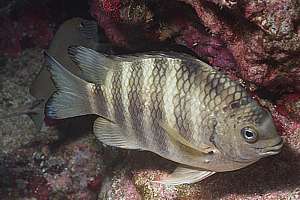
Abudefduf vaigiensis, sergeant major (papaao moana - papaao)
Abudefduf sordidus, blackspot sergeant-major
fish. (papaao moana - papaao). Greyish with 5-6 darker bands and small
black saddle on tail stock. Small 19cm, lives in shallow water and rock
pools. Mature form?,
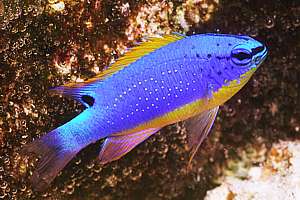
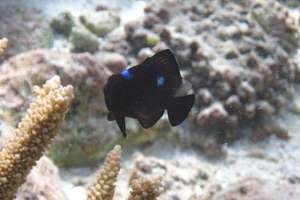
Chrysiptera taupou, south seas devil.
A most spectacular metallic blue-yellow rockpool demoiselle
Dascyllus reticulatus: Indian blue-lipped
humbug. Pale brown body and darker head with black lined scaled, dark fins
and blue lips & ventral fin. Often found in pairs. Territorial.
Dascyllus trimaculatus, threespot dascyllus. Grey with dark scale
edges. Fins dark except rear dorsal. 14cm. In groups. Juvenile
has 3 spots: one on its forehead and two each side onits back.[HF]
Chironemidae - kelpfishes: closely related to hawkfishes. Tapering
body with invisible smalle scales and no swimbladder. Breastfin with separate
fin rays for holding on to things. Front belly rubbery. hiwihiwi kelpfish
Cirrhitidae - hawkfishes: heavy bodies, large lips, dorsal fin tips
tufted/feathered.
Cirrhitus pinnulatus, marbled hawk fish,
sturdy hawkfish (ulutuki piu - ulutuki). One of the larger hawkfishes (28cm).
Blotchy brown with white spots. Solitary in shallow water.
Paracirrhites arcatus, ring-eyed hawkfish
(manini ulutuki manini - lulutuki). Small red fish, resembling a small
grouper. Long white stripe over lateral line from halfway to tail. Yellow-ringed
pupil and oval yellow/blue ring behind eye. Hides in Acropora corals.
Paracirrhites hemistictus,
halfspotted hawkfish. 28cm. Grey head withpale yellow to grey body and
white side line or white side spot. Numerous dark dots on upper body. [HF]
Ephippidae - old wifes: long pelvic fins like boarfish, and long
anal fins. Backfin split with some long fin rays. Small breastfins.
Cheilodactylidae - morwongs: thick, rubbery lips. Body like boarfish
with some long backfin rays. Breastfin may have elongated rays. Tailfin
forked. Distinct coloration. porae, tarakihi, red moki, painted moki, magpie
morwong, red morwong
Latrididae - trumpeters: similar to morwongs but more streamlined,
with thick lips, deeply notched back fin and small rounded breastfins.
Head concave as in boarfishes. Small scales.blue moki, copper moki, common
trumpeter, telescope fish,
Opisthognatidae - jawfishes: goby-like fishes with large jaws inhabiting
sand burrows
Valamugil engeli, engel's mullet, dwarf mullet (fuafua, kanahe).
Schooling in shallow protected areas of sand, algae and mud in lagoons
and around shallow reef flats.
Crenimugil crenilabis, fringelip mullet (fuafua, kanahe). Silver
with narrow grey horizontal stripes, black spot at upper breastfin base,
dusky rear margin of tail fin.
Neomyxus leuciscus, yellow spot mullet, acute-jawed
mullet [HF]. Silvery with yellow spot on the base of the pectoral fin.
Forms schools.
Polynemidae - threadfins: elongate silver with fin arrangement as
mullets but threads hanging from breastfin base.
Polydactilus sexfilis, sixfeeler threadfin (ikata - ika). Slender
like mullet, with 6 threads at breastfin base.
Polydactylus plebius, northern threadfin, striped salmon (ikatea
- ika). Thicker than mullet, with thin yellow stripes and five threads
from base of each breastfin.
Labridae - wrasses: sideways compressed, elongate fish swimming
with breast fins. Many species, mostly invertebrate eaters.
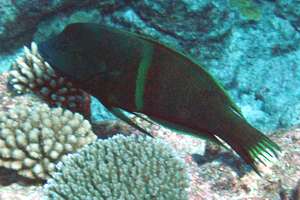
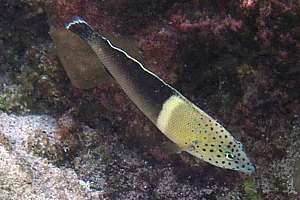
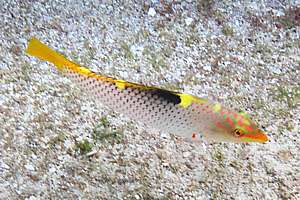
Coris aygula, clown coris [HF].
A light grey band separates its speckled light grey head from its dark
grey rear body. White fin margins. Initial Phase,
juvenile.
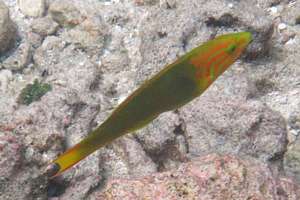
Coris gaimard, yellowtail coris.
[HF] 38cm. Variable from shades of blue to green and red, with a yelow
tail, bright yellow mid body bar, brilliant blue spots on rear body and
tail base.
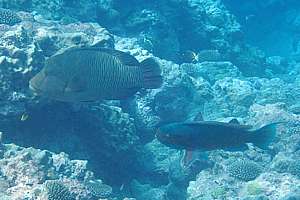
Cheilinus undulatus, humphead wrasse initial
phase [HF].Green body with vertical streaks and a bump above its eyes.
Can grow very large.
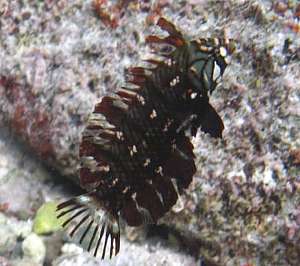
Novaculichthys taeniourus, rockmover wrasse. Rotten-leaf-shaped,
swims like a whirling leaf.
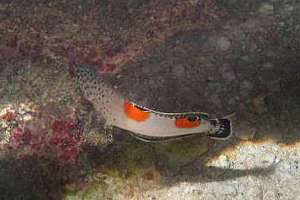
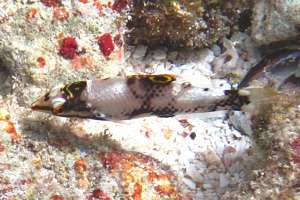
Halichoeres hortulanus, checkerboard wrasse
(intermediate phase) [HF]. Begins life as a black fish with two white bands,
then as shown in this picture and finally with a red-green tattooed head,
white saddle and a checkerboard rear half of its body.
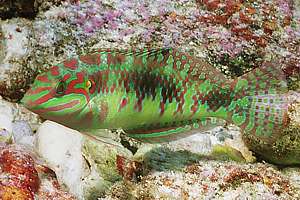
Halichoeres margaritaceus, weedy surge
wrasse. Body in shades of green with red scale spots forming blotches.
Pink diagonal band and radial bands on cheek. Lives in shallow water, small
to 13cm.
Halichoeres hortulanus, checkerboard wrasse (meai paku kope - meai).
Highly varied in colour throughout its life cycle. Blueish white to green
with blue bar on each coarse scale. Head green with pink bands. Dorsal
fin with three yellow and one black patch. Tail yellowish to checkered
blue. Juveniles banded with 3
black and 2 white bands. Small to 20cm.
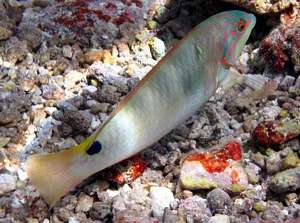
Halichoeres trimaculatus, threespot
wrasse. 27cm. [HF] Pale yellowish green with lavender vertical streak on
most scales & lavender band on head with pink lines. Black spot on
tail base and forebody. Juveniles are more pinkish all over and miss the
forebody black spot. 2,
Gomphosus varius, bird wrasse (meaigutu loa - meai)
Labroides bicolor, bicolor cleaner wrasse.
Macropharyngodon meleagris, leopard wrasse
Novaculichthys taeniourus – Rockmover Wrasse. 27cm. juvenile.[HF]
Pale grey/green head, body with light-dotted scales, light bar on
tail base, may have dark lines radiating from eyes. Found on rubble bottoms.
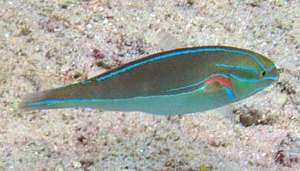
Thalassoma lutescens, sunset wrasse. 25cm. Initial
Phase. [HF] Pink head with green bands, bluish-green forebody and green
rear, yellow-green lunate tail. Yellow pectoral fin with blue outer edge.
Thalassoma purpureum, surge wrasse. 43cm. Initial
Phase [HF] Green to blue head and body with pink bands on head and
pink stripes on body. Old TP may lose stripes. In shallow water.
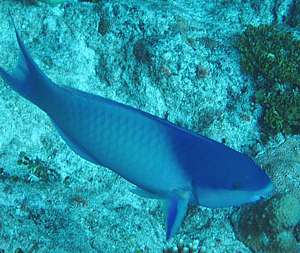
Scaridae - parrotfishes: swimming with breast fins, like wrasses
but eating coral with parrot beaks. Many species.
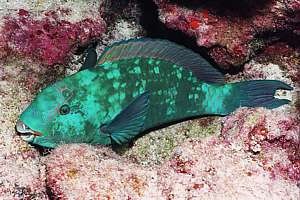
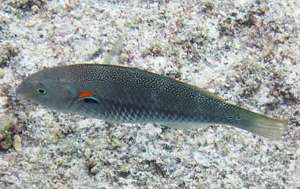
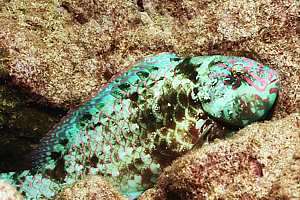
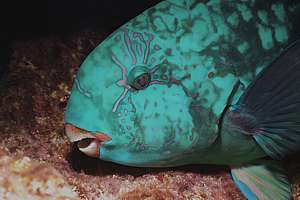
Calotomis carolinus, star-eyed parrotfish.
Blue-green with black spots and orange-pink bands radiating from eye. Large
to 50cm. The photo shows this fish sleeping.
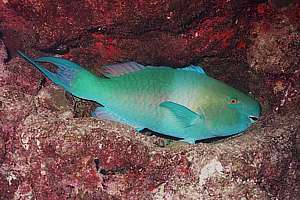
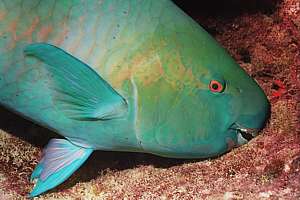
Scarus rubroviolaceus, red-lip or ember
parrotfish. Large to 70cm. Variable in colour through its life cycle with
darker band on upper lip and double bands on chin. Lunate tail with stripes.
Closeup.
variation [HF],
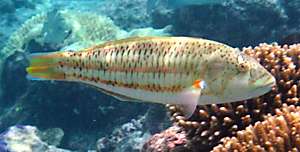
Scarus oviceps, egghead
or darkcapped parrotfish. 31cm. [HF] Blue-green with narrow pink scale
margins. Lime green and dark blue pectoral fin. Upper head and forebody
a darker shade of purple. Solitary. Initial phase is whitish-yellow with
a dark head cap.
Odacidae - butter fishes, cales & weed whitings: elongate to
very elongate bodies like wrasses with soft long fins. Mostly plant eaters.
butterfish,
Bovichthyidae - thornfishes: slender with large close-set dorsally
placed eyes and two backfins. First is spinous and short based, the second
soft and long based. thornfish
Uranoscopidae - armoured stargazers: a tapering body and large head
with mouth placed above and close to two small stalked eyes. First spine
of back fin can be poisonous. Stargazers burrow into the sand leaving only
their eyes exposed. Prey is caught by a sudden upward thrust and strong
suction. giant stargazer, spotted stargazer, brown stargazer,
Pinguipedidae- grubfishes, weevers, sandperches: slender tapering
bodies without swimbladders. Front of dorsal fin short with few hard spines.
Eyes high and bulging. Mouth low placed and large. Most are predators.
blue cod, redbanded weever
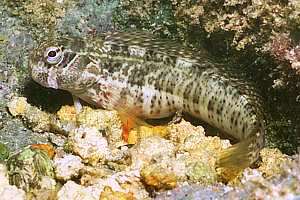
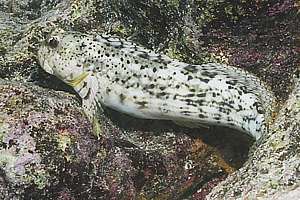
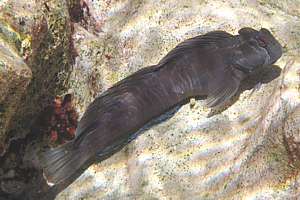
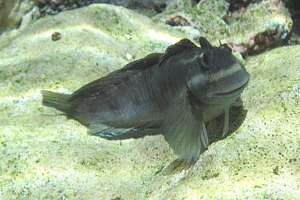
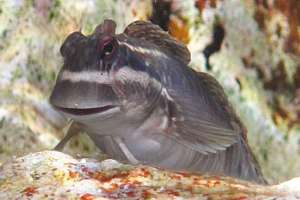
Blenniidae - blennies: slime fishes without scales, with one long
back fin and no swimbladder.
Istiblennius bellus, beautiful rockskipper.
15cm. Charcoal grey with alternatinglight and dark bars. Large sail-like
skin flap on head. 2 unbranched cirri (antennas). 2,
3,
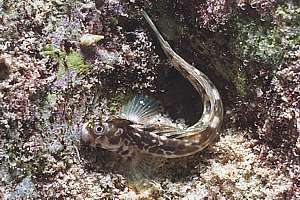
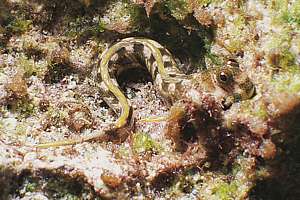
Istiblennius edentulus, rippled rockskipper
(lakua hopokiu - lakua). Small 17cm slimefish with about 6 paired unaligned
bars. Unbranched cirri above eye. Male has skin flap resembling a first
dorsal fin. These fish live at the sea's surface in shallow pools and skip
their way over the rock face, also able to skip on water. They do so by
folding their bodies in a V shape, and skipping sideways. photo1.
Eleotrididae - sleepers, bullies: Grahams gudgeon, Cran's bully,
upland bully, common bully, blue gilled bully, redfin bully
Callionymidae - dragonets: elongate tapering bodies without scales
or swimbladder, and very showy. Eyes placed high on head and mouth is small
but greatly extendable down and outward. Large showy fins.
Gobiidae - gobies: elongate small fishes with two backfins and no
swim bladder, often living in sand burrows. Ventral fins joined into a
single cup-shaped fin.
Ptereleotridae - dartfishes. Little elongate fishes with two-part
dorsal fins, long anal fins and small upturned mouths. Darting in and out
of burrows in the sand.
Nemateleotris magnifica, red fire
goby or fire dartfish. 8cm. Living paired together is a sandy hole and
hovering nearby. White front with long first dorsal fin, orange rear half.
Microdesmidae - dart gobies: long tubular and slender and small
head. Often occurring in large schools above reefs when feeding, yet lacking
a swimbladder.
Tripterygiidae - threefins, triplefins: usually small to very small
fishes with three dorsal fins, the first of which is hard spined. Long
anal fins. No swimbladders. Usually feeding on small invertebrates.
Clinidae - weedfishes & snake blennies: well camouflaged and
highly variable in shape and colour, looking like the weeds they live on
and in between. Many live upside down.
Siganidae - rabbitfishes: looking and behaving much like surgeonfishes,
but not having a spike on their tail stocks.
Zanclidae - moorish idol: have long wimple like backfin filament
on flat round bodies. Pig like snout and concave head. Jaws have long bristle-like
teeth covered by fleshy lips.
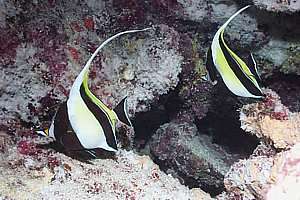
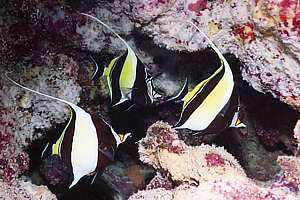
Zanclus cornutus, moorish idol. A spectacular
black-white-yellow baded fish with a dark band over its eyes and a long
banner as first dorsal fin. Has a narrow snout. Small
group.
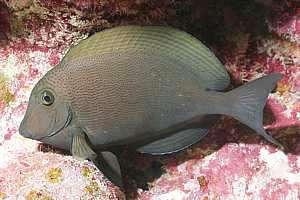
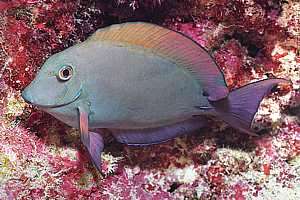
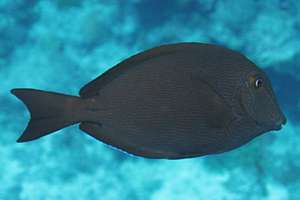
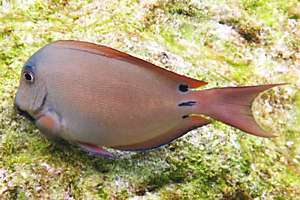
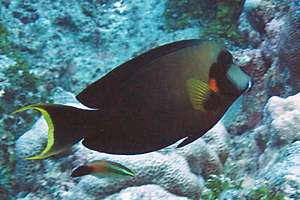
Acanthuridae - surgeonfishes & unicornfishes: plant eaters of
the reef. Sideways compressed with a sharp spike on their tail stocks.
Many species, many colours. Surgeonfishes are also called tangs after their
sharp tang (=spine) on their tails. Also includes sailfin tangs, unicornfishes
and bristletooths.
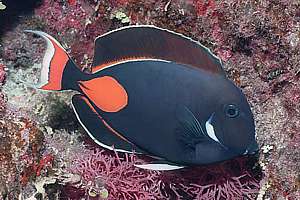
Acanthurus achilles, Achilles tang (humu
kolala - humu, kolala). 20cm. Dark to navy blue with large orange teardrop
on rear body, white band on gill cover and white bands on edges of fins,
orange band on tail fin. Solitary.
Acanthurus dussumieri, eyestripe surgeonfish (humu tea - humu).
Greyish-blueish body with fine blue horizontal patterns, yellow fins, blue
tail with fine spots and yellow stripe through eye.
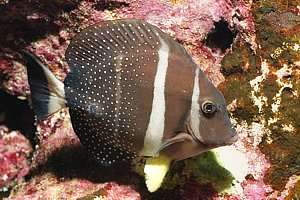
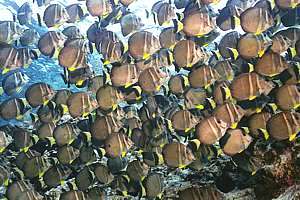
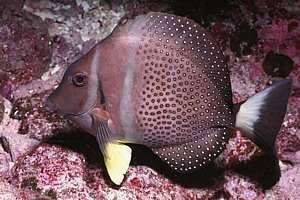
Acanthurus guttatus, white spotted surf
tang (hapi). A medium sized (to 30cm) fish with brown/grey colour and vertical
white/grey bands. Numerous round spots on rear of boedy. Tail white/black
banded by night or yellow/black by day. Yellow bellyfins. Usually occurs
in large groups but sleeps alone. Schooling,
sleeping,
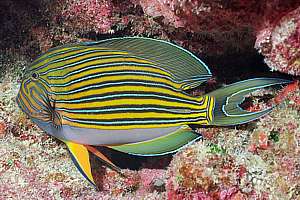
Acanthurus lineatus, lined or striped
surgeonfish.38cm. One of the most spectacular fish of the reef. Horizontal
yellow/blue/black lines, orange hip fins. Feeds on algal scum and defends
a small territory.
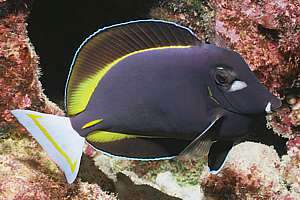
Acanthurus nigricans, velvet surgeonfish.21cm.
Dark blue-black with white tail and yellow detail lines.
Acanthurus nigrofuscus, brown
tang. 21cm. Brown with numerous orange spots on the head. Black spot on
rear base of dorsal and anal fins. Can be olive-coloured. Forms large schools,
grazing algae. [HF]
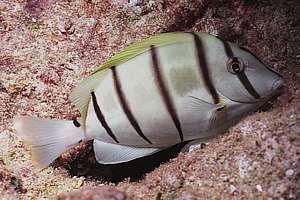
Acanthurus triostegus, convict tang.
Perhaps the most common reef grazer. Often in large groups on shallow reefs.
Small fish (to 25cm) with pale lemon colour and 6 narrow black bands as
on a convict's uniform.
Acanthurus pyroferus, mimic surgeonfish.
25cm. [HF] Brown, curvin black band from snout to top gill cover, orange
patch above pectoral fin base, yellow tail margin and pectoral. Solitary.
Ctenochaetus striatus, fine-lined bristletooth.
Olive green with fine horizontal lines.
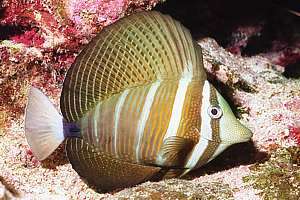
Zebrasoma veliferum, Pacific sailfin
tang (meito ago - meito). 40cm. Long sail fins (veils). Body with 6 alternating
dark/light bands, beautifully patterned. Tail white to yellowish to brown
without spots. Purple tail stock.
Naso caesius, grey unicornfish. Grey to brownish grey, able to change
colour and patches on body. No horn and no dark margin on gill cover. large,
to 60cm.
Naso hexacanthus, blue-spine unicornfish. A large (to 70cm) elongate
surgeonfish whose unicorn is not very visible. Males change colour to white
blue at will. Lives along drop-offs, feeding on plankton. Blue tail.
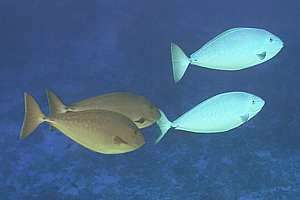
Naso unicornis, longsnouted
unicornfish, bluespine unicornfish (humu tea). 70cm. [HF] Grey to olive
with short horn and tail thread. Solitary.
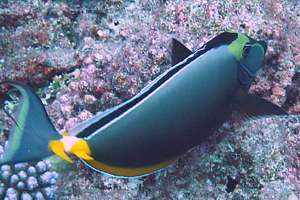
Naso lituratus, orange
spine unicornfish, smooth-headed unicornfish (humu kai niu - humu). Large
(to 30cm) brownish grey body with yellow nape, orange tail spines and anal
fin. Black band over back with black/grey back fin. Yellow fringe on tail.
Yellow/black pattern around eyes and snout.
sword fish (haku la - haku), marlin (haku tagata - haku)
Centrolophidae - warehous: common warehou, silver warehou, white
warehou, blue-nose warehou, rudderfish, ragfish
Pleuronectiformes - Flatfishes
Bothidae - lefteyed flounders: a small family of unusual flounders
with their eyes on their left sides. Brestfin used as rudder. Changes colour
rapidly.
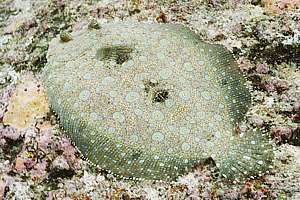
Bothus mancus, peacock flounder (ali).
Solitary on sandy bottoms or rocky surfaces. Grey to brown with blue spots
and circles. Lower eye in front of upper eye. Eyes widely spaced, lower
eye in front of upper eye. Changes colour. Can grow large to 80cm.
Parlichthydae - large-tooth flounders: ventral fins short-based,
clearly separate from long anal fin. Tailfin slightly pointed or rounded,
radiating from a narrow base. Eyes on the left side wich is pigmented.
Underside usually not pigmented.
Pleuronectidae - right-eye flounders: both eyes on the pigmented
right side and underside unpigmented. Eyes small and close together, directly
above each other. Fins entirely soft-rayed and tailfin straight. yellow-belly
flounder, sand flounder, greenback flounder, black flounder, brill, turbot,
lemon sole, NZ sole, spotted flounder
Soleidae - true soles: both eyes on the pigmented right side and
left underside unpigmented. Head and eyes small and body shape oval almost
without discontinuity between fins.
Tetraodontiformes -
Balistidae - triggerfishes: swimming with dorsal and anal fins.
First dorsal spine lockable in upright position by second spine. Small
breast fins, no hip fins.
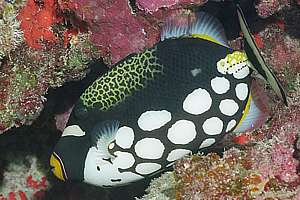
Balistoides conspicillum, clown triggerfish.
50cm. Dark to black with white circles on belly. Yellow lips and other
markings.
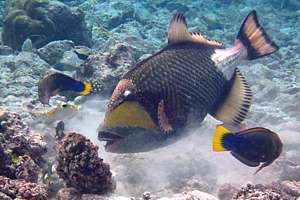
Balistoides viridescens, giant or
Titan triggerfish. 75cm. [HF] The largest triggerfish on the reef, usually
solitary and shy. Colours changeable from blue to yellow to pink. Dark
mustache band.
Balistapus undulatus, orange-lined triggerfish (humu). A large (30cm)
triggerfish, green with orange lines.
Melichthys vidua, pinktail triggerfish.
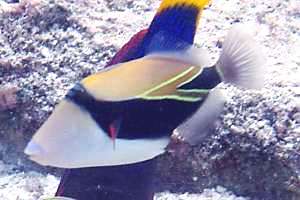
Rhinecanthus rectangulus, rectangular
or wedgetail triggerfish. 25cm. [HF] Light brown snout and back; white
below. Black band through eye and lower body to tail. Distinct yellow wedge
mark from mid body to tail.
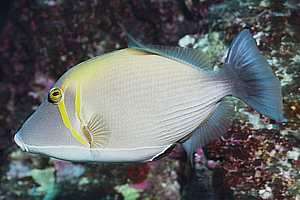
Sufflamen bursa, boomerang/scythe triggerfish,
(humu). 24cm. Greyish with dark tail and two yellow bands behind eye and
white line on belly.
Monacanthidae - filefishes: leatherjackets, swimming like triggerfishes.
Also have one lockable dorsal spike.
Pervagor pilosoma, filefish (humu kotoku - humu)
Ostraciidae - boxfishes & cowfishes: Looking like pufferfishes
but have rigid bodies.
Ostracion meleagris, spotted boxfish
Tetraodontidae - pufferfishes: soft inflatable bodies with soft
fins and a small beak-like mouth with fused teeth. Paddles with breast,
back and anal fins. toados, pufferfishes, without spines.
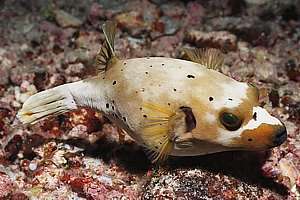
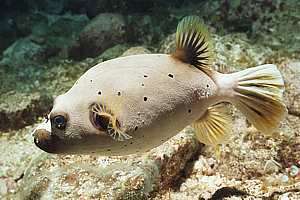
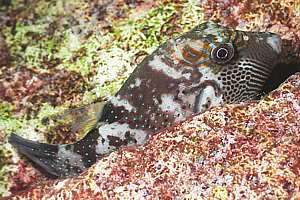
Arothron nigropunctatus, black-spotted
puffer (tete). 33cm. A small common pufferfish with variable colours from
brown to yellow and camel but always with small variable black spots. Photo2,
Arothron meleagris, guineafowl
puffer. 50cm. Brown-black, covered in small white dots. Solitary, feeding
mainly on live tips of corals. Can be all yellow.
Canthigaster amboinensis, Ambon puffer
(tete). 14cm. Blue lines radiating from eye and blue-ringed white spots
on body.
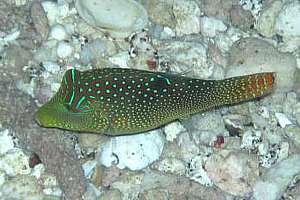
Canthigaster solandri, solander's
toby, spotted toby. 10cm. Brown, covered with white to blue to green spots
and similar stripes on snout and back. eye spot on dorsal fin base. Solitary,
feeding mainly on algae, corals and invertebrates.
Diodontidae - porcupine fishes: soft inflatable bodies with small
spines all over. Large eyes and small gill opening which can serve jet
propulsion when deflating. porcupine fish
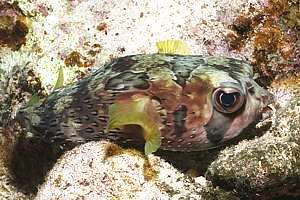
Diodon liturosus, masked porcupine fish,
commando porcupine fish (toutu). Large (50cm) with small spines and variablee
marking like a commando's military fatigues.
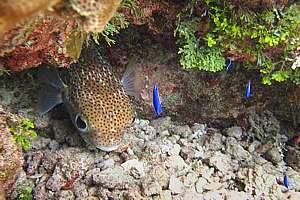
Diodon hystrix, common porcupinefish. A large
(to 71cm) pufferfish, white below and yellow to olive brown on top, often
with black and yellow patches and numerous small spots. Many short movable
spines. Mostly solitary in calm waters. [HF]
Molidae - sunfishes: ocean sunfish
Mola mola, ocean sunfish. 300cm. Broad
oval body with long dorsal and anal fins, with which it swims, and no tail
but body flattens towards rear. Often swims near the surface.