This site map gives a structural overview
of the entire Seafriends web site. It contains many keywords to guide you
to your area of interest. It also shows which sections and chapters have
been planned for future addition. This overview is kept up-to-date.
Use the Edit/Search
or Edit/Find
option of your browser to find what you are looking for.
Bold listed sections have
been completed or are uptodate, and are worth visiting first. The sections
marked (in preparation) are the ones we are now working on, to be
released usually by the end of November this year, but priorities may shift
without prior notice. Use your go back
button to return to this page after clicking on one of its links.
.
alternative navigation:
how to navigate this site from different perspectives
tips: brush up on your
navigation knowledge and get the most out of your visit by reading tips
first. (7p)
big picture overview: navigate
this site according to your kind of interest. Challenge your knowledge.
Challenge our discoveries. (7p)
autorun: begin with the
CD autorun page which gives prominence to the slide shows and indexes with
large images on CD (1p)
Seafriends:
information relating to the Seafriends organisation and its field centre
in Leigh, New Zealand.
Introduction:Why
Seafriends? Why this web site? History: How Seafriends came about. About
Floor Anthoni: Curriculum vitae. Making a start: The Seafriends philosophy.
Opening windows to our sea.Seafriends organisation. (6p)
Blueprint: a blueprint
for saving our seas. A visionary plan, (now in need of revision). (22p)
Swimming with the fishes:
an introduction to the joys of a visit to Goat Island with proper snorkelgear
from Seafriends (2p)
Introduction
Where are we? How can you find us? History: A challenging beginning. Services:
The field centre has aquariums, a library, a restaurant, dive hire and
more. School trips. (3p)
Diving Goat Island:
diving and snorkelling in the Goat Island marine reserve. All the links
you need.
Diving: Diving in the
Goat Island Marine Reserve. Diving around Leigh. Tips for diving and snorkelling.
A special snorkel course. Photos and maps: View photos of Goat Island and
maps showing the underwater vegetation. (5p)
Dive hire prices: Hiring
dive and snorkelgear at Seafriends is convenient and not expensive. (1p)
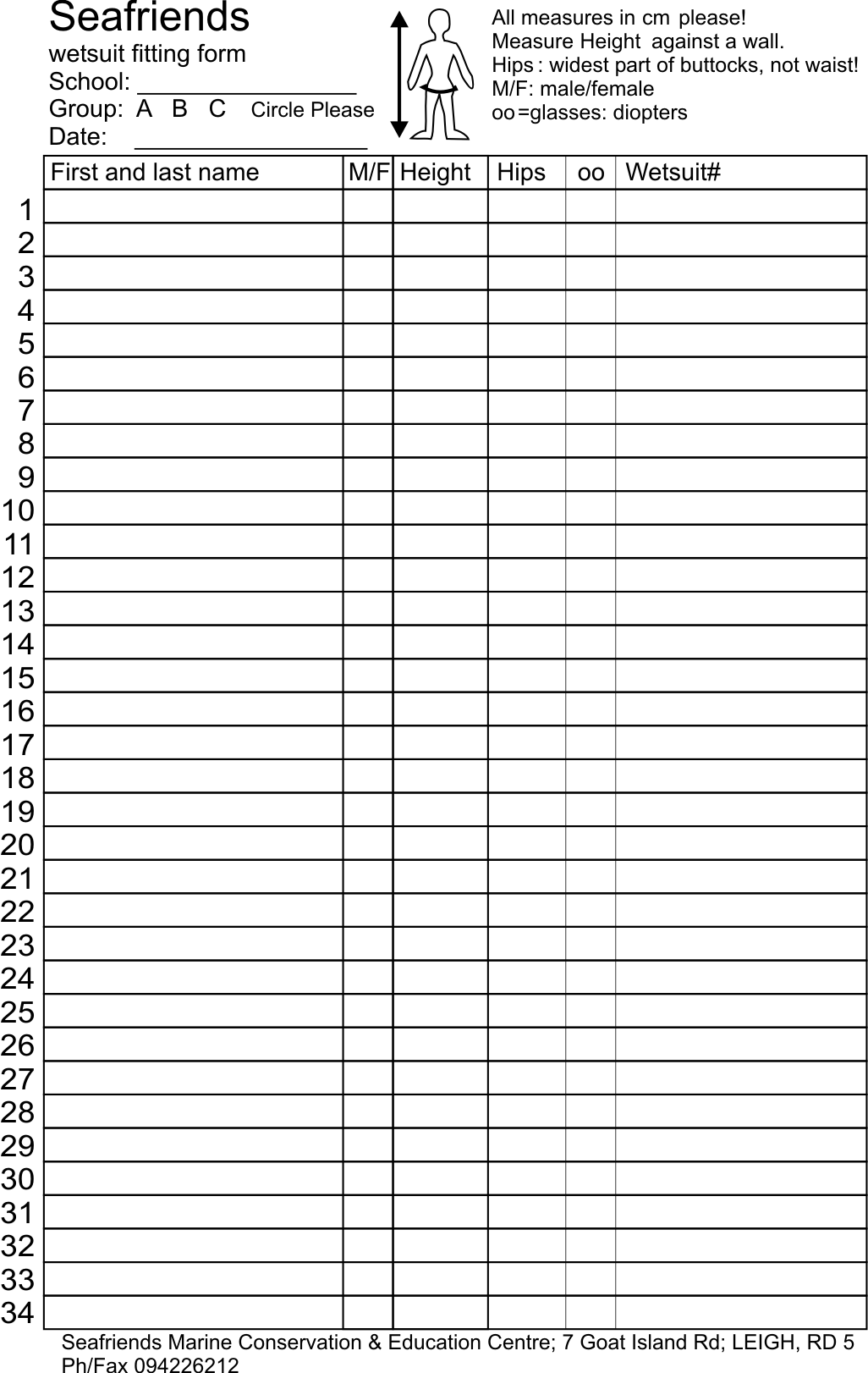
Seafriends' safety suits:
designed for the local conditions for optimal comfort and safety, and affordable
(3p)
Sea conditions: a daily
update of the sea conditions at Goat Island and around Leigh, with this
week's outlook. (2p)
Seafriends café:
a meeting place in Leigh, licensed restaurant and marine education centre
with aquariums. Open every day. Great meals & coffee. (2p)
Seafriends aquariums:
these world-unique aquariums are temperate water ecosystems with species
that other aquariums can't keep. Its circulating seawater is nursed to
a higher quality and health than the sea around Leigh. Note! discontinued
under new management (sigh). With links to aquarium
design and species list (2p)
Camping for Goat
Island: find the place that's best for you with Seafriends centrally
placed. (2p)
Lecture-lunch: For organised
groups, such as pensioners, we offer a lecture and lunch with visit to
the aquariums. (1p)
Evolution: principles and examples, common misconceptions,
Ecology: the principles of ecology, focussed on the sea.
Habitats: The factors
that influence marine life. A catalogue of NZ's marine habitats. (growing
slowly) (2p)
Introduction:
What is a habitat? What physical factors cause habitats to differ? Climate
regions, wave regimes, substrate, depth zones. Terminology, definitions
and topographic scales. Important for understanding the sea. (14p)
Classification:
The proposed classification of sea habitats, first by area, then by depth.
(4p)
Sample habitats: detailed
biology and ecology of common habitats.
Rocky shore:
understanding the intertidal rocky shore and what lives there. Universal
principles and factors, illustrated by over 300 photographs in 15 documents.
6MB (21p)
shoreid1:
identifying the fishes, crustaceans and echinoderms (17p)
Fertility: where
does soil fertility come from? How is it recycled? What are fertilisers?
How is fertility lost? Plant needs, watering, nutrients, fertilising. Trees
for grassland. (18p)
Sustainability:
how can we understand sustainability? Why is it so difficult to achieve?
What to do? Signs of fatigue; defining sustainability; sustainable systems;
energy efficiency; economy; permaculture and organics. (20p)
Erosion & conservation:
How is soil lost? How does erosion work? What can we do? Concern; degradation
(gravity, frost, wind, rain); estimating erosion; how it affects the sea.
(23p)
Roading and development:
roading is a main source of pollution. How to prevent erosion? How to maintain
road sides? Erosion control; bank stabilisation; beautification. (12p)
New Zealand:
the situation in New Zealand - history, dependence, geology, problems,
sustainable land management. (12p)
Threatened Species:
An extract of the Red Data Book of extinct, endangered and vulnerable species
of NZ. (see below)
Ocean acidification:
understanding the processes, doubts and missing science, and the global
carbon cycle. Dissecting scientific studies. Index, intro and conclusion
(10p)
Soil: How soil
forms, how it works, what it needs, sustainability. Soil
erosion: how we lose our soils. How it threatens. What is being
done. (see Environment above)
Disappearing
beaches: Many of our beaches are retreating. Why? New insights.
(See Oceanography below)
Degradation:
the principles behind degradation, explaining why it strikes so rapidly
and widely, affecting all species. (25p)
timeline: a
timeline chronicling the many degradation events that happened in New Zealand
(4p)
decay: a separate section
devoted to pictorial examples of decay (see above)
Poisonous plankton: A new threat for the world's shores,
estuaries and lakes.
Effluent discharge: Sewage treatment and discharge; farm
effluent. How it damages and what can be done.
Chemical/Industrial pollution: How industry pollutes. Its
effects on the sea.
Ballast water: The threat of ballast water. What can be done?
Habitat destruction: Mankind has changed his environment
considerably. How much did he change the sea?
Conservation
index: A complete study of methods, policies and how to create
marine reserves. (4p)
Resource Management:
principles, types of resource, tragedy of the commons, economies of exploitation
,sustainability, management principles and types. (28p)
Biodiversity:
kinds and causes of diversity, ecosystem services, resilience, differences
between land and sea. (32p)
Marine conservation:
marine conservation principles, various viewpoints, perceived benefits,
what reserves do best and what they don't do, how they can fail, spillout,
larval dispersal. (34p). See also Goat
Island Marine Reserve.
Lessons from Leigh:
how marine reserves can fail. Mistakes to learn from. Only reading is believing.
(24p)
Frequently Asked Questions
(FAQs) about marine reserves, dispelling many myths. A must-read for all.
(32p)
Degradation:
the principles behind degradation (see above)
Myths
and fallacies exposed in articles and speeches. We owe it to our
children to expose lies, myths and fallacies. A must-read to ground-truth
what you believe in. Here is an annotated index to the myths chapters below.
Myths1 (10p)
Minister of Conservation, NZ Underwater Association, Forest & Bird
Soc.
Myths2 (10p)
Forest & Bird Soc, The Independent newspaper.
Myths3 (9p) Minister
of Conservation, NZ Underwater Assoc, various newspaper articles.
Myths4 (12p)
Official reply by the Department of Conservation, Forest & Bird Soc.
Myths5 (11p)
Bill Ballantine, Pew Oceans Committee, S R Palumbi.
Myths7 (24p)
the NZ Marine Reserve Experience, the science behind the politics.
Myths8 (15p)
DoC's answers to criticism by Option4, DoC response to issues raised.
Myths9 (8p) DoC
provides one-sided information to journalists and pays them to write one-sided
articles.
Myths10 (8p)
a critical look at Daniel Pauli's public statements. Naive and deceitful.
Myths11 (19p)
DoC releases monitoring results of marine reserves but reports selectively.
Misrepresentation, lies.
Science exposed:
a critical review of marine ecological research carried out recently in
northern New Zealand with an emphasis on the snapper-urchin-kelp myth.
Scientists find truth difficult. (43p)
Designing marine reserves: principles and practice in marine
reserve design. in prep
Marine monitoring: principles of monitoring, and how to select
sites and methods. in prep
Marine mammals conservation: (postponed)
Legislation: environmental legislation, the good and
the bad (postponed).
Links: Internet
links to valuable sites on conservation and marine conservation. (2p)
IUCN recommendations
for Protected Areas, Fifth World Parks Congress, Sept 2003. A long
wish list of recommendations and actions for protected areas of all kind.
Printer-friendly version of the 210 page document. (60p)
Global Threats: a
summary of global threats to society, atmosphere, land and sea. Shocking.
(20p)
Global
problems: the state of the planet and possible solutions. Understanding
the issues is the first step.
Population: world's number one problem, causal factors, predictions,
consequences.
Energy: the present situation, estimating the resource, alternative
energies, political map, restructuring society,
Ecological footprint: the physical limitations of the planet,
human needs, critical resources, calculating the human footprint,
Global climate:
an extensive education to understand global climate. Index, introduction
and timeline (7p)
marble
in space: Planet Earth 'hangs' by an invisible thread between
a sun of 6000ºC and outer space of -273ºC. Planets compared,
radiation balance, imaginary atmospheres and more (30p)
water,
ice & vapour: understanding the strangest substance
on Earth, available as water, vapour, ice and cloud (15p)
measuring
temperature: Measuring temperature
is not as easy as it seems, and measuring past temperatures of thousands
and millions of years ago, even less. (18p)
manmade
global warming: It is widely
believed that cumulative burning of fossil fuels has upset the climate
to such extent that catastrophic global warming could follow, but what
is the story? (30p)
greening
planet: Higher levels of carbondioxide are beneficial to
plants and the world at large. This page examines the ecology of carbon,
plant ecology and how scientific growth experiments are done. Examples
of important plant species. (9p)
supporting
documents: From time to time, valuable documents appear
in the blogosphere, some of which have been saved here for future reference.
(5p)
Natural Climate Change:
What is normal and natural? The seminal work of the late Joseph Fletcher.(17p)
hall_of_shame:
Climategate has exposed corrupt scientists and their institutions. Here
we mention names in order to hold them accountable. Lest we forget; we
owe it to our children. We also dissect some utterly disgraceful articles
and statements from the scientific establishment. (22 pages)
climate change controversies:
a disgraceful propaganda document produced by Fellows of the Royal Society
UK (10p)
El Niño: global currents, heat transfer, decadal pacific
oscillation, influence on weather,
Ocean acidification:
are the oceans becoming more acidic and is this a bad thing? Scare or scam?
Read to understand the issues (52 p) In several chapters.
Disease: causal factors in the global spread of disease,
biocide resistance, epidemiology,
Genetic engineering: the promises of GE, current methods,
needs, risks, uncertainties,
World economy: extent of the global economy, strengths and
weaknesses, the casino economy, past mistakes, revival of economic theory.
Rise and fall of civilisations: how ancient civilisations
rose and fell to ruin. Analysis of the world's situation.
Limits to complexity: natural laws, cost of complexity, bad
law, environmental costs, historical overview, escape?
Oceans: general knowledge
about the oceans. Origin, tectonic plates, continental drift, Earth's interior,
growth & formation of continental crust, ocean basins, ocean floor,
trenches and mountain ridges, oceans and seas. (11p)
Oceans (2): physical
properties of sea water; temperature; seasons; chemical properties; salinity,
density, productivity; land vegetation, biomes, vegetation types, soil
types. (7p)
Waves: wave motion;
velocity, wave length, height, energy; waves and wind; fully developed
sea; breaking waves; wave groups, reflection, tsunamis; mega-tsunamis;
seiches and bores; internal waves, trapped waves, deadwater; damage to
shore. (18p)
Tides: tides are caused
by the rotation of the Earth under the pull of moon and sun. The simple
model; the buckling crust; tides around NZ; tides and environment. (4p)
Circulation and currents:
structure of the atmosphere; magnetosphere; artificial satellites; solar
radiation; atmospheric filter; solar spectrum; incoming and outgoing radiation;
radiation by latitude; radiation and photosynthesis; air cirdulation; general
global circulation; jet stream; worldwide weather systems; wave heights;
Coriolis deflection, Ekman spiral; surface currents of the world; deep
currents, deep water circulation; El Niño introduction. (14p)
Dunes & beaches:
origin of the sand; beach profile; beach/ dune system; beach repair, wind
transport; storm damage and repair; beach cycles; sediment transport and
budget; pebble beaches; rips and cusps; sample beaches. (9p)
Disappearing
beaches: new insights about why and how humans destroy their beaches.
Important reading. (4p)
new observations:
observation problems; the living beach; self repair; beach laws; the sand
pump. (6p)
drying in the tide:
critical timing; effect of beach slope; crusting; beach pollution. (5p)
obstructing the wind:
shelter belts; tall buildings; tall dunes; headlands & pocket beaches;
driftwood; shells on beaches. (7p)
dune stabilisation:
motivations for planting the dunes; do roots protect? myth of succession;
rolling dunes; effects of dune planting. (8p)
engineering solutions:
the line in the sand; beach renourishment; beach drainage; sea walls; groynes
and jetties; breakwaters; artificial surfing reefs; excessive amounts of
sand. (9p)
saving our beaches:
symptoms of a sick beach; threats to our beaches; what we could do; examples
of beaches worth saving in NZ. (8p)
missing knowledge:
a summary of basic scientific knowledge about beaches, which has been overlooked.
(4p)
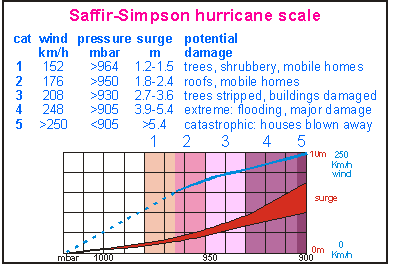
Storms: tropical cyclones,
typhoons, hurricanes; how and where do they form? Storm threats and consequences;
Saffir-simpson hurricane scale. (5p)
Special New Zealand:
why is New Zealand so special? location, natural environment, climate and
economy dictate benefits and problems. Currents around NZ. (10p)
Mining the sea sand:
sand is an important resource. Society needs lots of it, but can it be
mined sustainably? Society's need for sand; origin of the sand; geology
of the sea bed; where does the beach end? environmental consequences; effective
restrictions; concrete; glass. (28p)
Underwater
photography: an essential course in advanced underwater photography
with theory, examples and tips from an experienced cinematographer, photographer
and diver. History of important events in underwater photography. (3p)
Introduction: knowledge,
experience and skills required. Equipment. How to manage your resources.
Diving skills and buddy; camera resources; managing resources; expedition
skills; better chances; clouds, waves, visibility; photographer or diver?
(12p)
Film and lens: What
film to use or digital? What lens to use and what to expect. Slide films
compared. Flat port or dome port? Digital image manipulation. (10p)
Water and light: How
does the quality of light change as it enters the water and travels through
it? Surface effects, crinkle light, cathedral light; light refraction;
scatter and diffusion; scatter from strobe light; loss of colour and intensity;
positions and camera angles. (10p)
Mixed light: a help
light (strobe or other) brings colour and problems. How to understand and
use filters. Colour correction; mixed light with filters; complementary
filters; controlling the strobe; continuous movie light. (11p)
Macro
photography: the theory and techniques of advanced macro
photography under water. (12p)
Opportunities
& behaviour: how to recognise opportunities and how
to behave in order increase your chances. (11p)
Digital
Darkroom: the combination of a slide/negative scanner and
computer processing, offers entirely new perspectives on picture rendition,
quality and longevity. Advanced computer techniques to improve your images.
(35p)
Nikonos
cameras: how UW cameras evolved to the Nikonos RS. What
to expect of the ideal camera. What it can and cannot do, experiences
and how to use it. Digital cameras, their advantages and disadvantages.
(9p)
Movie&video: making
a movie does not consist of just taking moving images. Here is the most
essential advice. (4p)
Tips & tricks: a
look at photographic gear and how to adapt it to your needs. O-rings, brackets,
connectors, cables, lights.(in prep)
Wide angle unsharpness:
how to fix wide angle unsharpness & calibrate a fixed distance macro
lens. How to make the illusive depth scale. (7p)
Kermadecs:
Over 200 beautiful and functional images depicting their underwater ecology.
(44p)
Goat Island: an overview of images from the Goat Island marine
reserve. in prep
Slide shows: 'Fish
of the Month' slide shows and more. 1998,
discontinued (8p)
Fish Eyes: Can you
recognise these eyes? Click on one to find out. (10p)
Images:
a growing library of selected images by category, complete with narratives.
470 photos, growing. See also images of decay.
Portfolio: a personal
portfolio of a number of categories showing what we specialise in. (7p)
Ecklonia kelp: forest, groups
of plants, deep kelp, tumble kelp, butterfish bite holes, kelp death, (3p)
Urchins and starfish: red
diadema young & old, blue diadema, kina, purple urchin, radial patterns.
(6p)
Habitats: Poor Knights,
Mayor I, Leigh, inner Hauraki Gulf, atrina rock habitat, barren urchin
flats, cave, kelp zoning, South Island, bull kelp, macrocystis, (9p)
Magazine articles:
titles of selected articles from magazines, journals, periodicals. Dive
New Zealand (tabloid) (complete); Forest & Bird magazine; National
Geographic; New Zealand Geographic (almost complete); New Zealand's Nature
Heritage (1975) (complete); New Zealand Science Monthly; Scientific
American (from 1992); Tane (from 1970); Water & Atmosphere(NIWA);
growing (30p)
Individual articles: photocopies
of scientific articles relating to the subjects in this web site, by author.
(to be discontinued)
New acquisitions:
new books, magazines and articles are listed here first before being posted
to the library catalogs (fluctuates)
Glossaries:
these grow as this site grows
Marine Glossary:
An explanation of concepts, ideas and strange words used in marine biology,
conservation and environment. (30p)