Our drive to overexploit comes from our ability
to do so, and the imperatives of doing so economically and efficiently.
By knowing the economics of natural exploitation, which governs the interaction
between populations, sustainability can be understood and practised.
The world has evolved with exploitation as a
main mechanism controlling populations. Mankind is no exception, but because
it has the technology to control nature, has escaped some laws of nature.
Rules of resource sustainability. Rights are serious obstacles.
Humans are the very cause of their problems.
They have created the capability to exceed natural limitations. Beyond
the stabilising influence of natural control, environmental problems emerge,
which beg for solutions. By knowing the accelerating and mitigating factors,
problems can be solved at several levels.
Note! for best printed results, set your page up with
a left margin of 1.5cm (0.6") and right margin of 1.0cm (0.4")
The whole section covers about 0.2MB (27 printed pages),
including text, drawings and photographs.
For suggestions, improvements and corrections, please
email
the author, Dr Floor Anthoni.
-- Seafriends home -- conservation
index --site map--Rev:20010820,20030130,20030705,20070722,
Economics of exploitation
When applying economic principles to exploitation, a clear picture emerges
of what happens between populations, feeding from each other. The findings
are so universal that they apply to substances as far apart as soil, grass,
sheep, dolphin, human, and business. Take some time to completely understand
what is discussed here. Read the ecology
section for more detail.
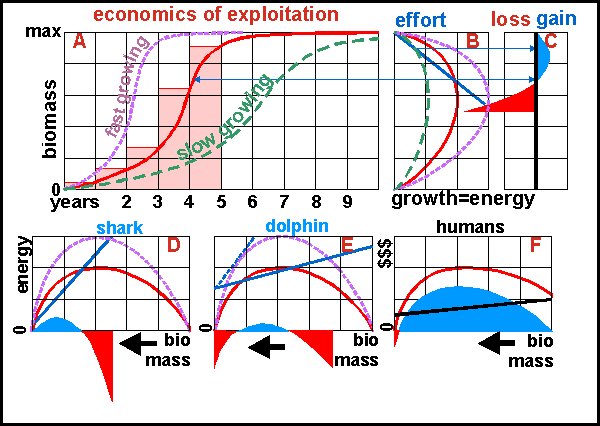
The six graphs shown above, are perhaps the most important ones on this
web site, so it pays to take time to understand what they say. Graph A
shows the growth of a population, which is not unlike that of a single
individual. Horizontally the time in years; vertically the population biomass.
The red curve shows a population growing, first slowly but accelerating
at an explosive rate (exponential growth), which turns into decreasing
growth as the population reaches its maximum, limited by the carrying capacity
of its environment. By example, also a slow growing population (green)
and a fast growing one (purple) are shown. The staircase graph shows growth
as if it happened stepwise, from year to year. Where the curve is steepest
(in the middle), biomass increases most rapidly. Please note at this point,
that these are idealised theoretical curves. In practice they are influenced
by the vagaries of climate, natural disasters and disease. The top of the
curve, reaching saturation, is particularly idealised.
Graph B shows the same process, only now growth
in biomass is plotted horizontally, showing again, that around the middle
(half biomass), replenishment is fastest. The important conclusion is now,
that if the amount of biomass harvested stays within the red curve (to
the left of it), a state of balance will be reached, which is called sustainability.
That balance can only just be achieved all along the red line; at
the bottom with a minimum biomass and catch; at the top with a maximum
of biomass and minimum catch; or in the middle with half the biomass and
maximum catch. Fisheries managers refer to this point as Maximum Sustainable
Yield (MSY), because that is exactly what it is, in the idealised situation.
However, the curve in the middle is rather flat, such that above and
below it, MSY is not much less. Yet, by limiting the biomass to no less
than 70% of maximum, one can have both MSY and an amount of precaution.
The reason fisheries do not do this, is partly greed, and partly because
fish stocks (biomass) are very difficult to assess, and because fishermen
move from one stock to the next.
Since biomass, when eaten, converts to energy, which is spent to eat
more food, the amount of effort to catch food, can be plotted in the same
diagram (blue line, graph B). What the line says, is that more food can
be obtained if more effort to catch it, is spent. It also says that in
order to survive, one must catch more energy than one expends, which is
the area between the blue line and the red curve. Shown in graph C, it
has a profit side (blue) which turns into a loss side (red), because the
prey becomes harder to catch as their numbers dwindle. Natural predators
(in general any exploiter) have evolved to function in the survival blue
area, before its peak, in such a way that spending extra effort is rewarded
generously. Now don't forget that the blue line is not that of one predator,
but that of a population of predators. So it includes both their population
size and their cumulative effort. It can now be seen, that predation
stabilises both the prey population and the predator population.
First it must be noted that each predator has specialised in its kind
of prey, not because of preference, but because it has evolved to do so,
for economic reasons. A predator able to live off a fast growing prey population,
would be ill equipped to live off a slow growing population. Watch how
the blue line won't intersect the green dotted curve. A large predator
would waste too much energy catching small prey, but apparent exceptions
exist (whales have the 'technology' to fish small prey efficiently).
Graph D takes graph C and turns it around, but
remember that the left side of the diagram corresponds to maximum biomass
(full), and the right side to minimum biomass (empty). We can now compare
various kinds of predator, and their effects. A shark is a cold blooded
animal, and a very efficient swimmer. Because of its energy efficiency,
a shark can live off a large range of prey, including slow growing species.
Watch how the shark line intersects both the red and the purple curves
economically.
By comparison, graph E shows that of a dolphin. It is warm blooded,
and spends an enormous amount of energy when it doesn't hunt. Its energy
expenditure curve therefore, starts way up the vertical axis. If it had
the same catching efficiency as the shark (dotted blue line), it would
not be able to feed on the red population, requiring faster growing stock
instead (purple population). Fortunately, it has developed the technology
of sonar, which gives it an advantage over the shark, pulling its energy
curve flatter. Because of this advantage, the dolphin can now feed on the
red stock.
When it comes to humans, the situation is totally out of proportion.
Instead of energy along the vertical axis, we now have money. People are
silly enough to pay many times the energy value of their food. It allows
fishermen to spend massive amounts of fossil fuel to chase the last fish.
Their fishing technology is so superb that it lays the blue effort line
almost flat, and although their boats are expensive, the line does not
start high up the vertical axis like it does for dolphins. Subsidies lower
it too. So people are able to fish a stock down, without any natural stabilisation
occurring. To make matters worse, as the fish becomes rare, their price
goes up, which lifts the red curve up towards the right. So, for the fisherman,
fishing has become 'economic' until the fish stock is depleted so much,
that recovery becomes doubtful. Herein lies the tragedy of present-day
overfishing.
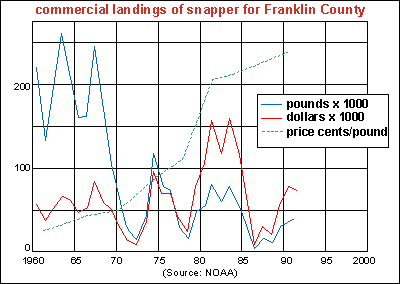
The
diagram on right illustrates typically what happens to a fishery, in this
case the snapper fishery in Franklin County (USA). The blue line shows
how, after a period of fluctuating returns (possibly caused by extinguishing
several fish stocks) around 1968, the stock was suddenly fished down. But
as the catches declined, the price went up. In the end, fishermen made
more money out of the depleted stock than before. The green dotted line
shows how price soared ten-fold in 30 years.
It can now also be understood that subsidies have the effect of drawing
the blue effort line further down, thereby making the situation worse.
Many other problems can be understood from the economics of populations,
as discussed here: growing crops, grazing, disease epidemics, disease control,
etc. Use this as a tool to further your understanding of a resource and
its problems.
Fisheries management world-wide has failed, because:
the economies of exploitation as explained here, were not sufficiently
understood.
scientists do not understand fishing. Fishermen follow schools and
fish them out, then move on to new schools. Dolphins and other predators
do likewise. It makes economic sense. However, scientists measure stock
(correctly) by making random trawls. Stock numbers measured this way are
lower than those indicated by fishing effort, which causes fisheries managers
to err on the wrong side.
data of the resource is hard to get while being exploited. The stronger
the fishing effort, the more we measure that, rather than the reaction
of stocks to fishing. In a situation of fishing at Maximun Sustainable
Yield MSY, it is virtually impossible to obtain data of how the fish stocks
behave naturally. This is a natural principle, often overlooked, and it
is a strong argument in favour of fishing precautiously, well below MSY,
with stock levels not below 70%.
scientists underestimate the advantages of modern technology. Fishing
effort is highly subsidised by cheap fuel. The catch per unit effort (CPUE)
is not a good indicator of fish stock levels, but is widely used for this.
scientists underestimate the demand for fish. High prices encourage
depletion of the stock.
modern fisheries are naturally unstable. There is no stabilising
point where returns are discouraged economically, while retaining a healthy
biomass.
fishermen are driven by greed, and the necessity to pillage the
commons. If they don't, someone else will. They are also driven by uncertainty.
What is there today may not be there tomorrow.
governments encourage overfishing to repay debt by earning overseas
exchange. Worldwide subsidies amounted to US$90 billion agains catches
valuing US$ 70 billion (UN FAO).
Other environmental problems manifest themselves
from our peculiar way of fishing:
slow growing species are caught at the same ratio as fast growing
ones, resulting in old and large fish disappearing. The ratio of large
to small fish may prove to be a better indicator of overfishing than all
others.
by-catch (unwanted catch) can cause severe damage to stocks in the
following ways. Average by-catch is estimated at 25% of the global catch.
In New Zealand the bycatch during snapper trawling is 200%; that of trevally
trawling 300% (Spirits Bay trawl fishery)
it is discarded, thrown overboard. A short-circuit of the food chain.
economic discards: the portion of a catch that is not of economic
value and therefore not rational to retain.
regulatory discards: what regulation prohibits retaining; undersized
fish; fish over quota or for which no quota is held.
high-grade discards: discarded because of its lower value and because
limits exist and more was caught. It is similar to market-induced regulatory
discards.
it contains high numbers of juvenile fish, as if killing tomorrows
catch.
it is highly damaging to slow growing species, particularly for birds
(albatros) and dolphins.
by fishing a single stock down, its function within its environment
disappears, throwing other population relationships out of balance as well.
See also the section on fishing on this web site.
Sustainability
The word sustainability has been abused in too many conflicting ways, both
by greenies and capitalists. In this chapter we'll carefully explore its
many aspects.
sustainability: (L: sub=before/ under; tenere=
to hold) the ability to support for a long time period; endurance; the
ability to keep going continuously. Resource sustainability means
to be able to use the resource forever, without depletion, or causing
harmful effects.
When environmentalists speak about sustainability,
they envisage a world unchanged by our actions.
When politicians talk about sustainability, they
mean staying in power.
When fishermen or businessmen talk about sustainability,
they imply the ability to continue their business, by making profits. They
talk about the sustainability of extraction.
When the United Nations talks about sustainability,
they mean sustainable development, which means how to exploit more for
more people, while causing less damage. Development and growth are by themselves
unsustainable concepts.
So whenever one discusses sustainability, one
should first of all ask: sustainability of what?
resource
sustainability Society has never really asked whether extraction of a resource is
sustainable. Take for instance fossil fuel. We know that it is not self-renewing,
and thus unsustainable. Not only does it run out at some time soon (40-50
years for oil?), but the mining and use of it have proved to cause serious
environmental problems as well.
Yet, is society prepared to halt it? Would society have chosen not to mine
it, had these problems been known in advance? Not likely. The benefits
from fossil fuel are just too large. It would thus be fair to say that
the mining of any resource balances on these factors:
benefit: both to society and the miner.
The mining venture's profitability pays for extraction, whereas society
pays for the product. Costs trickle through the entire economy.
availability: almost without exception,
resources are used by people, and need to be transported from the mine.
The closer the mine to where the product is used, the more valuable is
the resource. The quality of the ore determines how much effort (and energy)
is involved in purifying (washing + grading) it to high standards.
cost: costs are incurred all the way.
Environmental litigation and resource consents add to it too.
sustainability: means a number of things:
sustainability of the resource: extraction
rate not to exceed renewal rate, or the resource being so abundant that
extraction can proceed for many hundreds or thousands of years.
sustainability of extraction: benefits
must outweigh costs. Often public subsidies are used or required to make
extraction possible.
sustainability of supply: supply must
be guaranteed over a number of years, in order to justify the setting up
costs of mining, processing, marketing, wholesaling, stockpiling, retailing
and industrial use. Supply must also be assured in order to win contracts.
alternatives: when considering a mining
consent application, society must ask what alternatives are available:
alternative locations: the resource
may be available elsewhere, perhaps in more preferable quantities, or where
nuisances caused by the extraction will be felt less.
alternative methods: are alternative
methods of extraction available? What are the merits of each?
alternative resources (resource substitution):
can other resources take the place?
minimising environmental damage: Only
very recently has society added this condition, which usually amounts to
minor concessions in the way things are done. Eventually, the external
costs of environmental damage may be taken into account (e.g. by taxation),
resulting in a higher price, which in turn may help to conserve the resource.
a precautionary approach: where in
doubt, through lack of knowledge, society is to take enough precaution,
in order to avoid irreparable damage. It often involves extensive monitoring
of possible effects and cumulative effects, which ripple through the fabric
of the environment.
monitoring: by monitoring/measuring the effects of extraction and
behaviour of the resource, insight can be obtained, which can help to better
manage the resource.
What is not measured is not managed
- conservation principle
Serious obstacles to conservation The summary above shows that resources need careful consideration,
something the general public should have a say in. However, in the course
of human history we have placed some serious obstacles in its way, discussed
in more detail below:
human rights: human rights demand compensation for confiscated property.
business rights: businesses have been given human rights.
traditional rights: if humans or businesses have been doing something
for some time, it becomes a right.
mining rights: owners and communities have no rights over the minerals
below their properties (in some countries).
open access rights: nations have taken tribal rights away, so that
people cannot control their local resources.
fishing rights: if a nation does not fish its resource to the maximum,
other nations can come in (law of the sea).
trading rights: free trade cannot be obstructed by resource or environmental
protection (WTO).
armed services: army, navy and airforce often remain exempt from
environmental laws or resource controls.
In order to protect the dignity of people, human rights have been
enshrined in nations' constitutions, the superior law that stands above
all others. One of the human rights is that nothing that belongs to him,
can be taken away without due process or compensation. It gives people
the reassurance that they and their belongings are safe within their homes.
However, the right is also exercised in rather unhealthy ways. People who
(often illegally and stupidly) built houses on the edge of the sea, want
to be compensated for damage caused by the sea. When their actions are
shown to be harmful to the environment, and such actions are limited by
law, they seek compensation.
Businesses (corporations) or Limited
Liability Companies were once created to limit the undertakings of a business
in such a way that its owners or offspring could not be held responsible
(for bankruptcy and debt, e.g.). In doing so, businesses were given human
rights as well, in all practical sense being the same as a person in legal
matters. As a result, human rights have become business rights, resulting
in claims for compensation for loss of property of opportunity by laws,
even if those laws limited their wrongdoings! As businesses grew into global
corporations, they became powerful enough to ignore or bend conservation
laws and human rights.
Because people have been doing something for some time, they feel it
their traditional right to keep doing so. Many native peoples (Indians,
Maori, etc.) insist that they should be allowed to continue their ways,
even if those ways are detrimental to the environment or to others. Curtailment
of traditional rights often requires society to compensate generously.
In order to encourage prospecting for minerals and mining for them,
governments have given miners draconian mining rights to do whatever
they like, to the detriment of local land owners and communities.
Part of the path to nationhood took the right of tribes away to manage
their resources themselves. In its place came a system of open access,
giving everyone the right to exploit what once belonged to a community.
The tragedy of open access to fisheries is now too well known. The open
oceans are still a free-for-all, including their minerals. Who gets there
first, obtains the right. Where open access was managed with quotas, a
new form of rights crept in, inviting for compensation claims, when such
rights are being curtailed to save the fishery.
As nations wanted to have a say about their fishing resources, Exclusive
Economic Zones (EEZs) were created along the borders of all sea nations.
In these zones, fishing is restricted so that nations have exclusive
fishing
rights. This gave them a better chance to manage their fish stocks.
However, a clause in the UNCLOS agreement remains that if a nation does
not fish its resources to the (sustainable?) maximum, other nations have
the right to do so for them. Fishermen now use this clause to get their
way, to obstruct conservation measures and to claim compensation for such.
Trading agreements such as the WTO (World
Trade Organisation), and NAFTA (North American Free Trade Agreement) aim
to encourage free trade 'for the benefit of nations', but such trade agreements
can cynically be regarded as a (rich country's) means of securing access
to (poor countries') resources, at rock-bottom prices. Any measure for
environmental or resource conservation can now be interpreted as unlawful
obstruction of 'free trade', and can be challenged in a secret trade tribunal
whose decision is binding. We've created an overruling regulatory authority
which is not accountable, non-democratic, and whose officers are
not elected!
The above-mentioned obstacles to resource and environmental conservation
cannot be underestimated, as judged by the many lawsuits and the huge claims
awarded. Here are some recent examples:
SACRAMENTO, California,
September 7, 2001 (ENS) - Corporations are using new rights and privileges
granted under the North American Free Trade Agreement (NAFTA) to challenge
a variety of national, state and local policies and decisions, a new report
has found. The report, "NAFTA Investor to State Cases: Bankrupting
Democracy," documents the track record of cases brought under NAFTA's investment
chapter, which granted expansive new rights and privileges to foreign investors
operating in the three NAFTA signatory nations: Mexico, Canada and the
United States. State lawmakers joined Public Citizen in releasing the report
in Sacramento on Tuesday.
Since NAFTA was implemented
in 1994, corporate investors in all three countries have used these new
investor rights to challenge a variety of national, state and local policies
and decisions. Corporations claim that these governmental regulatory policies
are "tantamount to" an expropriation of private property and therefore
they deserve compensation from the taxpayers of the country in which they
are investing.
Of the 15 cases reviewed
in the report, companies have claimed more than $13 billion in compensation
for actions that many consider to be normal regulatory activity.
"U.S. law does not allow companies to seek compensation for the cost of
complying with government health and environmental regulations," said Mike
Dolan, deputy director of Public Citizen's Global Trade Watch. "U.S. companies
can't appeal jury verdicts, state or U.S. Supreme Court decisions to a
secret trade tribunal to escape liability. There is no U.S. law providing
corporations with legal powers to attack public services to garner a larger
share of the market, but that is what foreign corporations are doing under
NAFTA."
One of the best known NAFTA
cases involves the state of California. Methanex Corporation of Canada
has filed a NAFTA case for $1 billion over California's decision to phase
out the gasoline additive MTBE (Methyl tertiary-butyl ether used in high
octane gasoline), which has contaminated drinking water supplies across
the nation. "Methanex company is attempting to hold taxpayers hostage
to the tune of nearly $1 billion, or 1.2 percent of our state budget, because
we had the nerve to ban a product that was contaminating water supplies
all over the state," said Martin Wagner of Earthjustice, who has attempted
to intervene in this NAFTA suit on behalf of California environmentalists.
"This is not what California was promised when NAFTA passed."
From Environmental News
Service: http://ens-news.com/ens/sep2001/2001L-09-07-09.html
A widespread sense of frustration
with the present status of fisheries and fishery management is causing
fishery stakeholders on all sides of the table to turn to the courts to
settle their differences. The Magnuson-Stevens Fishery Conservation and
Management Act, the National Environmental Policy Act, the Regulatory Flexibility
Act and other statutes provide for judicial review of agency decisions
and include citizen suits as a tool. Litigation can be a powerful
motivator for problem solving and an effective tool in protecting the public
trust. But is it being overused? The National Marine Fisheries Service
is now faced with an unprecedented number of lawsuits. What are the costs
and benefits of resolving fishery conflicts through federal courts?
The use of litigation as
a tool of fishery interest group politics is increasing. It is used to
challenge the completeness of analysis, the quality of analysis, or the
legitimacy of management decisions. Litigation moves the decision arena
from the regional fishery management council system to the courts.
It benefits those who prevail in the courts and may sometimes lead to improvements
in the management system. But litigation also produces an array of costs
that are borne by the fishery management system.
Litigation challenging NMFS'
fishery management actions has increased steadily the past few years, to
the point that members of the public, and even some agency employees, complain
that lawyers, courts, and judges are now the fishery managers. While it
is true that there are benefits to litigation, it is also true that the
costs of litigation are great.
As resource management and environmental protection are cast in law,
the courts take over, and discretion, common sense and fairness are lost.
The huge costs of litigation is eventually borne by the public in the form
of higher prices, while at the same time, conservation takes a back seat.
Let's nonetheless look at problems and how we solve them.
http://www.roskill.co.uk/
for the metals and minerals markets, but you have to pay a LOT for access.
Information is money.
Problems and their solutions
Resources all have their peculiar problems, but underlying them all is
that they are caused by humans. In this chapter, we'll investigate how
this happens and where solutions can be found.
Acknowledging a problem is
half the way to its solution. Problems cannot be solved
without being strictly honest.
Environmental
problems are not entirely new, but whenever they occur, one can be sure
that they have in one way or another, been caused by people. But why is
it that they have become pressing only recently? The answer is quite simple.
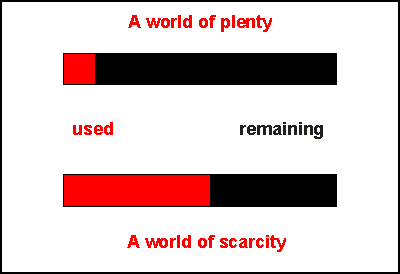
Look at the diagram. It shows two situations, that of a world of plenty,
less than a century ago, and that of a world of scarcity today. In the
distant past, the amount of the biosphere used by people, was negligible
to the total amount available. There seemed to be so much remaining. But
nowadays, many scientists agree that we have already overstepped the halfway
point. So doubling our use of the biosphere will no longer be possible.
And as the remaining part of it (used by 10 million other species) becomes
smaller, the ecoservices they provide, such as cleaning up after us, become
less, and thus our problems worse. The mathematics of scarcity are scary,
predicting an infinity of problems at infinite cost (like run-away global
warming).
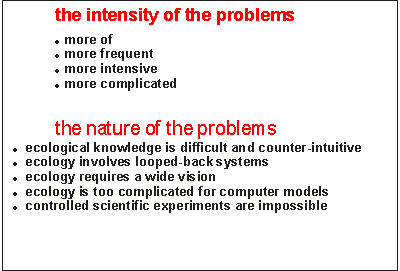
In
the near future (and perhaps forever), we can expect our problems to get
worse in the following ways:
more of: we will see more different kinds of problem. New problems
will present themselves with regularity.
more frequent: problems will appear more frequent, reappearing with
the natural cycles of our environment. First every 30 years, then every
ten, then every year and so on.
more intensive: our problems will become more intensive, as the
cumulative effects of our actions become felt. At first we will notice
acute problems, such as acid rain and chemical pollution, but gradually
the slower ones will announce themselves. These are at the same time larger
in magnitude and almost incurable (global warming, droughts, etc).
more complicated: the results of our actions will affect larger
and larger systems, while at the same time affecting more and more of the
biosphere.
The reasons we will experience these problems as more complicated, can
be explained as follows:
difficulty: ecological knowledge is difficult to assimilate, because
it involves many organisms and factors. It is often counter-intuitive in
the way one would expect them to work.
looped-back systems: because effects work back to their causes (looping
back), ecosystems are difficult to understand and to study. Problems can
cause new problems, or existing problems to grow larger.
wide vision: a wide vision, experience and knowledge is necessary
to study and understand ecosystems. It requires a multi-disciplinary approach.
complicated: natural ecosystems are complex. Disturbances to such
systems are not easy to understand, and they may indeed respond in a chaotic
way.
no experiments: ecosystems are large and specific to their locality.
They cannot be taken into the laboratory to be experimented on. As a result,
it is difficult to do controlled experiments. An experiment done in one
part of the world cannot be duplicated in another part, because environmental
conditions are specific.
To make matters worse, our main tool, science is reaching some limits too.
It takes longer to acquire, becomes more expensive, more complicated, less
certain, survives for a shorter period, and is more difficult to pass on.
See science&technology for more
detail. Environmental problems have their origin in the inventions we collectively
call progress.
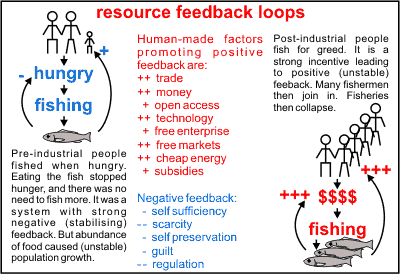
This
drawing shows how resource extraction has changed from our distant past
to that of today. The lefthand diagram shows a family or tribe going fishing
to feed themselves. It was a stable form of extraction, involving negative
feedback: by eating the fish, the motivation to fish (hunger) disappeared.
However, a slight positive feedback induced the population to grow. Eventually
such growth led to overpopulation and natural population crashes. Their
cycle is about 500-1000 years.
In modern times, however, families and tribes are fishing for money.
All feedback loops have become strongly positive, leading to explosive
exploitation. Success in fishing brought in money, which motivated more
fishing for more money. In the process, many others joined in. Collapse
happens in a matter of years or decades, rather than centuries. So what
caused the transition from the stable form into the unstable one?
Listed in the middle of the diagram are all
the human-invented strong accelerators (red), and a few remaining inherited
(natural) weak moderators (blue).
trade: the invention of trade made it pay to fish for others outside
the tribe. By trading fish, the tribe could obtain other goods.
money: the invention of money greatly facilitated trade. Money can
be saved and does not rot.
open access: as nations formed, tribal authority yielded to national
governments and the ocean was opened up to free access by all. It paved
the way to the tragedy of the commons. If you didn't fish to the
maximum, someone else would.
technology: technology changed the way we do things, beyond compare.
For fishing, the invention of cooled storage and transport meant that one
could build up fish catches for later sale, and transport the fish further
afield. At the same time, motors replaced sail, and cheap fuel allowed
ships to pull large nets at speeds from which no fish could escape. It
allowed us to fish further out to sea and trawl with awsome precision.
It allowed us to find fish schools, and to fish them out, one by one. Technology
allowed one to catch the last fish economically.
free enterprise: free enterprise demands no meddling by governments.
It insists on the freedom to make the largest possible profit from the
advantages obtained by inventiveness and technology. To catch all the fish
makes economic sense.
free markets: free markets insist on the freedom to buy and sell
without restriction to any place on the globe. It has made every resource
extraction a global issue, competing on the global market, and supplying
a large market. Prices first dipped due to competition, forcing fishermen
to catch what they could; but as the resource became scarce, prices soared,
and so did demand, resulting in increased profitability and the incentive
to catch the last fish.
free investment: the Multilateral Agreement on Investment (MAI)
and NAFTA demand free flow of capital and investment and any intervention
is seen as illegal intervention. It allows foreign capital to own national
means without being accountable.
Counteracting the accelerators to resource extraction
and depletion, some moderators (decelerators) remained:
self sufficiency: the desire to provide for local communities, drives
fishermen towards caution, but this motivation is very weak due to the
tragedy of the commons.
scarcity: eventually scarcity of the resource will make its extraction
uneconomic. But because of the damage done, the resource may never recover.
self preservation: having foresight and being involved with the
resource every day, fishermen may collectively decide to change their ways
and introduce conservation measures. Examples of this can be found. However,
governmental support with regulations is almost always required as well
(to make others comply too).
guilt: the guilt felt towards future generations. Also a weak motivator.
regulation: the most powerful and ONLY effective measure is regulation.
With regulation, all stakeholders can be made to comply, thereby removing
the tragedy of the commons. Regulation can be visionary and proactive,
which means that it can act before the resource shows signs of depletion.
The reason that even regulation has failed in most fisheries, is that the
say of stakeholders is too dominant, and because scientific stock management
is very poor.
Ambulances at the bottom of the cliff The picture here shows people falling off the cliff as a result of
wanting a better view. So what is the problem here and how can we solve
it? human nature is reactive rather than proactive/preventive. We see wounded
people at the bottom of the cliff, so we focus on sending more and faster
first aid. But the real problem exists at the top of the cliff where we
can put a warning sign and a fence instead. This may seem a silly example,
yet most of our problem solving is similar.
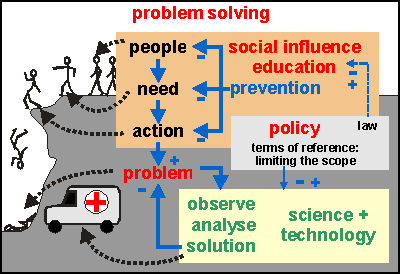
We
tend to look at a problem as if it appeared out of the blue, and then we
set out to fix it, usually with technology and cheap energy (or money).
Seldom do we fix the real causes of our problems, so let's have a closer
look at them. In this diagram the path of a problem and its traditional
solution is shown.
When we ask scientists to solve a problem, we expect them to work at
their level only, often specified by terms of reference or by a
limited
scope. The scientists then observe the problem, collect data, analyse
it and come up with a solution, which is supposed to reduce the problem
(green steps in the diagram).
However, each problem originates from people who have a perceived
need,
and then do something to fill that need (action). Without
much scientific knowledge, society can bring alleviating influence to bear
on these three preceding stages. We can change the way we do things, even
why we need to. Education appears to be the best tool for this, but laws
can be established to achieve the same. What is important to remember,
is that to every problem these three preceding stages exist, which can
be altered to prevent problems, without recourse to additional knowledge.
So they can work more quickly while costing less money. They are also more
lasting.
Note! Eventually, a section on problem solving will appear
on this web site. The above are some of the important points, relating
to resource management.
 The
diagram on right illustrates typically what happens to a fishery, in this
case the snapper fishery in Franklin County (USA). The blue line shows
how, after a period of fluctuating returns (possibly caused by extinguishing
several fish stocks) around 1968, the stock was suddenly fished down. But
as the catches declined, the price went up. In the end, fishermen made
more money out of the depleted stock than before. The green dotted line
shows how price soared ten-fold in 30 years.
The
diagram on right illustrates typically what happens to a fishery, in this
case the snapper fishery in Franklin County (USA). The blue line shows
how, after a period of fluctuating returns (possibly caused by extinguishing
several fish stocks) around 1968, the stock was suddenly fished down. But
as the catches declined, the price went up. In the end, fishermen made
more money out of the depleted stock than before. The green dotted line
shows how price soared ten-fold in 30 years.
 Environmental
problems are not entirely new, but whenever they occur, one can be sure
that they have in one way or another, been caused by people. But why is
it that they have become pressing only recently? The answer is quite simple.
Look at the diagram. It shows two situations, that of a world of plenty,
less than a century ago, and that of a world of scarcity today. In the
distant past, the amount of the biosphere used by people, was negligible
to the total amount available. There seemed to be so much remaining. But
nowadays, many scientists agree that we have already overstepped the halfway
point. So doubling our use of the biosphere will no longer be possible.
And as the remaining part of it (used by 10 million other species) becomes
smaller, the ecoservices they provide, such as cleaning up after us, become
less, and thus our problems worse. The mathematics of scarcity are scary,
predicting an infinity of problems at infinite cost (like run-away global
warming).
Environmental
problems are not entirely new, but whenever they occur, one can be sure
that they have in one way or another, been caused by people. But why is
it that they have become pressing only recently? The answer is quite simple.
Look at the diagram. It shows two situations, that of a world of plenty,
less than a century ago, and that of a world of scarcity today. In the
distant past, the amount of the biosphere used by people, was negligible
to the total amount available. There seemed to be so much remaining. But
nowadays, many scientists agree that we have already overstepped the halfway
point. So doubling our use of the biosphere will no longer be possible.
And as the remaining part of it (used by 10 million other species) becomes
smaller, the ecoservices they provide, such as cleaning up after us, become
less, and thus our problems worse. The mathematics of scarcity are scary,
predicting an infinity of problems at infinite cost (like run-away global
warming).
 In
the near future (and perhaps forever), we can expect our problems to get
worse in the following ways:
In
the near future (and perhaps forever), we can expect our problems to get
worse in the following ways:
 This
drawing shows how resource extraction has changed from our distant past
to that of today. The lefthand diagram shows a family or tribe going fishing
to feed themselves. It was a stable form of extraction, involving negative
feedback: by eating the fish, the motivation to fish (hunger) disappeared.
However, a slight positive feedback induced the population to grow. Eventually
such growth led to overpopulation and natural population crashes. Their
cycle is about 500-1000 years.
This
drawing shows how resource extraction has changed from our distant past
to that of today. The lefthand diagram shows a family or tribe going fishing
to feed themselves. It was a stable form of extraction, involving negative
feedback: by eating the fish, the motivation to fish (hunger) disappeared.
However, a slight positive feedback induced the population to grow. Eventually
such growth led to overpopulation and natural population crashes. Their
cycle is about 500-1000 years.
 We
tend to look at a problem as if it appeared out of the blue, and then we
set out to fix it, usually with technology and cheap energy (or money).
Seldom do we fix the real causes of our problems, so let's have a closer
look at them. In this diagram the path of a problem and its traditional
solution is shown.
We
tend to look at a problem as if it appeared out of the blue, and then we
set out to fix it, usually with technology and cheap energy (or money).
Seldom do we fix the real causes of our problems, so let's have a closer
look at them. In this diagram the path of a problem and its traditional
solution is shown.