SEAFRIENDS has changed. For café, snorkel hire, school programmes go to the
Octopus Hideaway For learning about our seas and planet, begin at the home
page of seafriends.org.nz Seafriends - Field Centre in Leigh The Marine Conservation and Education Centre inLeigh
Help us save our seas!
A number of school programmes have been developed around Seafriends'
resources and the natural resources of the area. 'Opening windows to the
sea' is one of the themes. Visit the separate section for schools.
where you can read more about school trips and how we fit in with the school
curriculum.
For organised groups, such as pensioners, we offer a lecture and lunch
with visit to the aquariums, an instructional and entertaining video and
visit to the beach. Learn about our concerns for the sea. (1 page)
Read why the Seafriends aquariums are so special as a functioning ecosystem,
while managed with a newly invented water quality measurement technique
(DDA). Read more about the marine
species we keep and how it works.
(2+20 pages)
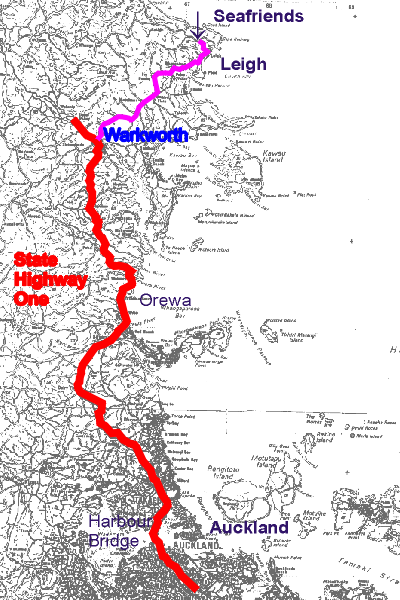
Location From Auckland (in New Zealand), drive North on Highway One to Warkworth
(55Km). Turn right (East) towards Matakana and Leigh (23 Km). Pass through
Matakana. In the centre of Leigh you will find directions to turn left
to Pakiri and Goat Island Beach. After 1.5 Km, turn right into Goat island
Road. Then immediately left into our driveway. You'll find signs at the
entrance to Goat Island Road and our driveway.
History The Seafriends marine conservation and education centre was established
as a base for a self-funding movement to fight for the preservation and
improvement of our seas. One would think that New Zealand, sparsely populated
and located far away from the industrial north, would be exempted from
problems affecting the seas. But nothing is further from the truth. As
enthusiastic divers -frequent visitors to the underwater world- can testify,
the seas around New Zealand are deteriorating at an alarming and accelerating
rate. What the public knows about this is the very little it has been presented
through the media, mostly focused on fisheries and direct threats to humans:
demise of snapper and other fisheries, disappearance of scallop beds, closure
of shellfish fisheries due to poisonous plankton, red algal blooms and
plagues of jellyfish, dogs dying on beaches. Even in the 1970s such problems
had never been experienced in NZ. Yet these symptoms are only a minor nuisance
compared to the massive kill of nearly all species that is occurring in
many places. How could this happen? What is its cause? Where does it end?
How bad can it get? Can we do something about it? What sort of sea are
our children inheriting? Is this really what YOU want to happen? Do YOU
care?
Here at Seafriends we believe that we can make a difference to the future
of New Zealand's seas. In 1990 it was decided to build a centre that would
earn enough to pay its way (your money by doing business with us). Hence
the combination with a restaurant/café. But finance was not available.
None of New Zealand's banks wanted to fund even as little as $10,000! So
we used our pension savings to convert the existing woolshed (a disused
shearing shed). In December 1992 we opened under difficult circumstances.
The next two years much more had to be built and improved upon. After that
we could concentrate on the diving gear and curriculum needed to take schools
from Standard 3 to Form 7 into the sea. In 1996 we embarked on an ambitious
project to document the marine habitats of our country, which will be on-going.
Then an Internet site with information about our seas, a Seafriends network
of people, a charitable foundation and finally political action. Where
could you fit in? Let us know!
We see the process of saving our seas as a succession of steps, each
of which challenging our present way of thinking. We must recognise that
NZ's problems need to be solved with NZ solutions. First we need to acknowledge
that we have problems that are getting worse at a disastrous rate. Then
we need to know how these manifest themselves and what the underlying causes
are. In the process we need to become familiar with the many creatures
in our seas, many being unique to our little patch of the world, and what
protection they need. Finally we may embark on a sustainable ecological
solution that may take our country confidently into the 21st century and
beyond, a vision that may be the envy of other nations.
The coastal fringe around our country, often no more than 50 metres
wide, houses the highest diversity of species, most of which are unique.
This coastal fringe is under direct threat, from north to south and east
to west but more so near large human settlements. Overfishing is an obvious
problem. Less obvious, where humans live, waste water causes major problems.
Even after complete treatment, it poisons directly and induces severe plankton
blooms in the coastal seas. Being unable to recycle our wastes adequately,
we also seem indifferent to our precious land resources being wasted only
to destroy our precious coastal resources. Elsewhere the water run-off
from farms washes silt and nutrients into the sea, which suffocates all
sea creatures. This combined effect causes animals and plants to disappear,
possibly forever. It also makes the sea and rivers dirty and unpleasant.
Ironically we seem to look helplessly at this triple destruction: while
our precious soils drain into the sea, it also kills our precious sea life,
and it erodes our beaches. What makes the coastal fringe so vulnerable
is that for every square metre of it, there are 10,000 to 100,000 square
metres of land capable of destroying it. We must learn to become more cautious
in the way we manage our soils.
Clearly, saving our seas won't be an easy task. But you can still help.
Simply by doing business with us, you contribute. Tell others about
us. Let schools visit us. Read more about the sea. Follow the progress
we are making. Give a donation, or better still, your time. Put us in touch
with the right people. And so on. Eventually our children will judge us
by what we've accomplished!
Services While you're in Leigh, visit SEAFRIENDS Marine Conservation and Education
Centre and make your stay unforgettable!
Relax and enjoy its pleasant atmosphere, out of the rain or wind, the chill
or heat. Have a coffee and cake and make use of our Marine Nature Library.
Study the many educational posters and web site print-outs about our marine
environment.
Visit our unique ecosystem Seawater Aquarium and discover over 100
species of life found on the shores around our coasts. Observe at close
quarters the
Mangroves and their tiny mudcrabs; the Tidal Flats
with their camouflaged hidden inhabitants; the swift Deep Estuary
fishes; the fragile Sheltered Reef community; the sturdy seaweeds
and fishes of our Exposed Reefs; the fairyland coloured sponges
and anemones of our Deep Reefs. It is fascinating. These aquariums
are now unique in the world, because their sea water does not return to
the sea, but instead, circulates. Where else would you find seaweeds, sponges,
seasquirts, mussels, oysters and other filterfeeders thriving in an enclosed
aquarium? Find out why and how.
If you have just come from the beach, make use of our toilets and
showers
and feel fresh again.
Visit our dive rental shop with the largest selection in snorkel
and dive suits, fins and masks. We even have optically corrected masks
for the near- and far-sighted! We also offer the lowest prices,
with group- and family discounts. We also make sure all our dive gear is
clean
and masks and mouthpieces sterilised. Every night all gear is dried
forcefully by a large dehumidifier, to avoid microbes surviving. Hire our
state-of-the-art bright nightdive torches for your night snorkelling.
Before you leave, no need to starve. Tasty meals, large or small, are ready
for you. Enjoy our cooking reputation for lunches and early dinners.
Try our great coffees.
If you are in a party or large family, try our marvellous
group meals
where you cook at your table or use our barbecues and terraces for parties
and celebrations. Group discounts give terrific value. Give us a ring
when you want to come and join us.
Your hosts will be delighted to welcome you. Drive to Leigh, take the Pakiri
Road out. Turn right when you get to the Goat Island Road turn-off. After
30 metres turn left into SEAFRIENDS, the friendliest place to visit.
If you make your booking by telephone (09 422 6212), we will have your
table ready. Table-cooking group meals should be ordered in advance. Don't
forget to tell us what you are celebrating .. you'll never know.
Seafriends
- School programmes The Seafriends school programme grew a little at a time and is still
growing. This Internet site bears testimony to what it has achieved so
far. But when we started the education centre in 1992, we had little idea
of where to begin. The public knows so little of our marine environment,
that parents often know little more than their school-going chidren. Eventually
a theme emerged, that of opening windows to our sea. We do so by:
Talks and lectures (since 1993)
Aquariums which show the living creatures and the kind of seascape they
live in (since 1992)
Movies and videos (since 1987)
A library, books, magazines and posters (since 1993, and growing)
Guided snorkel dives for schools (since 1993 but for primary schools since
1996)
Dive hire, to enable families to go out by themselves (since 1993)
Shore studies (since 1994)
Pamphlets and information about the reserve (since 1995)
Pictures, photos and postcards (since 1996)
School resource kits (since 1998)
Internet web site, the largest marine educational/conservational web site,
and entirely free (since 1997)
Large educational posters (since 2006)
Writing articles and publishing books (growing)
Educational videos and animated slideshows (since 2011)