Could the increase in rainfall have been produced
by the plankton? Are we entering a disastrous vicious cycle? How could
DMS (dimethyl sulfide) influence global climate and weather? Where does
DMS come from?
For comments, corrections or suggestions, please e-mail
the author Dr Floor Anthoni.
Note! for best printed results, set your page up with
a left margin of 1.5cm (0.3") and right margin of 1.0cm (0.2"). Read printing
instructions.
-- Seafriends home -- conservation
index -- issues index -- sitemap
--
Rev:20040310,20050523,20051123,20060325,20060629,20070507, 20070728
Cycles and trends
The natural world experiences many natural cycles like the daily day/night
cycle, the monthly tide cycle, the yearly seasonal cycle and much slower
cycles like the IPO Interdecadal Pacific Oscillation 'El Niño' (9-11)
years, which is perhaps triggered by the sunspot cycle of similar frequency.
Much slower cycles exist, such as the ice ages and others slower still.
Human-made cycles have now been identified, like the traffic peak hour
cycle, the weekday/weekend cycle and the pronounced summer holiday cycle.
Believe it or not, they have shown to affect the weather but not likely
the marine environment. (but they do affect the creatures found in the
rock pools at Leigh. Why?)
Trends are slow progressions, and global warming or the present climate
change can be called one. The gradual increase in the human population
is a very important one, with its associated influence from pollution,
habitat change, introduced species and many more. Although climate change
to a possible new ice age is another trend, all others are recognisably
caused by humans. So the perception that trends are unnatural whereas cycles
are natural, has taken hold in the minds of many. However, this may not
be entirely true or not true at all when one looks at their effects on
nature.
Suppose a warm/cold water cycle exists of about 10 years, superimposed
on the yearly warm/cold cycle. It could bring summers that are warmer than
normal and winters colder than normal, and these extremes could affect
the environment, although such extremes are entirely natural. Now add to
this the trend of plankton blooms increasing in density, and suddenly the
temperature extremes are amplified as they work through the plankton ecosystem,
causing cyclical mass mortalities. In other words, the effects of the natural
cycles have become unnatural although the cycles themselves are natural.
This has become the norm rather than the exception. Is the change in climate
natural or unnatural? Are the suddenly increasing torrential rains natural
or unnatural?
But
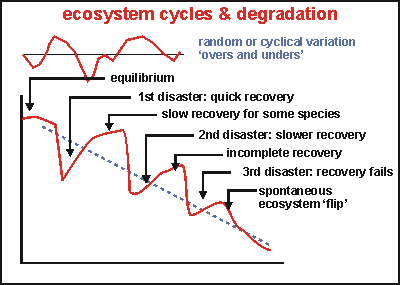
there is an important aspect of cycles superimposed on trends, as the diagram
shows. Although natural cycles are often undulating slowly like a clock's
pendulum,
their effects on the environment are usually not. It has to do with the
difference between life and death, which is a profound long-term change.
Because of this, disasters strike rapidly whereas their recovery times
proceed more slowly, as shown in the diagram. As disasters become more
frequent, or when these are superimposed on a gradual degradation, nature
appears to become tired, and recovery proceeds more slowly and less complete.
This is how degradation proceeds, something to keep in mind when reading
every point made in this document.
Think of the ups as good and the downs as bad. A bad
year allows one to look far into the future whereas good years look a little
backward. Likewise the leftover species allow one to look backward
in time. Eventually today's bad year will be tomorrow's good year.
Today's bad summer will be tomorrow's good summer. Think about it.
There are people who claim that we cannot make a value judgement about
the environment. Is a fine day better than a stormy day? Is summer better
than winter? Is a desert better than a tropical rainforest? Is gravity
good? and so on. If one reasons in a human-centric way, and looks back
at how Homo sapiens evolved, one can say that it did well somewhere
in between starving in the desert and dying from disease in the rain forest,
not unlike the plankton balance hypothesis suggests for all creatures
in the sea. From that perspective we can say what is good for us and what
is bad. But can we say that degradation is bad? Is losing both the quantity
and quality of life (which is not our life) bad? What do you think?
DMS cycle
From the above it is clear that increased rain intensity leads to a massive
increase in runoff and consequent stress to marine organisms, but could
the increased rainfall and increased occurrence of torrential downpours
have been caused by the plankton?
In
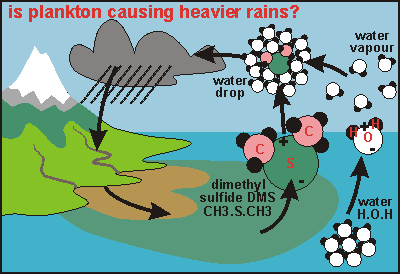
search of the cycles of essential minerals for life, Dr James Lovelock
discovered the sulphur cycle from sea to land already some 30 years ago.
As a by-product of photosynthesis, marine plankton produces an invisible
gas called di-methyl sulphide (DMS). Its molecule CH3.S.CH3 resembles that
of water H.O.H with similar polarity and shape and this attracts water
molecules to it. Dr Lovelock discovered that DMS plays a major role in
the formation of clouds (tiny water droplets) from water vapour which is
invisible and transparent. He posited that the marine plankton played a
major role in controlling the Earth's temperature by producing more white,
sun-reflecting cloud, when the Earth needed cooling. Global circulation
scientists now acknowledge that the DMS cycle should become part of their
computer models if these are to predict global temperatures reliably. But
the DMS cycle may have other consequences.
Increased runof from the land fertilises the sea, which causes more
intense plankton blooms. These produce more DMS which produces more rain
and more torrential rains. These in turn produce more runoff, and more
plankton blooms, and so on, a self-intensifying cycle. But there is more
to it.
We have recently discovered wit the DDA
method that when plankton density increases, the planktonic decomposers
can very suddenly increase their numbers, to such extent that they command
most of the solar energy. This means that the phytoplankton is decomposed
before it can be grazed by the zooplankton. During decomposition, the DMS
gas is formed as is now known from other studies. (DMS with its molecular
structure CH3.S.CH3 resembles the decomposition gas hydrogen sulphide H.S.H.
Also an intermediate form CH3.S.H can be formed during decomposition) The
conclusion is unavoidable: in recent times suddenly much more DMS has been
formed and this is accelerating still.
Could we have entered an accelerating vicious cycle which leads to
more and more dense plankton blooms and loss of land? It could help explain
why the sea's problems are accelerating so fast, world-wide. Is this vicious
cycle going to exceed all other known threats? The speed with which the
degradation of the sea accelerates, confirms it. Think about it.
In case of increased DMS levels in the atmosphere, the following can
be predicted:
more rain?: the amount of water vapour in the air (on land) is determined
primarily by the temperature and local evapo-transpiration from plants.
DMS makes clouds more likely where previously water vapour could not condensate.
So there could be a small increase in the amount of rainfall. Above the
sea humidity (water vapour) depends on temperature and wind speed.
denser rain: DMS invites raindrops to form more easily and more
of it would lead to larger droplets, and thus more intensive rains. It
is particularly because of this that erosion increases so dramatically.
more clouds: DMS will convert more water vapour into clouds, although
this may not be a large effect. However, everywhere in the world the blue
skies have been disappearing.
lower cloud ceiling: as air rises, it cools due to expansion and
to the fact that the air is cooler at altitude. An increased level of DMS
would allow clouds to form at lower altitude, thereby lowering the cloud
ceiling.
sea mists: sea mist is a low altitude cloud. Increased DMS concentrations
would provide more occurrences of sea mist, which has indeed been observed.
stronger hurricanes: hurricanes derive their energy from the transfer
of heat from a warm ocean to the sky. It is done by water vapour which
condensates into water droplets. All the above effects contribute to a
more efffective transfer of heat, and thus more powerful hurricanes.
The reason I think that the threat from the vicious DMS cycle should be
taken seriously, is that it is the only mechanism that explains why we
are getting more intensive rains despite the fact that temperature has
not changed. Indeed, even during periods of cooling, torrential rains keep
pouring. We have mentioned the importance of the change in the water cycle
which may well be the very cause of the world's climate change, but this
alone cannot explain why rains are becoming more torrential.
Reader please note that the threat from the DMS cycle
has not been published elsewhere.
resilience
In the chapter on resource management we discussed the ingredients that
make up resilience, the capacity
to rebound to original, from bad times in between. We noted that its main
components are: overcapacity, replication, diversity,
connectivity and adaptability. We also noted that the memory
functions within such ecosystems may well be the only functions that matter.
Note that ecosystems and habitats do not resist change because they are
made up of many species and individuals. As environmental threats arrive,
they change or yield gradually in response. When threats retreat, they
recover to the original state. Sometines a gradual change introduces a
flip to an apparently different form of environment and sometimes
the return to the original state does not occur or not immediately. The
idea of resilience describes the ability of an ecosystem to return to its
original state. Please notice that ecology (= knowledge of the environment)
is still very vague about this with few if any hard examples.
But individuals do exhibit forms of resilience because they tolerate
a range of conditions and because life repairs and because
the transition from life to death is a flip. Here are some of the
reasons why some species are hardy whereas others are not. Reader please
note that what follows below is speculation in order to think more clearly
about resilience.
overcapacity: an overcapacity in mouths, storage tissue, reproduction,
functionality,
binge-to-famine: capable of swilling but also fasting for a long
time: starfish, anemones, whelks
shrinking in size: capable of growing small, using up stored energy:
anemones, some echinoderms,
opportunists: species that live short, grow fast and reproduce profusely:
seasquirts, bryozoa, barnacles
broadcast spawners: species that produce many eggs in a short period:
barnacles, molluscs.
many mouths: colonial seasquirts, sponges, hydrozoa
growing old: being able to produce more offspring year after year.
replication: local replication by cloning, splitting, rhizomes,
body shape,
cloning: local copies of a parent: anemones, bryozoan mats
splitting: by splitting oneself, two smaller copies are made locally:
some starfish, anemones, micro-organisms,
rhizomes: plants with running roots, carpet tube worms, turfing,
many identical arms: starfish, anemones, corals, seaweeds,
hermaphrodites: being male and female in one organism, able to reproduce
asexually without a partner: many molluscs,
sex change: born female, becoming male sexual efficiency. Many females,
few males: various fishes
diversity: diversity within a species, diversity of food source,
functionality,
food generalists: eating many types of food: whelks, scavengers,
some fishes,
connectivity: individuals connected so that many can repair or feed
the few.
rhizomes: plants with running roots, carpet tube worms, some sponges
transport: by currents (plankton) and winds (plankton, picoplankton)
and swimming (fish)
schooling: schooling behaviour in fish, shrimp and many others
mobility: the ability to move out of danger and into areas rich
in food; to allow for recovery of exploited areas.
swimming: swimming actively like fish do. Note that the ability
to swim up and down the water columns is already very important.
dispersion by currents: ocean and tidal currents move organisms
around
dispersion by winds: very small organisms (plankton) can be dispersed
far and wide and against the currents
adaptability: adaptability to changing circumstances and food sources;
dual life cycles: hybernation, cysts, spores: seaweeds, plankton
organisms,
opportunistic feeders: adapting to what food is available: some
fishes, crustaceans, starfish, whelks
shutting off: switching to a low energy state in periods of adversity
(=misfortune)
ability to fast: clams shut down in periods of poisonous plankton;
sea urchins, mussels, cockles,
hibernating/aestivating: hiding in a small place and living frugally
from stored reserves:
The Plankton Balance Hypothesis posits (= proposes, assumes)
that decomposing organisms like bacteria, viruses and fungi are bound to
pose the main threats when an environment degrades. We will now posit that
an organism has two major defences: its immune system which fights infections
within, and its microcosmos of friendly microbes which protects it from
the outside. In the world of microbes a new microbe won't make it when
all space is occupied by others. Likewise evidence exists that the main
protection of the human skin is the microcosmos of microbes living on it.
Thus we conclude that organisms who are covered in a rich cocktail of friendly
microbes, are correspondingly more hardy:
tubes/ houses: those living within tubes protect their own microcosmos
inside these tubes.
Finally we must realise that the type of food organisms feed on, may
determine many resilience characteristics:
producers: these are the seaweeds (and phytoplankton). Seaweeds
have no roots to take up water and nutrients like land plants do. Their
leaves are designed to take up nutrients and to exchange gasses. As a result,
most seaweeds are sensitive to pollution and infection. Seaweeds depend
on light which makes them sensitive to deposition by mud. Many seaweeds
excrete slime for their protection and to remove dust. Where the water
sways, seaweeds clean one another by overlapping fronds. Seaweeds are bound
to be sensitive.
[Our slush hypothesis (see DDA
chapter) suggests that many seaweeds live in harmony with 'friendly' decomposers
that enable them to be more productive. It may help explain why many seaweeds
are so sensitive to degradation.]
herbivores: live in the sun-lit zone where wave action cleanses.
Food aplenty but must eat regularly. Low quality food and digestion is
slow. Many herbivores spend much of their energy on producing a shell
(snails).
Herbivores are bound to be sensitive: butterfish, bluefish, parore. The
rapid decline of butterfish at the Poor Knights marine reserve may well
illustrate this principle.
carnivores: depend on herbivores. High quality food with fat. Can
fast for a long time. Some high energy hunters (tuna) must eat regularly.
Most can fast well. Carnivores are bound to be resilient.
detritivores: live on the bottom. Feed from food rained down from
above. Low quality food aplenty. Must eat regularly. Live close to decay
organisms. Mobile detritivores are bound to be sensitive whereas burrowed
ones not.
scavengers: feed on dead animals. High quality food scarce and unpredictable.
Able to hibernate and fast. Must be resistant to decay organisms.
phytoplankton feeders: Low quality food is seasonal from binge to
famine. Can't change diet. Able to fast but many do not have large stores.
zooplankton feeders: High quality food is seasonal from binge to
famine. Can't change diet. Able to fast but many do not have large stores.
resilience or slide?
Reader please note that although
resilience is real in individuals, resilience of ecosystems may not exist
in nature, living solely in our minds. My own observations have confirmed
that ecosystems just adapt gradually according to the changes applied,
even if those changes are very small. When following ecosystems along a
gradient that extends over a considerable distance (like water clarity),
the (underwater) ecosystems do not make step-wise changes but rather, change
gradually and imperceptably. Thus ecosystems have no thresholds,
as is important in resilience theory. Much has been written about resilience
theory but with no evidence to back it up experimentally or with robust
data. It may just be a scientific fantasy.
Holling, C. S. 1973. Resilience
and stability of ecological systems. Annual Review of Ecology and Systematics
4:1-23.
 But
there is an important aspect of cycles superimposed on trends, as the diagram
shows. Although natural cycles are often undulating slowly like a clock's
pendulum,
their effects on the environment are usually not. It has to do with the
difference between life and death, which is a profound long-term change.
Because of this, disasters strike rapidly whereas their recovery times
proceed more slowly, as shown in the diagram. As disasters become more
frequent, or when these are superimposed on a gradual degradation, nature
appears to become tired, and recovery proceeds more slowly and less complete.
This is how degradation proceeds, something to keep in mind when reading
every point made in this document.
But
there is an important aspect of cycles superimposed on trends, as the diagram
shows. Although natural cycles are often undulating slowly like a clock's
pendulum,
their effects on the environment are usually not. It has to do with the
difference between life and death, which is a profound long-term change.
Because of this, disasters strike rapidly whereas their recovery times
proceed more slowly, as shown in the diagram. As disasters become more
frequent, or when these are superimposed on a gradual degradation, nature
appears to become tired, and recovery proceeds more slowly and less complete.
This is how degradation proceeds, something to keep in mind when reading
every point made in this document.
 In
search of the cycles of essential minerals for life, Dr James Lovelock
discovered the sulphur cycle from sea to land already some 30 years ago.
As a by-product of photosynthesis, marine plankton produces an invisible
gas called di-methyl sulphide (DMS). Its molecule CH3.S.CH3 resembles that
of water H.O.H with similar polarity and shape and this attracts water
molecules to it. Dr Lovelock discovered that DMS plays a major role in
the formation of clouds (tiny water droplets) from water vapour which is
invisible and transparent. He posited that the marine plankton played a
major role in controlling the Earth's temperature by producing more white,
sun-reflecting cloud, when the Earth needed cooling. Global circulation
scientists now acknowledge that the DMS cycle should become part of their
computer models if these are to predict global temperatures reliably. But
the DMS cycle may have other consequences.
In
search of the cycles of essential minerals for life, Dr James Lovelock
discovered the sulphur cycle from sea to land already some 30 years ago.
As a by-product of photosynthesis, marine plankton produces an invisible
gas called di-methyl sulphide (DMS). Its molecule CH3.S.CH3 resembles that
of water H.O.H with similar polarity and shape and this attracts water
molecules to it. Dr Lovelock discovered that DMS plays a major role in
the formation of clouds (tiny water droplets) from water vapour which is
invisible and transparent. He posited that the marine plankton played a
major role in controlling the Earth's temperature by producing more white,
sun-reflecting cloud, when the Earth needed cooling. Global circulation
scientists now acknowledge that the DMS cycle should become part of their
computer models if these are to predict global temperatures reliably. But
the DMS cycle may have other consequences.