FAQ - Frequently Asked Questions about marine reserves and marine conservation By Dr J Floor Anthoni (2003)
www.seafriends.org.nz/issues/cons/faq.htm
Many people question the wisdom of marine
reserves, as they listen to the platitudes and reassurances given by protagonists,
bureaucrats and politicians. In this section you will get honest and well-researched
answers to your concerns. It is unfortunate, that in the course of a quarter
century of marine conservation, many myths, half-truths and fallacies have
entered the discussion about the value of marine reserves. It is time to
test the truth. Read this chapter with care. For those who know little
about the sea, this page is a good beginning, and a good introduction to
marine reserves.
.
All links below refer to answers on this page.
Recent additions have been date-stamped in colour.
The best way to navigate this page is to use your back
button to return to this index.
You can also successfully print this page for further
study and to share it with others.
The word protagonist is often used (Gk: proto=before;
agonistes=
actor; chief actor; an advocate or champion of a cause)
Click here to go to the Seafriends
home page.
For suggestions, improvements and comments, please e-mail
the author, Dr Floor Anthoni
-- home -- conservation
index -- top -- myths&fallacies
--
Revised: 20030312,20030412,20030505,20030605,20040617,20050809,20060331,20060926,
What
is marine conservation? Marine conservation is essentially the act of saving our seas for
future generations. The word conservation is often misunderstood to
mean
improving the present conditions, but it works only when all
threats are taken away, forever.
Conservation is thus impossible without knowing what threatens the environment.
Our national parks are often praised for their quality, but because invasive
grazers such as rabbit, possum, goat, deer and pig are still present, and
also exotic predators like wild cat, stoat, rat, mouse, wasp, trout and
more, these parks have little conservational value. They cannot and will
not protect our native flora and fauna in the long term. By contrast, the
conservation islands like Little Barrier Island, Hen and Chickens, Kapiti
and Stewart Island and others, do not suffer such threats, and they will
be safe for our native wildlife. For conservation to work however, also
size is important, because the wildlife inside Noah's Ark must have
sufficient individuals of each species to contribute to a varied gene pool.
A varied gene pool is necessary in order to be able to adapt to changing
circumstances in the long term, such as climate change. Nature does not
'design' new organisms, but selects those who survive, which may lead to
new traits or organisms, or extinction. Exchange of genes must also be
present. It is because of this, that even the above mentioned islands may
fail in the long term.
Fortunately, the situation in the sea is entirely different. Here the
habitats have not been changed by human farming, habitation, industry,
roads and more. Also, in the sea all areas are interconnected. There are
no islands under water as they are above the water. So conservation of
our seas makes a better chance. But like the situation on land, marine
conservation works only when all threats are taken away.
What is a
Marine Protected Area (MPA)? A Marine Protected Area is an area in the sea where some protection
applies, but usually not complete protection. There can be many
reasons for protecting an area in the sea, not just to manage fishing,
but to allow activities to proceed without intervention of the public,
like bombing practice areas, mining areas, oil exploration areas, navigational
wrecks, ammunition dumps, and so on. One may protect areas from anchoring
on, such as cable ways because cables can be torn, and international shipping
lanes because large ships cannot dodge small craft at anchor.
MPAs can also be declared for traditional fishing, or to set an area
aside for a local community. In New Zealand, the Ministry of Fisheries
can create Mataitai and Taiapure reserves (see below).
What
are Mataitai and Taiapure reserves? Mataitai Reserves are traditional fishing areas of special significance
to tangata whenua (the Maori people), who are authorised to manage
non-commercial fishing in that area. Management aims must be consistent
with sustainable use of the fisheries resources, and fish stocks within
Mataitai
may be enhanced.
Management controls apply both to Maori and non-Maori fishers and
are enforced by MoF compliance staff and Honorary Fisheries Officers. Bylaws
can cover such matters as limiting species, methods, sizes and quantities.
A Rahui (temporary closure) may be imposed to allow stocks to recover.
Taiapure reserves may be declared in estuarine and coastal waters
that have customarily been of special significance to any iwi or
hapu
(tribe) as a source of food for spiritual or cultural reasons. Although
a
Taiapure is managed by Maori, other fishermen have access, and
commercial fishing may occasionally be allowed.
To find out more about how many of these reserves have been created
and where, visit the MoF web site
or Seafriends/reserves .
What
is a marine reserve? A marine reserve is an MPA (Marine Protected Area) that enjoys very
high levels of protection and continuity (no-taking, forever, without
discontinuity). The idea behind such reserves is that they are in principle
able to recover to a more natural state, and hopefully even to a pristine
state as if human influence had never occurred. It is a very noble and
exciting endeavour. Just imagine having areas in the sea which look the
same as the coast was before their discovery by humans!
However, most marine reserves created today will not even come close
to this ideal, because of a number of reasons. See how marine reserves
can fail, below. But those located far away from civilisation, such
as the Kermadecs, Auckland Islands and others, indeed come close to this
ideal. Their remoteness has afforded them de-facto protection through the
ages.
What
is a de-facto marine reserve? De-facto marine reserves are areas in the sea that have enjoyed protection
for many years, for reasons other than protection of the environment. These
are the cableways, shipping lanes, ammunition dumps, oil drilling platforms
and others. New Zealand has about 3000km2 (300,000 ha) of it, roughly half
in cableways and the other half in ammunition dumps.
By comparison, we have created 16 marine reserves in 25 years of marine
conservation, of which the coastal reserves (excluding outlying islands)
cover about 150km2. The de-facto marine reserves where anchoring and fishing
have been prohibited for over half a century, are thus 20 times larger
than our marine reserves. Yet they have never been investigated for their
value to biodiversity and fishing. In fact, what is known, is that their
fish stocks have declined just as they have everywhere else. This is a
major argument doubting the value of marine reserves for fishing, and also
one that goes against creating more reserves, and certainly one that questions
why suddenly, such haste is pressed by politicians. The current policy
is to have 10% of our coast in MPAs before 2010.
Very remote islands, when also unproductive, can enjoy de-facto marine
reserve status, since they are essentially economic deserts. The
Kermadec Islands are of such nature.
What
is it that marine reserves do best? Marine reserves are particularly good for:
protecting a unique spot: some places in the sea, such as around
offshore islands, are hot spots of biodiversity surrounded by a much poorer
sea and sea bottom. Islands attract fish towards their shallows. They work
like oases, attracting life from far around, including sea birds and sea
mammals.
protecting scientific experiments: scientists need to be assured
that over time, the equipment and cages in the sea remain undisturbed,
also the species and individuals that they are studying.
separating takers from lookers: people who take from the sea, particularly
spear fishermen, can cause tremendous harm to a protected area where fish
have learnt to trust people. People who come to observe the natural environment
must be assured that it will still be the same, and perhaps even better
when they return next time.
attracting people where access is easy: given the choice to go to
a beach outside a marine reserve, or one within, people will choose the
reserve, because there is more to see and the fish are more friendly.
helping marine education: where else would you like to take children
for their first encounter? Besides, the rocky shore in many places outside
marine reserves has been stripped barren.
helping underwater photographers: more fish, tamer fish, larger
fish.
helping to rebuild marine community structure: only large marine
reserves with relatively little spillover rebuild their ecosystems to a
natural state with large predators and other old species. This happens
only where no other threats remain such as from mud, dense plankton blooms
or poisonous plankton blooms. Because many fish change sex (female to male)
at a late age, a reserve can improve the sex ratio of some fish. However
this also increases competition between males.
Ironically, only one of the above reasons is not a selfish one. Marine
reserves work best for our own enjoyment. Protagonists have recognised
this as the other reasons for having them. What they overlook, is
that these activities are successful only when good access is available
and clear water. Everywhere else they will fail. Read more at Seafriends/conservation/marine.
Also read about the insurance value of marine
reserves below, to understand what they do not do well.
Does
trawling destroy marine habitats and biodiversity? Protagonists often claim that trawling destroys the sea bottom habitat.
This is only partly true. Various forms of trawl nets exist.
The scallop dredge is a small net (2-5m wide) with tynes (teeth)
raking the bottom to scoop up burrowed clams. The net has a coarse mesh
to let small organisms through. It acts a bit like a plough reaching only
finger-deep. In this layer the sea bottom is perturbed regularly by fast
burrowing organisms like worms. Also large storms cause damage to this
layer.
The net removes larger organisms, including the scallops' predators like
whelks, starfish and octopus. When trawled with consideration, scallop
beds can thrive by exploitation. However, spots of sufficient density must
remain for male and female scallops to mix their separate spawn. Present
GPS driven fishing techniques do not allow for this. Marine reserves may
work, but they are too static and too far away. Scallop beds everywhere
in the world are now being modified by the sedimentation of mud. Scallop
mass-mortality is often caused by poisonous plankton blooms. Marine reserves
won't protect against this but local management is a serious option.
The shrimp net is of moderate width (5-10m) riding on two sleds
connected by a beam above the ground. A tickler chain with rollers entices
shrimps to jump up and into the net which trails behind. The net has a
very fine mesh to retain shrimps. Thus it also retains small fish. Because
the juveniles of many species recruit and grow in the shallows where the
shrimps are found (3-10m deep), a shrimp net is very destructive to other
fisheries, but not as much to the sea soil which is perturbed by every
storm at these depths. In the tropics, shrimp nets catch turtles which
may drown. A Turtle Exclusion Devise (TED) has been invented to throw large
species out before reaching the cod end (tapered bag).
The standard trawl net has varying width from 10-20m for a single
trawler to 50-100m for pair trawlers. The net has a coarse mesh designed
to let undersized fish through. It is kept open by otterboards (weighted
hydrofoil wings) which slide over the bottom, able to dig a furrow of up
to a finger depth. The rest of the net has little influence since the weight
of fish under water is practically nil. Its influence on the sea bottom
is almost negligible but fishers are known to trawl their sleds through
beds of clams in order to damage these to attract fish.
The deep water trawl net is a very large net (100-200m wide),
trawled with precision for depth. Most trawls do not touch the bottom,
but it is known that they have been used in a risky manner to skim sea
mounts with delicate life.
When protagonists complain about alteration and destruction of sea bottom
habitats, they imagine sea bottoms full of fragile organisms being smashed
by hard metal at high speed. However, most of the trawled sea bottom consists
of mud, muddy sand and sand or coarse shell. Here and there an opportunistic
species can be found (soft coral, sponge, hydroid, seasquirt) on a stone
or other hard bit. But there exist places in the sea with low profile rock
covered in fragile and old sea life, particularly in places with clear
water where sea currents scour mud and sand away while providing much needed
food. Such places deserve protection, but they are found only by fishing
them first.
Although fishing may alter a habitat, it takes much more damage to threaten
biodiversity. Biodiversity entails viable populations of all species. As
long as the conditions for recovery remain, populations can and will recover
after fishing has become uneconomic. Where sessile organisms have been
broken, they often continue living while contributing to procreation. There
has been no record of extinction from overfishing in the sea, contrary
to the situation on land.
However, it is more prudent to prevent overfishing and collateral damage.
We must change our ways rather than believing that marine reserves will
fix all ailments.
Do marine
reserves have more fish? Yes, scientific research has shown in many experiments, that the fish
stock inside a closed area recovers (only where these were fished before).
Fish become more numerous and bigger. It benefits particularly the large
predators. Most studies report an increase of about 2-3 times to what is
found outside. However, this affects only the exploited species. The thousands
of other species remain unaffected, except that they may be more likely
to be eaten by the larger predators.
Where comparisons are made between inside and outside the marine reserve,
one should be extra careful because the resulting ratio represents more
an unwanted effect of marine reserves than that the reserve 'is working'.
The undesirable effect is that of the displacement of fishing where
fishermen are forced to fish outside the reserve more heavily than they
used to. One then sees the density of fish outside decreasing as at the
same time that inside increases, although the total amount of fish stays
the same. For instance, beginning with 100 fish inside and 100 outside
(ratio=1.0), this becomes 150 in vs 50 out (ratio= 3.0), then180 inside
vs 20 outside (ratio= 9.0) and so on. So, a doubling of fish inside
may lead to an extravagant ratio inside/outside. Because protagonists
do not take care with such figures, you must be extra vigilant.
Do marine reserves attract
fish? In 2004, scientists completed
a study on the permanent de-facto marine reserve around the Cape Canaveral
rocket launch site. They tagged fish inside and outside the reserve and
followed their movements. To everyone's surprise, fish inside stayed inside
but those outside migrated into the reserve, never to leave. Inside the
reserve, the tagged fish were lost, presumably due to predation. The scientists
concluded that the marine reserve acted as a sink (like a bottomless pit)
to fish(It 'ate' fish). Fish are attracted to other fish because
of perceived safety in numbers, and predators are attracted to an easy
meal. The study highlighted that scientists looked mainly at migration
out of reserves by tagging fish only inside and studying their movements.
By contrast, this study tagged fish both inside and outside, and is therefore
more reliable. However, the study has also shown its limitations, such
as the low numbers of fish migrating in or out, the possibility that the
reserve could have provided good spawning habitat, the fact that this study
was done inside an estuary rather than on an open coast, and that it was
conducted only over a short time span.
For the complete article,
visit http://fishbull.noaa.gov/1023/tremain.pdf
How
are fish counted? It is difficult to measure quantities and sizes of fish without actually
catching them. Particularly schoolfish who roam around, are almost impossible
to quantify. Here in NZ, scientists have employed the technique of the
baited
camera. It is essentially a heavy tripod with camera and a bait box
on the bottom and in view of the camera. (BUV= Baited Underwater Video)
The bait attracts fish, and the scene is taped. By standardising the method,
reasonably reproducible (repeatable) results can be achieved. At times,
the results are verified (ground-truthed) by divers. The baited
camera attracts only those fish who scavenge (eat dead animals)
now and then, but those are the ones also exploited by angling (but
not necessarily those trawled!). Paul Roux De Buisson [1] reports that
large fish chase smaller fish away, which skews the distribution of fish
size. Because of its restricted field of view, the BUV method is also quickly
saturated, not seeing the competing fish nearby.
When divers
count fish, their very presence affects their results, by on the one hand
shying some fish away, and on the other hand double-counting those who
follow them. The baited underwater video (BUV) technique is worse
still, in that it attempts to lure fish from far away towards the camera.
One
pilchard tied to the outside of the bait box, even feeds (rewards) the
fishes. In doing so, it under-counts those who are not hungry or not
interested in bait, while over-counting those who are hungry and who have
an acute sense of smell. Also, the presence of fish attracts other fish,
particularly once they rip into the external pilchard. After a standard
time of 30 minutes, the maximum number of fish shown is taken as the fish
count!
The most worrisome aspect of this techinique is that it is at odds
with a scientific principle of measuring apparatus, that of minimising
the effects of the apparatus on the quantity measured. By contrast, the
baited
camera technique
maximises its effects. It even creates its
own data, because fish attract fish. In other words, it exaggerates. By
scientific standards, it is thus a bad measuring instrument. Scientists
have never proved its linearity either, meaning a one-to-one correspondence
between measured and actual fish numbers. Results from this technique
must therefore be interpreted with the utmost care. They are in fact suspect,
and the method must be discarded, as should all results obtained with it
so far. Yet scientists have not taken this precaution. Why?
Scientists claim that in the Goat Island reserve, fish is over 20x more
numerous than outside. They also show that the reserve is so small, that
about half the fish have leaked out. These figures are much higher than
reported by other scientists. The worrisome consequence of these figures
is that they imply that the fish stock outside has been fished down to
less than 2% of their original stock. This is not in agreement with fisheries
statistics. So, obviously something must be wrong in their interpretation.
It would also imply that marine reserves are unsuitable for baseline
comparisons, which could have benefited fisheries. When applying these
figures to our very large de-facto marine reserves, they imply that astoundingly
large stocks of fish of all kind must be found hiding there, which
has not been observed.
In some other marine reserves in NZ, similarly high densities have been
found (up to 10 times). There is something fishy with these figures because
they do not cross-correlate. They are also far out compared with results
from marine reserves elsewhere in the world. To use them uncritically for
political purposes is bad science. Furthermore, most of our marine reserves
do not follow this pattern as they show hardly any increase at all. See
myths11
for marine reserve monitoring results.
While scientists were concentrating on only three commercial species
(snapper, blue cod, crayfish), they failed to notice that a number of species
have disappeared altogether where once they were common. Other populations
have reduced their numbers considerably. No effort has been made to monitor
indicator
species representative of the health of the reserve, so the massive
degradation of recent years has been left largely unrecorded. The people
managing reserves (DoC) should share some of the blame. Read more in
Seafriends/issues/cons/lessons
from Leigh and Marine science exposed
.
Do
marine reserves reduce fishing pressure overall? When one area is closed, it increases the fishing pressure on the remaining
area because the same number of fishermen have to make do with a smaller
area and fewer fish. The question is whether the overall pressure (on closed
+ remaining area) reduces. Protagonists claim this is so, because:
Fish spill over from the reserve. So, fishing at the reserve's boundary
(fishing the line) is going to make up for the lost area. However,
international scientific research has not confirmed this. The best spillover
measured, fell short of 35% of the lost fishery. Most reports mention lower
percentages. No data is available in NZ.
More fish eggs are contributed to the plankton, and these will settle
out as recruits in the unprotected areas, where they find more food than
inside the protected area. International research has shown that fish being
about twice in number and double in size, will theoretically contribute
threefold to the plankton. However, recruitment depends mostly on other
factors than just numbers of eggs (spawn delivers 99.99% food but 0.01%
recruitment). Because recruits face fewer predators outside, they have
a better chance to grow up there. However, no scientific data is available
to confirm or deny this. See also Dr Shipp's
report.
An ecological principle says that the bigger fish depend on more food.
So they eat more from the reserve, which includes other spawning organisms.
Only a small part of this food is converted to spawn. Thus the total spawning
mass of all species, emerging from a reserve, is less than outside. How
this affects the survival of the spawn of commercial species, is totally
unknown.
People prefer fishing the line: protagonists see more craypots
at a reserve's boundary so they conclude that fishing there is better.
Little do they realise that this has become the only place where displaced
fishermen who previously fished the reserve area, can put their pots. Many
recreational fishermen believe that fishing the line gives better results,
until they are proved wrong, but many new ones keep trying. The myth dies
slowly. With copious amounts of ground bait (berly bombs) one can attract
fish from a large distance inside a marine reserve, but only until this
stops working too.
Our 3000km2 of de-facto marine reserves should, by this logic have made
a measurable difference. But where is the evidence?
For a complete explanation visit marine
conservation/spillout.
Do
marine reserves help fisheries? Protagonists of marine reserves, claim that marine reserves do help
fisheries in many ways, but this is not so, or at least very much less
than is claimed. It is a hotly debated issue that has been dissected in
detail in Seafriends/conservation/marine, but
some of the main reasons are easily understood:
Our main commercial fisheries occur over the continental shelves where
the main food source originates from plankton. When alive, these organisms
either swim or use buoyancy control to remain suspended. But when they
die, they either sink down or float up. Thus the two places where food
collects are essentially the surface and the bottom of the sea. The sea
thus consists of three main habitats:
the shore: the soft and hard shores form a minuscule border of at
most 20m depth and the length of the continent. It is a habitat zone characterised
by very high biodiversity but low volume. There is just not enough fish
for a commercial fishery.
the sea bottom: the sandy and muddy sea bottoms extend over the
entire continental shelves. It is a monotonous habitat with few markers.
As a result, the fish species living here from detritus, worms and crabs,
do not set up territories. They essentially migrate slowly in search for
food, typically a few hundred metres per day when not actively migrating
for spawning.
the sea surface: not only does dead matter accumulate at the surface,
but because the sunlight here is bright, this is where the food is made.
Surface schooling fish are typically silver coloured. They do not have
markers as to where they are and cannot stay in one place as they are transported
by ocean currents and tidal currents. These fish typically migrate tens
of kilometres every day.
A marine reserve is typically static, declared over a fixed area. It is
thus principally unable to protect commercial fish species. What these
need is protection that moves with them, such as fisheries regulations.
But there are exceptions where commercial fish species remain fixed to
their areas: mussels, scallops, crayfish. Area protection can protect these
species.
The effectiveness of a marine reserve depends very much on its design,
whereby size is of major importance. Fish inside must essentially stay
inside and not wander out at every whim. So they must be able to feed and
spawn there. Most marine reserves created so far, are just too small, or
they do not join up the areas that fish find important.
Marine reserves do not have fences to keep fish in, thus their boundaries
must be natural boundaries. If a reserve is too much connected with an
unsafe area, then fish will leak out too much, and a reserve can become
unsustainable such that fish stocks do not increase over time. The problem
is that a reserve must be connected with other safe areas, for gene exchange
to take place. Scientists claim that this is achieved by the free movement
of their larvae, but this has not been proved. Furthermore, the mortality
of larvae is very high (over 99.99%).
Fishermen claim that the fish they catch, the commercial species, are
mainly migratory, which is largely true. These just wander through a reserve,
to be caught once they leave it. They are not really part of the reserve
community although they take residence there temporarily. Those species
that are, however, are not threatened as much. But what fishermen overlook,
is that some people fish with set nets, catching the reef fish that do
belong to the reef community. What's more, rather than eating their catch,
they use the fish to bait their craypots with. Marine reserves do benefit
these species. However, due to the limited size of reserves, they do not
protect sufficiently large populations to be sustainable.
Protagonists claim that fishermen reap more benefits from the reserve
than they lose. This is not true, and has repeatedly been shown by scientific
data, in many countries. It can also be proved from ecological principles
[1]. The highest benefit ever measured arising from a marine reserve falls
short of 35% of the lost fishery. Good reserves that also protect long-lived
species, spill no more than 5% of the lost fishery. So a closed area leads
to less fish caught overall, and an increase of fishing pressure overall.
Do we
need networks of marine reserves? Protagonists claim that we need networks of marine reserves. What they
don't say is that they want to establish a fisheries management regime
which is not controlled by fishermen but by ideologically driven conservationists,
often those who do not relate to the sea, and have no practical experience
with it. The network idea sounds plausible and feels good, so let's check
it out.
The idea behind networks is that the larvae (and fish) of one marine reserve,
dispersed by currents, are able to populate the next one downstream. In
this manner relatively small reserves can exchange genes with other places.
It would make their total population appear larger and more secure. More
fish would be able to spill out, to the delight of fishermen. As more and
more reserves are created, their connectivity in the network increases
rapidily, as each reserve finds itself closer to some of the other ones.
There are a few things wrong in this line of thought.
It discounts the presence of larvae originating from the outside, which
is a much larger area, albeit less densely stocked. Gene exchange will
happen mainly with this unsafe area. Thus the next reserve downstream is
not needed for this purpose.
Increased fish spawn is not necessarily going to produce more offspring,
since most of the fish eggs and larvae serve as food for other species.
The biology and ecology of the plankton ecosystems is very much unknown.
Many of our commercially fished species move towards spawning grounds,
often located far outside any marine reserve. The nature and place of such
spawning grounds is still unknown, vary from year to year or shift over
time.
It can be proved (see [1] above) that the total fish spilling out of a
network of marine reserves, will still be a very small part of the lost
fishery (30% for small, bad reserves and less than 5% for good, large reserves).
See the reasoning in the Question above.
Conclusion: networks of marine reserves do not perform better than individual,
widely spaced ones. The fishery does not benefit from increased spillover.
Are
marine reserves needed because fisheries are failing everywhere? It is claimed that marine reserves could help fisheries world-wide
in essentially two ways:
By providing sample areas of pristine stock, fisheries managers
can assess the level of the stock in relation to a full-baseline. Their
target is to fish at Maximum Sustainable Yield (MSY), which is dangerously
close to Unsustainable Yield. However, this implies very large reserves,
designed with minimal connectivity, while they should also be allowed to
be fished for stock sampling. One of the problems with the world's fisheries
is that stock sampling (scientific trawling) is not done enough,
and fisheries models rely on catch quantities and catch per unit
effort (CPUE) instead, which is highly unreliable. With this method
they essentially regard each commercial fish trawl as a scientific fish
trawl (with some 'corrections').
By protecting spawning fish stocks, it is hoped that more larvae
make it to adult stage. However, fisheries managers have always been able
to call for closed seasons and temporarily closed areas. To lock an area
up permanently, would not serve the purpose, also because spawning grounds
may move around, and they can be large (e.g. where warmer water is found).
The main reason scientists are looking at marine reserves for fisheries
management, is never told: they have run out of ideas to control fishing
in conventional ways. In fact, it can be shown that managed fisheries everywhere
have failed because of scientists' failure to understand the marine environment
which does not conform to computer models (aka bean counting). Ironically,
the pro-reserve lobby also uses unproven computer models to prove
their claims relating to spillover, larval dispersal, community structure
and more. To illustrate this point, marine reserve proponents are now clamouring
for zoning as reserves have shown not to work for fisheries [1].
[1] Newsletter of the World Ocean Observatory W2O: thew2o.net/newsletter.html
(early 2007)
Should
we have marine reserves where no threats exist? This seemingly simple question is surprisingly difficult to answer.
In first instance, one would say that it neither harms nor benefits the
environment nor people. If there exists no threat, it means that few people
are fishing it. But more importantly: what is the point? Are we willing
to sacrifice freedom that easily? A father can suddenly no longer take
his son fishing from the bridge or wharf. Marooned seamen cannot fish for
life without trespassing the law. Elderly people on a benefit cannot fish
for sustenance.
Protagonists reason that we should save pristine areas before they get
damaged, and this is certainly true for the land, where private ownership
invariably leads to deforestation, development and habitation. But the
sea is different. Protagonists say that because nobody is using it, there
won't be a fight getting it, which is true. But is that a good enough reason
to give up a freedom?
We must, however, remember that certain areas in the sea, such as sea
mounts, may suffer irreparable damage from trawling. In the deep sea, creatures
grow very slowly, and those that have made it to standing height (like
deep corals), must be very old indeed, and thus very precious and vulnerable.
In such cases preventative conservation is necessary. In general, preventative
conservation is necessary in areas of low productivity, where no other
threats exist. The Kermadec Islands are a good example.
People often think that fishing is the only and worst threat, but this
is not true for most of our coast. Degradation from mud and sewage threatens
more species than does fishing, and it is getting worse very rapidly.
It
now threatens commercially fished species by as much as fishing does, and
it threatens spawning and the success of spawning.
Should
we have marine reserves near cities? Right in the middle of the busiest centres, one can find parks with
flowers, and nobody picks them. These are a kind of voluntary reserves,
appreciated and respected by all. Likewise, marine reserves right on many
people's doorstep, would be appreciated by many and used intensively. However,
they need to have clear water, and this is usually not the case near big
cities. Wellington is an exception, being located along a coast with swift
currents of clear water. It makes sense to have an extensive marine reserve
there, however, the water there is rather cold.
Should we
hurry into creating more marine reserves? Protagonists for marine reserves have influenced the United Nations
to accept a biodiversity strategy (to which New Zealand is signatory),
which compels countries to implement marine reserve networks of representative
areas, and the Labour Government has made it official policy to have
10%
of our seas in marine reserves by 2010 (some say this includes MPAs,
which include de-facto marine reserves and Mataitai).
The rationale for this is that
marine reserves are thought to be the
only suitable tool for conserving biodiversity in the sea. There is
a lot wrong in this line of thought (see later), but it is easy to understand
where haste comes from. The Forest&Bird protection society wants 20%,
as does the Green Party.
The first marine reserve in NZ was created near Leigh in 1975, but it
was opened in 1977. That is a quarter century ago, during which time another
15 marine reserves were created. In other words, less than one a year.
At this rate it would take over a hundred years to achieve the above presented
goals.
If it is true that fish larvae do not travel further than 100km, then
marine reserves should be located no further than 100km apart (not proved).
New Zealand's coastline is about 15,000km, which demands 150 marine reserves,
spread evenly around. In order for a marine reserve to be sustainable,
it should be sufficiently large. Experience has shown that 5-10 km2 is
insufficient by far, and 50-100km2 is to be preferred, which surmounts
to squares of 10km on edge. Such reserves are 20 times the size of that
at Goat Island. By this reasoning, a marine reserve should extend for about
10km, spaced by 90km of open access, amounting to 10% of the coastline
in 150 reserves, or 150 x 100 = 15,000km2. New Zealand's entire land area
is 270,500km2. Our coastal reserves would thus amount to just over 5% of
the land area.
To hasten this process, the Minister of Conservation has made NZ$12
million available to 'purchase' 40 marine reserves costing NZ$300,000 each.
Madness?
There is no objection against marine reserves for specific purposes,
such as for marine research. But to have them to protect biodiversity (UN
resolution) is flawed. Protection of biodiversity is having sustainable
populations of all species; not necessarily unexploited or pristine
populations. Marine reserves are not the best tool for achieving this.
what
are good and bad practices for setting up marine reserves? Unnecessary antagonism against marine reserves
results from bad practices during the process of proposing and creating
them. Unfortunately, Government Departments have learnt very little in
the past. Here are the good practices:
A transparent process where discussions
and decisions are kept public, without hidden agendas, without
foreclosed decisions and without political and ideological motivations.
A process that is not rushed by tight deadlines, one where everyone
has a say but where informed debate is encouraged and fostered by
education rather than by rose-coloured propaganda followed by aggravation.
A proposal that is well documented on what it wishes to achieve,
justifying
the biological and ecological consequences of various options,
illustrated
by photographs that are actually taken inside the area so that people
can view the situation under water without being deceived. An honest
discussion of the benefits but also the disadvantages, which should
not need to be brought forward by objectors. Fostering a clear perception
that everyone's input will make a difference, and will be worthwhile.
A transparent decision procedure, the outcome of which can be
appealed against without incurring high legal costs.
Does any of this resemble what is happening today
in New Zealand or anywhere else in the world for that matter?
Also read Bob Earll: Working
on a Common Agenda. 1999. Marine Forum. UK.
Have
existing marine reserves been evaluated? One would expect that before rushing into more marine reserves, our
existing marine reserves would have been evaluated first regarding their
effectiveness in achieving the expectations we have. But this has not been
done. The situation is in fact quite disappointing. In order to achieve
political objectives (marine reserves are successful), DoC has funded research
into counting migrant species like snapper, blue cod and crayfish with
a questionable method (the baited camera).
Monitoring is usually begun before the establishment of the reserve, and
continues until a positive difference can be shown. Then it is discontinued.
In no case has a complete evaluation, like a bill of health, been completed
for any of the reserves we have created. The best so far is found in the
Seafriends website (Kermadecs,
Goat
Island, and growing) where a quality rating
can be found for each marine reserve.
Even the first and most praised of marine reserves at Goat Island, has
not been evaluated. While scientists have been busy monitoring the above
mentioned species, they have been blind to the loss of many others, and
the overall degradation of all habitats within the reserve. The bottom
line is that we have learnt little from marine reserves in 25 years. We
cannot expect this to improve in the foreseeable future.
It is also fair to say that no method has been developed for doing a
marine ecological appraisal. The nearest effort is a species list, which
bears little relevance to the health of the environment or whether it degrades
or not.
In 2004 a number of important
documents appeared. First DoC released monitoring results from their marine
reserves, claiming that these showed that marine reserves were well worth
having. However, a closer look at the data showed that DoC had been selective
in its reporting, and that the opposite was indeed the case. For a complete
rebuttal of this important aspect of marine reserves, read Myths11.
The report shows that the management of our reserves and its monitoring
leaves much to be desired, and that we already have more marine reserves
than we can manage. Only reading is believing!
Secondly, scientists investigated
the effect of marine reserves on plant communities and their grazers [1].
The effect of marine reserves was negligible, but the effect of water clarity
and sediment cover proved overwhelming factors on the environment, many
times larger than natural factors like depth and wave action. This gives
firm support to our claims that marine reserves do not work for saving
the environment as degradation from human activities is now wide-spread
and decisive. One can no longer understand the marine environment if
one does not understand degradation.
For this reason, we have
now added a large section about degradation
to our web site, a must-read for all who care.
[1] Shears NT, Babcock R
C (2004): Indirect effects of marine reserve protection on New Zealand's
rocky coastal marine communities. DOC Science Internal Series DSIS192.
How many
reserves do we have and where? The 16 (or so) marine reserves (excluding those created by the Min
of Fisheries, which protagonists claim are not marine reserves) are roughly
evenly spread around our coastline, but when drawn on a map of our country,
they are too small to be seen. Visit the DoC
web site or Seafriends/marine reserves.
Are
protected areas created by Min of Fisheries marine reserves? The Minister of Fisheries can create marine reserves, as can local
and regional government. Protagonists of marine reserves do not recognise
those created by MFish as such, even though these reserves enjoy the same
degree of protection and continuity, and policing. In fact, fisheries enforcement
officers have more powers and more experience than those of DoC. Only the
marine reserves created by DoC are recognised as such. The rest are called
marine
parks. Logical?
There exists no good reason to have two types of marine reserve. Thus
it makes sense to abolish the Marine Reserves Act altogether so that all
means of protection for the sea can be brought under the umbrella of Fisheries.
After all, a marine reserve is all about fishing - NO fishing.
Do
marine reserves protect biodiversity? The word biodiversity is difficult to grasp, because it covers
a vast store of thought and knowledge. Should you wish to equip yourself
with this knowledge, read Seafriends/conservation/biodiversity.
A rough idea of biodiversity is all species, including plants, bacteria,
viruses, pests, diseases and so on.
Since the only thing a marine reserve does, is to stop fishing, a marine
reserve makes a difference only to those species that are fished. Most
of these are migrant, so a marine reserve does not even protect these.
The tens of thousands of remaining species, have never been threatened
by fishing, and a marine reserve does not make a difference to these either.
Those species that are fished but which stay inside a marine reserve, do
not reach sustainable populations, so a marine reserve does not protect
their biodiversity either. So the bottom line is that a marine reserve
does nothing for biodiversity. Remember that biodiversity is about
sustainable populations of all species, which does not require that
these have to be pristine or unexploited. Unexploited populations do not
exist in the sea.
To make matters worse, the main threats to biodiversity are mud and
sewage, and marine reserves do not protect against these. Thus coastal
marine reserves do not protect biodiversity at all!This is a major
fault in the thinking of many scientists, the United Nations, Governments
and their many departments! The proposed Marine Reserves Act 2002 states
as its only objective: to protect marine biodiversity! Madness?
Do
we need to protect every habitat in order to protect biodiversity? There exists great confusion worldwide as to what biodiversity and
habitats are, as these ideas live mainly in our minds rather than out there
in nature. Biodiversity is the 'confusion' of life, created in response
to external factors. Change the factors, and life's biodiversity adapts
likewise. So biodiversity is not a constant thing. Where humans change
habitats, wildlife adapts, and remember that in the sea very little habitat
has changed. There are exaggerated stories about trawler damage, but check
it out for yourself in a deep dive to 30-60m. One sees only large ripples
in the sand (megaripples); no trawl tracks. Remember the following that
sums it all up:
We talk about habitats, we see
and measure communities but we know
little about how it functions.
There are only three main habitats: the open water, the (soft) sea bottom,
and the hard shore. All other habitats are combinations and variations
of these three. As species in one community also occur in other communities,
we do not need to be concerned to protect all variations of habitats in
order to protect biodiversity. Just some of the three main habitats in
the various climate zones will do.
Do marine
reserves provide an insurance? Protagonists often claim that marine reserves provide an insurance
in case things go wrong. It sounds nice and feels good, but what does it
mean? The idea is that even if all else fails (goes wrong) outside, the
marine reserve would still be there to seed its species in the bared areas
outside. Let's check this out.
When we think about insurance, we understand that we pay a little (premium)
in order to expect a large payout (indemnity) when things go wrong. But
marine reserves do not protect against large scale events such as damage
from hurricanes, invasions of introduced species, oil spills, mass mortalities
from poisonous plankton blooms, degradation by mud and sewage and so on,
because these play havoc equally inside as outside marine reserves. What
about global climate change, global warming, ultraviolet irradiation, industrial
pollution and acid rain? So who wants to take out such an insurance?
Since no-take marine reserves affect only fishing, they may provide
an insurance for fishing-related accidents. But this only relates to fished
species that are resident, which is but a very small part of the total.
Who wants to take out such insurance?
Suppose a marine reserve does indeed provide the larvae to restock the
outside in case of a fishing related disaster, it would take a very long
period before stocks re-establish themselves, often more than ten
years. During all that time, the fishery has to be discontinued. Who wants
to take out such insurance, especially since better methods are readily
available and already being practised? Is there anybody who believes that
a protected sea mount hundreds of miles from a damaged one will repopulate
it?
Obviously, the insurance argument is seriously flawed.
A very important aspect often overlooked by protagonists, is that marine
reserves do not fix the causes of the problems in the sea. They change
neither our behaviour nor our methods. They act like plasters here and
there covering small parts of a large wound.
can
marine reserves provide resilience against threats from pollution? Marine reserves obviously do not stop pollution, oil spills, poisons
and other threats from entering, but many people believe that a marine
reserve is in a better position to recover afterwards. These people see
the environment as a web or net where each organism is in some way connected
to every other. Such a web when weakened by fishing, would be less strong
(less resilient) to cope with any other threat, including that from land-based
pollution. Unfortunately, this analogy is too simple.
The
environment does not hang together like a net with nodes and strands of
equal importance, but is shaped like a pyramid in which the base is formed
by plant life: algae and plant plankton. The amount and quality of this
base determines how many and which grazers can be found in the next tier.
These in turn determine which and how many primary predators will live
in the next tier, and so on through some five stages to the top level of
tertiary predators of which many are the commercial fish species. Of course
there are influences going down the pyramid but these are very much weaker,
and the furthest levels have the least influence. Thus the very peak (apex)
affected by fishing has a negligible effect on the base formed by plant
life. This also explains that fishing has only a minimal effect on the
marine environment.
However, for land-based pollution, the situation is entirely different
because it attacks the lowest levels on which all other species depend.
Thus the threat from land-based pollution is unlike that from fishing,
severe and wide ranging. A marine reserve will in no way be more resistant
to such a threat, as has clearly been borne out by New Zealand's marine
reserves.
Often a collapse in the fish stock is attributed to overfishing when
in fact this is caused by degradation. When, as the diagram shows, a bite
is taken out of the bottom of the food pyramid, all tiers above shrink
until a new but smaller pyramid is formed. To fishermen this appears indistinguishable
from overfishing.
how
serious is degradation? For
many reasons, degradation is not easily seen but scientists recently measured
its effect by accident as shown on the diagram. We have some 17 coastal
marine reserves, and the Poor Knights Islands, located far out in sea on
the edge of the continental shelf, is certainly our best, still with the
cleanest water of all. Yet we observed a sharp decline in the quantity
and quality of fish since the late 1980s, followed by mass mortalities
in 1983, 1992 and 2001 (see degradation timeline).
After becoming a full marine reserve in 1998, DoC wanted to use it as desperately
needed proof that marine reserves are working. Indeed the snapper densities
increased as they also increased in non-reserve locations due to good spawning
years before (not shown here) but hidden in the data were these graphs
of the fish that normally belong at the Poor knights and reproduce there.
These are not straglers from warmer or colder waters, and they are not
migratory either.
What the curves show is the number of fish found in a transect the
size of a tennis court, and these are all declining seriously. For instance,
butterfish has declined more than ten-fold in only four years! Yet they
have never been fished here! Notice how sweep (light blue) is making its
debut at the Poor Knights where it normally does not belong, as it inhabits
coastal waters such as around Kawau.
Seeing what is happening to the best of our marine reserves, it needs
little imagination what the fate is of all others. Suppose these curves
related to kiwi, kakapo, kaka, kea and so on, wouldn't there have been
an outcry of indignation? If this is not serious, then what else is? Read
our recent
degradation chapter for more.
how can
degradation be bad as bacterium species increase in number? This is an oft touted argument by people who
do not quite understand biodiversity. They say that degradation is just
shifting the environment to something different but not necessarily worse.
We cannot apply an objective measure of quality, they say, which is like
saying that one bacterium species equals one elephant species. What is
wrong with this kind of reasoning?
An elephant has much more genetic information in its genes, which took
many hundreds of millions of years to evolve by trial and error. Thus both
the amount of evolutionary time and the amount of genetic information in
a species are objective measures of quality. Bacteria just do not come
near. Besides, it takes only a few days to generate a new bacterium , and
what's more, they can exchange genetic information readily by means of
viruses. So the whole idea of species at the bacterium level becomes questionable.
These people say that a spoonful of mud contains X million of bacterium
species, whereas a coral reef has only hundreds of fish species and corals.
Not only does an enormous gap of quality exist between the two, but these
people forget that each living higher organism, due to its shape, houses
cavities (guts, gills, scales, etc) which are filled with host-specific
parasites and commensals, each in turn with their own cavities of specific
organisms and bacteria. Thus a rich environment has myriad selective compartments
that add to biodiversity, whereas a putrid mud flat has not. When all this
is taken into account, coral reef biodiversity exceeds that of putrid mud
flats immensely. Degradation is definitely a path to worse.
.
Can
marine reserves fail? Most of the marine reserves in the world have indeed failed. 69% do
not achieve their objectives (Kelleher et al 1995). The Goat Island
marine reserve is hailed internationally as the best success story, mentioned
in one breath with the Galapagos Islands. This is only so because ambassadors
for marine conservation have travelled the world with good-news propaganda,
while hiding the real facts (see below and read Lessons
from Leigh). What motivated those people to do so was their desire
for NZ to lead the world in marine conservation. Indeed, much nonsense
has been proclaimed in the race to outdo one another. Here in NZ the public
suffers the same treatment. (Ironically, New Zealand is leading the world
in soil erosion instead.)
In poor countries, marine reserves fail because of corruption, inadequate
policing and subsistence fishing, a struggle for life (either my family
dies or the fish). Where marine reserves are visited by overseas tourists,
the pressure on fishing outside increases to unsustainable levels, in order
to feed these visitors. Most reserves fail because they are too small.
Particularly when reserves are small, their design becomes critical to
their success (location, isolation from unsafe places, natural boundaries,
etc). Once a reserve becomes successful, poaching becomes an increasing
problem.
Most reserves fail because they address only one threat (taking), ignoring
other threats (mud, sewage, poisonous plankton), which are often more damaging,
while also impossible to remove. In NZ most reserves have failed for their
failed design, location, mud and sewage and mass mortalities from poisonous
or infectious plankton blooms.
What
are the Five Myths of conservation and restoration? By far most conservation and restoration projects both on land and
in the sea have been disappointing or failed altogether. Scientists have
begun to recognise the common causes of such failures, and some have had
extraordinary courage to speak out [1]. Their observations completely match
those presented on the Seafriends web site and they are summarised here:
the myth of the carbon copy: people think that we can restore or
create an ecosystem identical to a copy of a previous or ideal state, as
if our goal is an end point. Our aim is particularly the natural or primeval
state that existed before human or European settlement. But the sheer number
of non-native introduced plant and animal species and changes to climate,
atmosphere and soil make such a goal a pipe dream.
the myth of the field of dreams: we think that if we create the
right conditions, the desired ecosystem will self-assemble. But this is
not at all how ecosystems work, since an effective restoration of the physical
variables may create the template for biotic recovery, but physical
structure does not always beget biotic structure, and biotic
structure does not necessarily result in similar ecosystem functions
across sites. The idea is just too simple.
the myth of fast-forwarding: we think that we can accelerate ecosystem
development by controlling pathways, such as dispersal,colonisation,
and community assembly, to reduce the time required to create a
functional or desired ecosystem. We thereby assume that we can reliably
recreate key processes and links between the biota
and physical environment as if we can control the biotic successions
that occur after a disturbance. Often restorations are required by law,
such as plantings but these usually result in disappointment because the
desired trajectory towards the goal may not occur. When a forest is planted,
it will not resemble a natural forest for many hundreds of years.
the myth of the cookbook: we assume that when a particular restoration
experience is successful in one area or ecosystem, it also applies to other
places. But ecosystem restoration is not like engineering and depends on
many variables that are different from place to place and time to time.
the myth of command and control: often we achieve our goals by active
intervention and unending control, or manipulation of physical
and biological components of the ecosystem. This Sisyphus Complex
[Sisyphus' task in hell was to push a stone uphill, as it came rolling
down again] often occurs when the dominant, large-scale drivers of the
system have changed and are either not noticed or conveniently ignored
and we become fixated on treating symptoms rather than the root of the
problem and so become susceptible to failure. For instance, degradation
in the sea is the large-scale driver but we remain fixated on treating
symptoms such as creating marine reserves.
The
early Maori burnt large areas of forest - why is the European burn worse? This
map shows how New Zealand forests disappeared in the course of history.
First look at the light-grey areas. They are the natural barrens of New
Zealand, consisting of ice, rock, dry grassland or low shrub. The olive
coloured areas are those laid barren by the early Maori in their hunt for
moas and while practising shifting agriculture. Most of this consisted
of dry scrub land which burnt easily. By the time the Europeans arrived
around 1840, the green and brown areas were still in native forest cover.
With their steel technology of axes and saws, oxen and horses, carts and
trolleys (later motorised) they were able to lay barren the stands of large
trees marked in brown.
Area for area, the Maoris burnt as much as the Europeans, which must have
resulted in a similar amount of erosion and damage to our coastal seas,
one would think. But Maoris did not practise large scale husbandry. Their
barrens were not converted to pasture, but left to recover instead, to
be burnt again at a later date. These practices did not affect the topsoil
very much.
By
contrast, European farmers converted native bush of large trees with deep
soils underneath to pasture and arable land. With their mechanised ploughs
they were able to make substantial changes to soil structure. Under pasture,
the hill country degraded until today it has reached epidemic scale, which
is bound to happen after 50-100 years of use. This diagram shows how soils
degrade after clearfelling the forest. Only fertilisation can halt the
process, but not for hilly land. Once the soil passes the point of no return,
it becomes almost impossible to salvage. Much of our coastline, clearfelled
by possum damage, fits this category.
Although
erosion is a natural process, today's rate of erosion exceeds what is sustainable
for our best soils by 3-5 times and for the worst soils by 30 times or
more, and it is worsening rapidly under heavy downpours which are also
a recent event. The mud plumes entering our seas today are very much larger
than they have ever been. Recent estimates of soil loss amount to 300 million
tonnes per annum (about 6 times what is sustainable and over 10 times what
was natural), which is probably an underestimate. The map shows where our
most problematic soils are located. Since digging machines, bulldozers
and scrapers were used to flatten land for building, large areas of soil
are laid entirely bare each year. On such barrens erosion is 6000 times
larger than natural.
Note how many of our good, non-problematic soils are located in areas
first cleared by Maori.
Why does
sewage damage when treatment plants are so safe? Sewage plants 'treat' the water by letting bacteria do their job in
breaking our wastes down. Most organisms do not utilise more than 30% of
their food, thereby passing 70% as waste. This needs to be broken down
further, until it becomes natural fertiliser in the form of soluble salts
(nutrients). At the end of the process, most sewage plants now sterilise
the liquid, so that it becomes 'safe' to drink. Modern plants remove solids
from around 300ppm to 10ppm, which reduces sedimentation near sewage outfalls.
The end product is always fertiliser (nutrients). This should be recycled
back onto the land, but in the meantime, it has become too diluted, a problem
inherited from the use of water for flushing (WC='Water Closet'). Thus
the nutrients are pumped out to sea, and for reasons of cost, close to
the shore. Here it fertilises the plant plankton, which blooms gratefully.
Animal plankton eats the plant plankton, and this forms the beginning of
the food chain, which feeds many of our commercial fish species. Thus sewage
can be a good thing.
Where it goes wrong, is when nutrient concentrations and plankton concentrations
become too high (eutrophication-= overnourishment). Then the balance
of the plankton community is upset, and unpredictable things happen, such
as poisonous nuisance blooms. Quite unpredictably, plankton can
become poisonous, producing some of the most potent toxins known to Man.
It poisons the food chain, and many organisms perish. Such could also be
our fate.
Dense plankton blooms also obscure the light, and when underwater visibility
reduces below 4m, the kelp bed dies. In 1993, this happened over a vast
area north of the Hauraki Gulf, including the Goat Island marine reserve.
We recently discovered that plankton is naturally infectious to sea
life because it also contains (fish-) wastes and decomposers, and that
it can rapidly become a potent killer. Read the Plankton
Balance Hypothesis.
In the years 1992-1995, and in 2001-2004, poisonous plankton has caused
massive and often invisible mortality of all species, including fish. Right
now (2001) many fish have gone missing: kahawai, blue maomao, trevally,
koheru and many more. Because of the potency of this problem, and its rapid
acceleration (before 1983 it was largely unheard of), we would be foolish
not to heed its warnings.
Why do
I see little degradation on the intertidal rocky shore? Mud
and diatom strings need calm water before they can settle out. Waves (and
strong currents) prevent this. But even when sediment has accrued over
a period of calm weather, successive large waves have a cleansing effect.
Near the surface it is the sheer force of the water movement which cleanses
the rock and organisms. But also in the deep large waves pick up the sand
and cleanse the substrate and organisms by scouring them as in sand blasting.
In between these zones, the environment is most affected by sedimentation
and its devastating effects. Where shelter is found, such as in deep rock
pools and undersea caves, sediment accumulates easily. It is here that
the first casualties occur.
Is
the Goat Island marine reserve a success story? Goat Island has been a reserve effectively since 1977. In that era,
exploitation was the main problem and scientific research the main reason
for having a marine reserve. After a good run up to the 1990s, the reserve
enjoyed both a healthy growth in fish populations and visitors (up to 120,000
per year).
The reserve suffers from a large number of problems, which prevented it
from ever reaching pristine stock levels, or a baseline as scientists
call it. You can study this in Seafriends/conservation/lessons
from Leigh and you can make a virtual visit to this reserve
at Seafriends/reserves/Goat Island.
But since 1990 a new problem presented itself. Rains became heavier
and the surrounding land eroded heavily, also because it was starved of
fertiliser (In 1986 the Government abolished the subsidy on fertiliser).
The waters became murky and mud caused stress and death to many species.
In 1998, 85% of all crayfish walked out, and their stock has stayed low.
The reserve is now degrading rapidly. Recently, DoC prohibited the feeding
of fish, and since then visitor numbers have plummeted as fish also disappeared.
End of a success story!
Remember that this used to be the clearest water nearest to Auckland,
located along a coast with a very small rain catchment area, and large
tracts of sand dunes bordering it. It is not difficult to imagine what
is going on elsewhere in New Zealand coastal seas and other marine reserves
that are less fortunate.
Can we
learn from situations overseas? With much caution, we can learn from experiences
overseas. For instance what could you learn from a wildlife park in Zimbabwe
that is of use for saving our kiwi? Not much. Likewise, a success recorded
from a tropical situation is most likely not of any use here. However,
it is quite surprising that protagonistic scientists do not exercise such
care. For instance, a success with the closure of a fishing ground in Canada
is hailed as proof that marine reserves do work in New Zealand. Likewise
a success in a pinprick tropical marine reserve in Fiji, obtained not by
the presence of the reserve but by fisheries regulation, is hailed
as proof that they will work here.
Since humans are predisposed to believe in myths,
propaganda must be suspected in all good news. Makers of documentaries
often make them to achieve a political outcome, which they can achieve
not by lying, but merely by not mentioning unwanted facts and opposing
views. For instance, in the entire literature about marine reserve, not
a word is mentioned about the detrimental effects from runoff from the
land and how this renders marine reserves useless.
Unfortunately, at the moment at least, too much
scientific work is politically driven, while equally politically-driven
Non-Governmental Organisations (NGOs) have hi-jacked the decision making
process. It is sad that our opportunities to learn from others has been
compromised.
The pro-reserve lobby has indeed made such a mess
of available information that we must insist that we only consider facts
proved in our own locality (New Zealand). Even here the quality of research
on the benefits of marine reserves is highly coloured and inaccurate. At
least we can verify scientists' statements about our own marine environment.
Citing
successes from overseas is no longer acceptable. Study the poor quality
of marine reserves science done here in New Zealand.
Why
is so much wrong with marine reserve science? True science aims to protect itself from fallacies and myths, wrong
measurements and wrong conclusions. Rigid procedures are in place such
as reproducible experiments, peer review and international publication.
Furthermore, it is the duty of every scientist to doubt what he thinks
[2]. So how can anything go wrong in the discipline of marine reserve science?
The problem does not only relate to marine reserves but mainly to the
discipline of marine ecology of which marine reserves are a small part.
Bluntly put, marine scientists do not have the foggiest idea of what
is going on out there. Why? It is a puzzling question.
The answer must be found in the complexity of
the marine environment and our inability to spend long hours there. But
the very nature of the scientific experiment, as laid down by Francis Bacon
[1] must also be blamed. In the end, scientists themselves cannot but shoulder
most of the blame. Let me explain.
Ecology is a complicated study of living things
and how they interact, and how in doing so, they change their environment
to suit the survival of a community of organisms which all depend on one
another. Add to that some freeloaders, and the situation becomes rather
complicated. Ecology essentially takes the experiment out of the laboratory,
often in such a way that no controlled experiments can be done (before/after,
with/without, inside/outside, etc) or can be repeated elsewhere in the
world (here/there). This did not deter terrestrial ecologists, because
they were at the same time naturalists who tramped the forests and spent
most of their lives amongst the vegetation and animals. They did good science
just by observing and wondering, culminating in impressive works towards
the end of their lives.
The problem with marine scientists is that preciously
few are also marine naturalists, diving very frequently on their own accord
from own funds for sheer pleasure and for observing and wondering. Add
to this that it takes over two decades before one can see order in the
apparent confusion that nature presents. Then add many more years before
one can read nature's signals the way an aboriginal tracker can. In other
words, to become a discerning marine naturalist is a long path of sacrifice
and cost, but also one of immense satisfaction. Serious naturalists cannot
only gauge a situation accurately, but they are also privy to a glimpse
of the future from the trends they observe. In doing so, they may forge
ahead of science by one or more decades.
I have followed this path since 1968, and since
1990 full-time. I have learnt to read the messages of nature although there
is still so much to learn. I base my knowledge on what scientists say,
able to verify every bit. It is here that I have come to disagree with
many scientists and the research they do. These people try to fathom the
environment by using junior divers to measure arbitrary features, and then
behind their desks, deriving far-reaching conclusions that are plainly
wrong. In this web site you will find many examples of this.
Let me illustrate their blindness. In 1991/92
massive fish mortality occurred over large areas, left unnoticed. In 2001
this happened again, unnoticed. In oct/nov 1998 over 85% (a four times
reduction) of crayfish walked out of the marine reserve due to the massive
ingression of mud. Two groups of scientists were working with crayfish
at the time and did not notice, even though I personally notified the Establishment
twice. I was met with derision, and mud is still not accepted as the cause,
neither do they accept 1998 as the year that it happened. A large burrowing
heart urchin (Brissus gigas) lives in their thousands right under
the Laboratory. Their markings in the sand are large and clearly visible,
yet nobody had noticed them. In the late 1990s, the Goat Island Road was
upgraded in an environmentally unfriendly way. Hundreds of tonnes of mud
slipped into the reserve, displacing and killing organisms. Yet nothing
was done about it. The Leigh marine reserve has been degrading badly. Scores
of organisms are missing or have declined in numbers. Yet nobody noticed.
Twelve of 16 marine reserves are degrading badly. Nobody noticed. And so
on.
But
the situation is worse still. Some of that Establishment have become vocal
protagonists for the marine reserves lobby, believing so much in their
cause that they have twisted the facts in favour of a rosy picture. It
must be noted that none of these people actually dive, let alone qualify
as marine naturalist. Worse still, this disease has spread worldwide, and
one can now wade through thousands of publications of thousands of researchers,
most of which are based on opinion, seeded with words like marine reserves
can and could and would and may and have potential
to. Lacking all necessary proof, they have resorted to unverifiable
computer models depicting what should or may happen. They
are of course not alone in this kind of optimism. UFOlogy and scientology
thrive similarly. What they have achieved is that a whole discipline in
marine science can no longer be trusted, which is an important message
for the public.
The graph shown here is from an excellent introspective
article (burdens of proof in PDF, 260KB) that
examines the marine reserves scientific literature, concluding that by
far most of it is review or opinion (including computer model studies).
Of the small amount of fact, most is flawed by insufficiently robust experimental
design. Empirical field studies (solid circles), reviews and notes (open
circles), theoretical studies and computer modelling (triangles). In the
authors' own words: "it is apparent
that much of their raison d’être is advocacy for the establishment
of marine reserves in parts of the world that lack them, rather than real
attempts to contribute to the science of the field. The difference
between science and advocacy in this field is becoming increasingly blurred
(Polunin 2002), and we may soon be in the unusual situation of being faced
with a greater number of reviews than there is reviewable material."
Read also Myths and fallacies 6.
[1] Bacon, Francis (1561-1626),
was an English philosopher, essayist, jurist, and statesman. He was
one of the earliest and most influential supporters of empirical (experimental)
science and helped develop the scientific method of solving problems. Bacon
prescribed the scientific method wich made experimental science great.
However, ecology does not fit in because the environment is too large to
take inside the laboratory. So other scientific methods are needed, of
which the scientific community is unsupportive.
[2] Read Science, technology
and human naturewww.seafriends.org.nz/issues/probl/science.htm
for a discourse on knowledge.
Will
more research improve the quality of our marine reserves? One would say that the more we know, the better equipped we are to
create marine reserves that work or to do what is necessary to save the
sea. However, in 25 years, no real progress has been made in this respect.
To the contrary, our 'knowledge' has been dominated by myths and fallacies
created by marine scientists who do not actively dive, but who believe
strongly in their cause. It has confused our knowledge, and misdirected
research efforts. There is clear evidence that knowledge of marine ecosystems
is seriously lacking. Only by changing the present mind-set, can we hope
to make progress.
To make matters worse, we have been creating rigid legislation, which
does not meet the adaptability that the environment requires. We have failed
to inaugurate local management committees which can respond quickly to
the day-to-day needs, and changing conditions (like improved knowledge),
managing the marine reserve's budget as well. We have failed to harness
local knowledge and experience and that of the people who work with the
sea from day to day.
Since any group or person can make a reserve proposal, the process has
become fragmented, lacking overall vision and strategic approach. More
knowledge does not appear to improve this. Every new reserve is created
with the same design shortcomings as the very first, as if we haven't learnt
at all.
How
many marine reserves are needed? We should not have marine reserves for the sake of having them. It
is not about quantity but about quality. Marine reserves are of no use
at all, unless they work and achieve their objectives. Such objectives
do not necessary need to be environmental. A marine laboratory needs an
area to do research. Schools need undisturbed places to do rocky shore
and soft shore studies. Migratory sea birds need relays to feed and regain
strength. Divers need places to look at the best nature can offer, and
so on. If a marine reserve is needed, then it must stand or fall by its
merits. People have no problems with that.
What we must always remember, is that we won't have many bites of the
apple. Marine reserves are a gift of the people to the people, hopefully
for future generations. As they take the rights of many away, they must
be chosen and designed with care. People must understand why. It is
a gradual and educational process in which political expediency has no
place, neither has cheating, nor fast-tracking.
Dr Bill Ballantine claims that 10% of the sea is a moral minimum. 1600
marine scientists signed a call for 20% of the seas to be protected by
the year 2020 [1]. Many others claim higher proportions (30-50%) in order
to prevent fishery collapses [2]. Why are their claims so high and so conflicting?
All these claims are based on studies using computer models, bearing
out that marine reserves do too little to make much of a difference, hence
one needs many of them. Ironically, these scientists condemn fisheries
management models as: fish having become particles within homogeneous
seas that are fished randomly by unthinking fishers. Yet the models
they use suffer from the same problems: fish having become unthinking
random particles that disperse randomly. It is an indictment of science
that these studies are being accepted so uncritically. Blinded by the only
hammer they have, these scientists try hard to use this one and only conservation
tool for solving all marine problems, thereby losing sight of the most
obvious: let's get fishing right and let's save the land.
[1] Troubled waters; a call to action: a consensus statement
backed by 1600 scientists and conservationists. This used to be found on
the www.mcbi.org
web site, but has been safeguarded to www.seafriends.org.nz/issues/cons/statemt.htm.
Also read other scientific consensus statements here. Scientists appear
to resort to consensus statements when they want to achieve a political
objective for which they do not have sufficient evidence.
[2] Read our chapter on computer modelling studies to determine the
target sizes of marine reserve systems (target.htm)
On land
we have more than 10% of protected areas and national parks, why not in
the sea? The problem here is like comparing apples with pears, or worse. The
marine environment is essentially and totally different from the terrestrial
environment [1]. Our national parks are, almost without exception, useless
tracts of land which are inaccessible and unproductive. One cannot get
there or live there. Conservation was an accident. By contrast, the sea
is valuable, easily accessible and productive everywhere. Marine conservation
is a deliberate act of care.
In private ownership, land is threatened by deforestation, development
and habitation, which leads to an irreversible ecological change. Saving
some before such things happen, makes good sense. However, this is not
so in the sea: we do not live there, burn the kelp forests, rip the soil
for farming, or build motorways. The sea has largely been spared this kind
of ecological rape.
Our terrestrial conservation estate (except for a few islands), is still
threatened by invasive and predatory species, and is not safe for our native
wildlife. It is poor conservation estate. By comparison, the sea has only
few introduced species.
Our sewage and pollution does not run uphill to soil our National Parks,
but it runs into the sea, which has become the sump of civilisation. This
is the sea's foremost problem.
Thus there exists no compelling reason to have X% of the sea in marine
reserves because Y% of the land is protected. This is false logic. Unbelievably,
it has become Government policy (Biodiversity strategy).
Do
marine reserves create great fishing spots? It is thought that inside marine reserves, the fish become more numerous
and older (larger). This is true, and has been measured repeatedly in many
places. In the first few years after closure, the fished species recover.
However, depending on the reserve's connectivity with unsafe terrain (leakage),
fish leak out. Old fish (trophy fish) are better spawners, so losing
them is not a good idea. Although this is caused by a shortcoming of the
reserve, it is sold to fishermen as a benefit.
Fishing cannot be done inside a marine reserve, of course, so it must
be done at its boundaries. Unfortunately, because fishermen believe in
this, fishing pressure becomes so high so close to the marine reserve,
that small marine reserves cannot work because of it. It has been measured
that the benefit of spillover, is no more than 35% of the lost fishery,
and usually much less. An increase this small, spread over an increased
number of takers, results in no appreciable benefit to each. Experienced
fishermen say that it is a waste of time to fish close to a marine reserve
boundary.
Why
do fish spill out of a marine reserve? Fish cannot read maps. They do not know where a safe area begins or
ends. The only clue they have is that it is safe where a lot of fish are
found (humans do so too). Helping safety in numbers, is one reason why
feeding the fish inside a protected area is not a bad idea. There exists
a vast difference between migratory and resident species. Migratory species
move in and out frequently.
Resident species invariably maintain a territory, which they defend
against competitors. On fish prime real estate (usually in shelter
or currents, archways and caves), the pressure is high and territories
are small. When young fish grow up, they find a place on prime real estate
hard to get, so they are pushed to lesser territory or empty territory.
Outside the reserve and near its boundaries, exists a lot of empty territory,
so the young ones move there. Then they get caught. Fish diffuse
(driven by the difference between full and empty) out of a safe area.
Many fish need a lot of space, not for territory, but a place to sleep,
an area to feed, a spawning ground and so on. Schooling fish make almost
fixed rounds from morning to evening, over appreciable distances, while
adjusting to the timing of the tidal currents. If such places are not part
of the reserve, which is often the case, they spill over on a daily basis.
Then they get caught.
It is not clearly understood what the spatial requirements are for the
various fish species. Even prime real estate is not clearly understood,
or daily migrations.
Many fish spawn or bask in warm waters, often found elsewhere. Then
they are caught.
Protagonists make a great
deal of fish spilling out and thereby benefiting fishermen. In the
studies they quote, fish are tagged inside a protected area and then recaptured
outside, often appreciable distances away (like 200km). Such studies are
false because they did not tag fish outside, to recapture them inside.
In other words, they assume that the tagged fish were born inside.
If fish are tagged inside and outside and recaptured inside and outside,
a different picture emerges, that of fish moving into the protected area
and then 'disappearing', as if protected areas are fish sinks. Predators
perhaps find food easier to find inside protected areas.
The main thing to remember
is that most commercially fished species move around and the tag-and-recapture
studies show just this and no more. Marine reserves do not influence their
migrations and do not protect them.
Are
fish larvae spilling out? Most fish are broadcast spawners (a lot of egg and sperm in open water).
Others (very few species and numbers, and usually the small ones) guard
their eggs until they hatch. In all cases, the larvae have to go to the
open water to feed on minuscule plankton organisms. As they grow, they
change their diets to match their mouths. A 2mm snapper larva grows 125x
to 10mm, then 125x to 50mm, then 125x to 250mm. Before it can be caught,
it has grown over a million times in weight (humans grow 20-30 times their
birth weight). There comes a moment that a juvenile leaves the plankton
to settle on the ground, or form a school. That is when it is called a
recruit. Only very few of the brood make it so far, and many more will
die as they grow further.
Once an egg or a larva or a small fish is in the open water, it drifts
where the water takes it, usually outside the reserve. So they all spill
out. Conversely, others spill into the marine reserve. Because marine reserves
have more and bigger fish, more of their larvae will spill out than in.
However most commercial species move out of a reserve in order to spawn,
and fish larvae are but a small part of the total spawning mass from nearly
every species (seasquirts, sponges, worms, sea stars, crabs, fish, etc).
Those species that move little but eat much (barnacles, sea urchins, sea
lice, oysters, mussels, etc) produce disproportionately more spawn. It
could be said that the main purpose of spawning in the sea, is to
make food (99.99%), rather than offspring (0.01%). In all, the
situation is quite complicated, and scientists have not been able to prove
that marine reserves indeed produce more (commercial) fish larvae, let
alone recruits. It must also be noted that the area outside is very much
larger, contributing much more to the spawning mass, even though fish densities
there are lower. Also many exploited species swim out of a marine reserve
to spawn elsewhere. Their recruits do not settle down randomly but have
a preference for certain sheltered places that may not be part of any marine
reserve.
The intricacies of plankton ecosystems and the role fish larvae play,
is totally unknown to such an extent that simple assumptions may prove
to be entirely wrong.Why scientists keep hammering the larval dispersal
argument shows that they believe more than they should. The reason that
so far no scientific proof has been produced may well mean that the arguments
are flawed for reasons yet unknown. What is wrong with leaving more fish
in the sea? It is such a simple alternative!
What
is the thistledown effect? Thistles are invasive weeds, quick growing, fast seeding plants which
propagate over vast distances by the shape of their seeds. These bulk up
by a network of fine hairs, so that they can be carried by the wind. It
is amazing to find them crossing the sea for 40km, to arrive at a remote
island. The fluffy seeds are called thistledown.
Marine organisms have a similar advantage, because their eggs and larvae
are carried in the water, while sea currents transport them far away (however,
most currents go to-and-fro). Fish larvae can travel 50-100km, and 'stragglers'
may arrive from warm waters, 1000km away. The thistledown effect is claimed
to give marine reserves a disproportionately large advantage as a source
of tiny colonisers, acting like an insurance. It is reasoned that
even a small reserve can produce a lot of larvae, an acceptable assumption
because fish there are about twice as numerous and a bit larger than outside,
producing three times more eggs. Large fish can produce over a million
eggs each, by far enough to restock the entire outside, one may think.
However, this is not how nature works in the sea. A vast overkill in
larvae (from all species and phyla) is needed to convert the energy of
the sun into parcels of energy (little fish) that are large enough for
sizeable fish to eat. This happens in stages, which we call the food chain
or food web. Thus a predator fish in the end, lives from food produced
by its own eggs. It illustrates nature's intricate system of harmony between
its many players, and it explains why so many sea creatures are broadcast
spawners, wasting almost all their eggs in reproduction. It is a survival
strategy that, although wasteful for each, is beneficial for all. It can
be said that fish spawn mainly to make food (99.99%) rather than offspring
(0.01%). Fisheries scientists, accounting only for some fish species,
while believing that a low stock is able to produce enough offspring, apparently
are ignorant of the intricacy of such food chains. This is probably one
of the main reasons that fisheries worldwide collapsed, even when managed
intensively. If we wish to save commercial fisheries, we must manage them
with larger stocks. Marine reserves would simply not help. The thistledown
effect is a myth, lacking scientific proof and foundation.
Do
marine reserves produce more spawning mass? Because inside a marine reserve more and larger (commercial) fish are
found, their spawn mass increases. However, the total spawning mass of
the reserve decreases because there is less from the prey species that
the larger fish feed on. Because of the 8-10 fold loss in energy between
food and feeder, a substantially smaller overall amount of spawn results.
Do
marine reserves recruit more fish than outside? It is thought that new recruits drop out of the plankton without preference
for where (randomly). Assuming this is true, a marine reserve will receive
as many newcomers as outside, per area. But inside the reserve there are
more and larger predators (which has been demonstrated), thus their survival
chance is less than outside. Marine reserves do not produce more recruits.
However, recruits may settle in preferential areas such as shallow sheltered
places (which has been observed), and marine reserves can be designed to
include these places. Many species recruit inside estuaries.
Do
scientists benefit from marine reserves? Scientists claim that they do. A marine reserve protects their experiments.
But they need permission from reserve managers in order to do such experiments,
even when no harm is done. Scientists need to be able to harvest organisms
to study them in the lab. Thes are killed while being dissected. So scientists
are not completely at ease with no-take regulations. They complain about
the time it takes to obtain permission. Sometimes a research must be done
quickly in response to an external event. The lesson is that scientific
reserves must be managed with more flexibility.
There is no reason that much research conducted inside the marine reserve
could not have been done outside. Doing it near the Marine Lab is just
convenient. However, protagonists claim that all research conducted inside,
was possible only inside a marine reserve, which is not true. The fact
is, that more and more research is being done outside.
Scientists hope to use marine reserves as baselines for comparing other
areas with (fished/nonfished, trawled/nontrawled). However, this has not
eventuated because marine reserves so far are too small, and also because
one place can differ considerably compared with another. For instance,
Goat Island and the Poor Knights are so special, that they cannot be compared
with other places. Yet protagonists often do not make this distinction!
Would
more marine reserves make Goat Island less visited? One of the main reasons for having more reserves, is the success of
Goat Island. It can be very crowded there on a sunny summer weekend. By
having more reserves, it is reasoned, the pressure will be taken off Goat
Island, but this is not true. People travel a long way to get there, bypassing
the Long Bay marine reserve at Auckland's boundary, and then the Tawharanui
marine reserve, 10km short of Goat Island, where one never sees people
in the water with snorkel and mask. Why?
The reason is that Goat Island is a special place, with safe swimming,
clear water and a lot of interesting underwater habitat. The fish agree.
It has good access too, right to its centre. There is no other place further
from or nearer to Auckland, with these characteristics. So, no matter how
many reserves are created nearer to the City, people will still pass them
by, in favour of Goat Island. Furthermore, if Goat Island loses its attraction
(by degrading further), there still won't be another place like it anywhere
else.
Marine
reserves cause the kelpbed to expand and sea urchins to disappear. Is this
true? This has become the hottest issue in the debate about marine reserves
in New Zealand. Here is the story:
Scientists have seen the kelp settle on urchin habitat (barrens), and
these disappeared at two reserves (Goat Island, Tawharanui) but not at
four other reserves (Poor Knights, Long Bay, Hahei, Mayor I). They see
barrens on the east coast of the North Island but not on the west coast.
Snapper are found more so on the east coast (not true). They have found
some snapper with urchin spines in their stomachs. The conclusion is: marine
reserves protect snapper and crayfish (big predators). They become more
numerous and bigger too. They eat more and bigger urchins, who eat kelp.
Therefore there are less kelp-eating urchins and the kelp returns, which
is better for the environment. There is more diversity and more biomass
or productivity.
Unfortunately, this story amounts to the worst scientific work done
in this country, for the following compelling reasons:
It is a failed experiment: the experiment could not prove its hypothesis
(all marine reserves lead to loss of barrens), neither could it prove its
null-hypothesis (outside, this does not happen). There were just too many
exceptions. This is bad science. In the authors' own words: "While reserve-related
differences in benthic communities can only be detected for the two oldest
reserves at this stage, we may expect continued monitoring to demonstrate
similar patterns at other reserves after longer periods of protection".
Where is the proof? Other related studies have made matters worse. A study
published in 2004 (DSIS192) confirmed this further.
Why
did it happen suddenly? The Goat Island reserve has been stable until
1995/96, when it suddenly happened, at age 18. Next door at Tawharanui
it happened simultaneously and at the same rate, at age 14. Scientists
reasoned that it did not happen at Hahei and Mayor I because these are
much younger (both from 1992, age 4). Is this proof?
Scientist also claim that the kelp invasion happened gradually, but
here is an aerial photo taken on 14 April 1999, which shows the urchin
barrens (light patches) still largely intact although the kelp is expanding
swiftly (dark patches). Read our rebuttal of failed science conservation/science_exposed
and our own research habitat/survey93
which follows the kelpbed death and what happened afterwards.
Why
did it also happen outside? Scientists forgot to look at Leigh, Kawau,
Little Barrier, Great Barrier, Mokohinau and the Hen, where the barrens
also disappeared, but these are not marine reserves. On the map the two
marine reserves are shown in red and the nearest areas where the kelp also
invaded the urchin barrens, in yellow. What all these places have in common,
is that they lost their entire kelp forest in 1993.
These places refute
both the null-hypothesis and the age argument. Ironically,
what scientists attributed to the good influence of a reserve (loss
of urchin barrens), was in fact caused by degradation (loss of kelp
forest due to dense plankton blooms, folowed by mass urchin mortalities)!
It was not replicated: all scientific research must be replicated
by others, in similar places, before far-reaching conclusions can be drawn
and a hypothesis can be accepted. However, since this research was politically
driven and funded by DoC, the hypothesis was immediately broadcast here
and overseas as the biggest thing since sliced bread (Major ecosystems
shifts within marine reserves). Within one year, NZ children
were learning it at school! This is sad, and a bleak day for NZ
marine science, which will forever be smudged. Somehow, the peer review
was not knowledgeable, and nobody in NZ had any idea of rocky shore ecology,
or dared to speak up. It shows again, that one should proceed with more
caution.
In a recent study [1], marine scientists quantified
coastal marine communities in 13 marine reserves spanning the length of
New Zealand. They looked at algal communities and their grazers, particularly
the green sea urchin
Evechinus chloroticus. They also noted environmental
variables. To their credit, they also included degradation variables of
Secchi
disc visibility (the opposite of turbidity) and the percentage
sediment
cover. Their most important result is the proof that degradation
(=turbidity + sediment) is by far the most decisive factor
on what grows where. In other words, the seascape cannot be understood
without understanding degradation. Marine reserves have no measurable
effect (0.5) on coastal marine communities. Read our chapter on degradation
and decay.
[1] Shears NT, Babcock R C (2004): Indirect effects
of marine reserve protection on New Zealand's rocky coastal marine communities.
DOC Science Internal Series DSIS192.
Effects of environment
variables 25 turbidity/ visibility
18 sediment cover
10 maximum depth of
transect
7 slope, aspect
6 fetch, wave
exposure
4 sea urchins
in the open
0.5 marine
reserve or not
In 1998 at age 21, 85% of the crayfish walked out, and their stocks diminished
further to less than 5%. By the above reasoning one can say: all marine
reserves will lose their crayfish after two decades, while this won't happen
elsewhere. Yet children do not learn this at school as it is kept hidden
from the public. Scientific madness?
What
is the real urchin story? We have been studying the rocky shore ecology for over 15 years, and
by being in the water at many places, over a thousand dives, have obtained
a clear picture of what the real story is. We stand very strong in our
assertions, which arise from intimate observations, while we saw it
happen!
It started with a study of the extent of the kelp death, and thus the dense
plankton blooms that caused it. Should you be interested in more detail,
read our discoveries in Seafriends/enviro/habitat/survey93.
From that point in time, the following happened:
The kelp bed died: In 1991/92/93 the kelpbed died in the area north
of Kawau and south of Whangarei Heads, due to dense plankton blooms which
obscured the light.
The urchins dispersed: there being no boundary of the urchin barrens
any more (by kelp), the urchins dispersed to deeper water. It considerably
reduced their presence in their traditional barrens.
Kelp recruitment failed: the first kelp recruitment, which happened
only in the kelp's traditional zone (a spore bank?), failed because
of the many grazers there which had been starved of food for some time,
including plant eating fish and even plankton eating fish! They ate most
kelp recruits. (1993/94)
The kelp recruited everywhere: after this fast-response recruitment,
new kelp appeared in all zones, including the urchin zone, but this happened
more slowly.
Urchins became ill and many died: perhaps because of reduced grazing,
a poisonous algal slime ( 'brown slime') settled on many places
. Urchins that grazed it, folded their spines and died. Their numbers declined
sharply. This scourge has been seen increasing its intensity over the past
two decades. Scientists have observed this too (now identified as a poisonous
dinoflagellate Ostreopsis sp).
Urchin recruitment failed: for reasons unknown (same poisonous algae?),
juvenile urchins were absent at that time.
Maximum kelp growth rate: the lack of effective grazing, but particularly
the massive invasion of kelp of identical age allowed the kelp population
to reach maximal growth, all at the same time, because they recruited massively
at the same time. This produced so much biomass that no amount of grazing
could keep it in check. Such an event is possible only after a massive
die-off. The kelp took over.
Not everywhere the above sequence of events happened: ONLY in those
areas that were denuded in 1993.
Urchins are not preferred food: both snapper and crayfish do not
select urchins as their preferred food. In an aquarium, snapper do not
touch urchins, not even small ones. Crayfish prefer sea cucumbers and snails
over urchins. Crays are flexible in their choice of food, which includes
anemones, and other unlikely species, including algae. It is not likely
that these predators will eat their prey down below sustainable levels,
which also goes against ecological principles. Underneath the new kelp
forest, dense stands of sea urchins can still be found. However, crayfish
are attracted to sick or damaged urchins.
We discovered that the urchin barren zone is created by storms,
while grazers like sea urchins, paua and Cooks turban shells just maintain
and widen it. Even kelp-free barrens exist WITHOUT strong grazers. The
last big storms occurred in 1975 and 1977. The next serious storm from
the right direction will likely recreate the barren zones.
In 2006 we had enough evidence that showed that urchin barrens have disappeared
from the far north to East Cape, and also on outlying islands (Cavallis,
Mokohinau, Cuvier, Mercuries, Mayor). Marine degradation appears to be
its main cause.
Thinking that urchins live in intimate relationship with kelp and predators,
scientists overlooked the most important factor in the urchin ecology:
storms.
Not
urchins create the barrens, but storms do, although urchins may create
a barren pocket here and there. We have found plenty of evidence of this,
since we dived after every major storm to see what had changed. Once the
barren zone has been created, urchins are capable of maintaining it, also
because recruiting kelp can be checked before it reaches maximum growth
rate. Interestingly, urchins do not need to be present in barren zones.
We
discovered many barren zones without urchins. Other species also assist
in keeping the barrens bare. More importantly, we have not had a major
barren-creating storm, perhaps since 1977. But once another one arrives,
the barrens will be recreated, widening again with each successive storm,
whether located inside marine reserves or not. Then again, we may have
entered a new climate era with fewer large storms and a major influence
from degradation. Read the results of our own studies in habitat/survey93.
We have challenged scientists to have a look at nearby Kawau Island
and Little Barrier Island, where urchin barrens were also overrun by kelp,
but they have not done so. Why?
Is it
better to have more kelp? For over a quarter century, scientists have maintained that the barren
zones, are more productive than the kelp forest. Analogies can be found
on land, where the short grass (barrens) is more productive than the forest.
If it were not, we could not have produced enough food for ourselves, let
alone for export. This reasoning is ecologically sound for the following
reasons:
Sunlight: barren zones occur in depths with maximum light and not
enough water movement to be destructive. Kelp grows much deeper, until
it can no longer grow for lack of light. Barrens are covered with an incredible,
hardy organism which is called pink paint (Lithothamnion sp.). This
stone-hard alga forms the substrate (underlayer) for whatever grows on
top. Urchins are not able to bite through it. Because it is light pink
in bright places, it reflects the sunlight, such that the amount of light
just above the barrens is nearly twice that elsewhere at same depth.
Filamentous algae: the smaller an organism, the faster it can grow
because it does not need to produce woody cells for strength, neither would
it need to pump substances inside its body over large distances. So, the
almost invisible algae on the barrens are very much more productive than
the very much larger kelp (1000x ?).
Short food chain: the food chain from light to alga to urchin to
urchin eggs, is a very short one, producing large quantities of urchin
larvae, which become part of the planktonic food chain and food for others.
It is a very productive cycle, also because urchins do not spend much energy
in moving around.
Biodiversity: contrary to what scientists claim, urchin barrens
are diverse too, with their many snails, limpets, chitons, starfish, triplefins
and many more. There are many grazers feeding on the small algae. By contrast,
very few grazers feed on kelp. Most of storm-broken kelp is caught and
eaten by urchins within their barrens.
Within a very short time, scientists have suddenly reversed this logic,
claiming that the larger biomass of kelp is more productive, and that kelp
shelters whatever lives below, leading to higher biodiversity. Where is
the proof? It is not supported by ecological principle. It is bad science.
In 2005 the masses of kelp became sick, rotting on their stalks, as
their grazers were insufficient in numbers. The rotting kelp affected other
organisms like a rotten apple in the fruit bowl. The Goat Island marine
reserve is now indeed a sad sight (2006). Anyone diving or snorkelling
here can easily observe the many kelp plants that do not feel slimy, which
is a sign of ill health and death.
Is
there a need for a Marine Reserves Act? Back in the 1960/70s, scientists were suspicious of the Ministry of
Agriculture and Fisheries (MAF) because of the many failing fisheries at
the time. What they wanted was the security of law for a protected area
for scientific research. Thus the Marine Reserves Act 1971 was born.
What they did not sufficiently consider, was its unnecessary complexity,
due to duplication and linkage with other acts, and enforcement. What they
also did not realise, was that marine reserves should be an integral part
of fisheries management, such as local management, temporary closures,
regulation of methods, gear, minimum sizes and catch quantities. The Fisheries
Act already allows the Min of Fisheries to set aside protected areas, as
has been demonstrated in several reserves ('marine parks'). In fact, MFish
now controls more marine conservation estate than DoC, in the form of protected
sea mounts, and other types of reserve. See Seafriends/marine
reserves. Over time the marine reserve concept was extended to that
of protecting the environment, and later for protection of biodiversity,
using the same Act, for which it was never intended.
Thus the time has come to abolish the MRA1971 altogether and to place
all marine reserves under one umbrella of the Fiseries Act. It just makes
good sense, while also being cheaper, less complicated, better enforceable,
more flexible and an affordable legacy for our children. The same should
happen to the Marine Mammals Conservation Act.
Is
the Department of Conservation the best guardian of marine reserves? Judging by their performance over the past 25 years, DoC may not be
the right department for managing marine reserves. It does not have the
expertise and presence, like divers and fishermen do. It is condemning
that they have been responsible for so many failed marine reserves in the
very badlands of our seas, and that they continue to push for more like
it.
However, where they have a remote presence, such as on the Kermadecs,
they may well be in a better position to manage those particular areas.
The best guardians of a marine reserve are the locals, who know it intimately,
know its history, use it on a day-to-day basis, and who can act swiftly,
driven by common sense, two attributes found missing with DoC. However,
DoC has consistently resisted the formation of such local management committees,
and will not hand the management budget over either. As a result, local
communities do not get the benefits they deserve, and public money is wasted
on impractical solutions. For examples of what is typical, read Seafriends/conservation/Lessons
from Leigh.
Can
concessions control problems inside a marine reserve? In land reserves, DoC has established a system of concessions 'to control
activities in protected areas'. Commercial operators have to surrender
a percentage of revenue, which amounts to quite high a percentage of profit
(profit= revenue less costs) which is then recovered from mainly overseas
tourists. DoC wants to introduce this system for marine reserves (see MRA2002).
However, the situation here is quite different:
It interferes with the traditional right of free access to all places in
the sea, be it for recreational or professional activities (commercial
fishing excepted).
We have coped well for 27 years, without the need for concessions.
The concession system does not control non-profit activities, such as large
school visits, and day visitors, but these are the ones causing the
most disturbance and damage, when many feet tread on sensitive shores.
It is wrong to introduce a system that makes people accountable or culpable,
in their normal act of going about their business, which they have been
doing for many decades. Dive schools, being commercial, suddenly find themselves
having to pay for something they have done for decades, an activity which
causes no harm whatsoever, because divers are weightless in the water.
Since concessions are based on extracting money, (a large percentage of
profit), DoC is effectively having a finger in the honeypot. This means
that it can no longer be seen to be an independent and impartial manager.
As is known from many examples, DoC will be tempted to judge in favour
of the honey, rather than the environment.
Concessions can and will be allocated to the highest bidder. This means
that it favours large operators, to the detriment of smaller, often local
operators. The local community suffers, as DoC creams off their potential
profits. The commercial 'extraction' mushrooms as companies try to maximise
their profits while recovering costs. The environment suffers.
Concessions effectively rationalise operators' demands as compliance follows
the hand that feeds, in other words, Who pays, says.
These are good reasons to resist the introduction of marine concessions.
However, one of the severest problems facing most marine reserves worldwide,
is that of obtaining finance. Once finance fails, the reserve becomes ineffective
because rangers cannot be paid, signs and markers maintained and so on.
So who should pay for its upkeep? This depends on the reasons for having
one, and on who are using it most:
a world wilderness area: the United Nations and the Government should
pay
a national asset: obviously the Government should come to the party.
to save/protect biodiversity: the Government should pay up. This
is now NZ policy.
fishing management: fishermen should be charged.
research: the research establishment should be charged. All reserves
were created for marine research.
diving: divers can be charged a maintenance fee as part of the chartered
trip costs but independent divers cannot easily be charged.
other recreation: snorkellers and visitors may need to be charged,
which becomes impractical.
education: it is immoral to charge school children or their parents
or their schools.
Does the
public have access to marine reserves? Not everywhere in the world do people have access to marine reserves.
In Spain, for instance, scientific reserves are closed to the public. Access
to other marine reserves there, is controlled by the police (Guardia Civil).
In NZ the Marine Reserves Act 1971 has enshrined the principle of free
access and innocent passage.
This means that anyone can enter any marine reserve for any activity that
does not compromise the environment.
Innocent passage guarantees
fishermen to be able to pass through marine reserves, launch their boats
from, and so on, while having their fishing gear on board and even fish
caught elsewhere. The public should ensure that such rights of freedom
are not compromised, as they are in the Marine Reserves Bill 2002.
How
should marine reserves be managed? A vast amount of literature exists on how reserves should be managed.
The following principles apply:
If a local resource is involved, local management is to be preferred. This
can work only when the management budget is managed locally as well.
If a resource is not local (e.g. migrating fish stocks), or the resource
is of national importance, central control is to be preferred.
For all other resources, some form of co-management achieves best result
and compliance.
For a coastal marine reserve, which is strictly a local resource, there
must be a local management committee who manages the reserve's daily and
seasonal needs. This committee must have control over the entire reserve's
budget. To read more about this, visit Seafriends/conservation/resource
management/management.
What
are our main problems in managing the seas? Every
part of our coast has its unique set of problems, but in general the following
can be said:
Close to urban populations, sewage is the main problem, then mud, then
fishing.
Where large rivers flow into the sea, mud (sediment) is the main problem,
then fishing. This is worse for catchment areas with poorly managed hill
country, and worse still, if such catchment areas are large.
Further out to sea, where the water clears up, fishing is the main problem.
Recently poisonous plankton blooms have become a substantial problem in
these areas.
The problems created by mud and sewage are increasing rapidly, which is
not easily understood. Apparently our continental shelves become saturated,
where once we thought they would lose their sediment and nutrients to the
open and deep ocean.
To save our coastal seas, we must save the land first and find solutions
to sewage disposal in the sea. Marine reserves cannot be of any help. Our
nation is insufficiently aware of the looming ecological disaster,
should the present trend continue. Time is running out. Rather than spending
millions of dollars on spreading and propagandising the green and clean
message, the Government should take action before it is too late. We are
fortunate enough to live on the side of the globe with the least number
of people, but in recent years, the threats thought to belong to more populous
areas, have found New Zealand, and more threats are still to come.
Familiarise yourself with Seafriends/enviro/soil/
to understand the huge problems facing us due to loss of soil fertility
and erosion, in which we appear to lead the world. Judging by the messages
that the sea gives us, we cannot wait any longer. Our estimates point
to the situation worsening three-fold within each decade. Read our
new degradation section.
How
is the situation overseas? The bad environmental news by and large, does not reach New Zealand.
Because changes are generally slow, they do not become newsworthy at any
given point in time, and they do not affect us personally. For our nation,
it is therefore easy to believe that elsewhere, it is business as usual.
Because this space is too small to elaborate on the world's (marine) problems,
please visit Seafriends/issues/threats.
I can't
escape the conclusion that we have been deceived. Is this true? Yes, you have been misled. Not by people deliberately wishing to cause
harm, but by do-gooders who believe too strongly in certain causes and
solutions, without realising that the situation has changed rather suddenly.
We have seen arm-chair conservationists, who never dive in or work with
the sea, travel around the globe spreading fairy tales about marine reserves.
We have seen scientists surrendering their reasoning and objectivity to
believing strongly instead. We have seen scientists demonstrate their ignorance
of the sea. Once they can no longer take the experiment into the laboratory,
they appear to have lost the plot. It is about time to make room for common
sense.
What
is Seafriends' position on marine reserves? Seafriends is the most committed group fighting to save our seas. The
first Marine Conservation and Education Centre was established in Leigh
in 1990, starting its work in 1992. We saw how the sea suffered and how
rapidly this became worse, far earlier than anyone else. We then set out
to find answers that nobody could give us. In the process, we created an
environmental learning resource on the Web, second to none, and the fight
continues.
We soon observed that marine reserves can fail and that most (if not
all) of these do, and will not deliver. We took notice of the nonsensical
reasoning that has sprouted amongst conservationists. Our main concern
is to do the right thing for the right reason, at the right time.
An equal concern is that we must leave the sea in a similar or better condition
than we borrowed from our children. For that purpose, fallacies and
myths must be stamped out. We must be strictly honest in order to
be able to make the right decisions. We cannot afford to steer by
a faulty compass. We must not saddle our children with unbearable
burdens of ideas and laws that do not work. We must not create false expectations.
We must not take their freedoms. We know that many countrymen will
support us in this process, for aren't we all facing the same future? Seafriends
is not against marine reserves, but we want them to work and to deliver
on our expectations. Who doesn't?
The main battle ahead will not be about dividing the cake (traditional
rights and who gets what), or even about setting some cake aside (marine
reserves), but about making more cake (saving our seas and changing fishing
practices). Since the main threats now come from the land, we have to
save the land first in order to save our seas. Marine reserves are
no longer important, because where they would be needed most, they can
no longer work. In the meantime, time is running out. The sea is worsening
rapidly as we are also losing our most precious soils and beaches. What
a waste of time to talk about marine reserves now.
How can
I help? Unfortunately, nobody can tell you what to do, for society does well
when each of us does what he/she does best. The first step is to become
aware, then to become informed. Then you will see where your place is,
how you can help best. You cannot sit on the sideline, just to watch, because
our generation has done so much wrong, that in effect, we have stolen from
our children, being unable to give back to them what we borrowed, let alone
in a better state. We have mismanaged our soils, which are now killing
our seas and making our beaches disappear [1]. It is a triple stupidity,
and it is still going on, accelerating year by year.
Reading these FAQs is a good beginning, but there is more. The Seafriends
web site was created to help you find your role. But be aware that this
web site can grow only slowly, such is the amount of effort required to
get all facts and logic right.
Always remember that your vote and your say are important, and in matters
of reserves, they are counted. You can print the contents of this site,
and share it with those who are not 'connected'. Buy
the Seafriends CD. Take an active interest..
Do you
have some exercises? Examples of contorted logic, myths and fallacies abound, and you can
find them as soon as someone opens his/her mouth. Armed with your newfound
knowledge, you will be able to find what is wrong. Politicians, of course
make good targets. Here are some examples for myth-spotting.
Hobby fishers will
be better off - minister- Rodney Times, 12 December 2002
Recreational anglers will be
the greatest beneficiaries of a marine reserve off the Whangaparaoa Peninsula,
says Minister of Conservation, Chris Carter. There is a lot of 'misguided
information' in the community about marine reserves, when in fact, they
create better fishing spots, Mr Carter says. "The fishing will improve
considerably once it has been established for ten years. If you think about
it logically, a marine reserve around Tiritiri Matangi Island and at the
end of the Peninsula is an absolute benefit to the local people."
A 'keen fisherman', Mr Carter
says locals say the best fishing spot is Leigh, which is just outside the
marine reserve. "There is no underwater fence so fish get to roam free,"
he says. "It is a win-win situation."
Mr Carter says he recently
spoke with Californian marine scientists, who said recreational fishers
were now the biggest lobbyists for marine reserves, as they understand
the spillover effect of fish from the reserves. "Although they (marine
scientists) said that there was a fight at the start, recreational fishermen
are now the ones pushing for them," Mr Carter says. Marine reserves not
only create great fishing spots but also preserve fish and create educational
and tourist opportunities. "The American experience and our experience
locally proves marine reserves have beneficial effects for recreational
fishermen. I feel confident people on the Hibiscus Coast will see how it
happens."
Scientists use marine reserves
to understand the environment and compare it with areas which have been
changed, he adds. Around 33.5 per cent of New Zealand land area is protected,
while only one per cent of New Zealand's territorial sea is protected,
he says.
"We're talking about an
absolute need to protect areas of the coast," he says. "The Labour party
is committed to having 10 per cent of our coastline protected by 2010."
He is also confident that the sewage outflow will not affect the reserve
as land-based treatment facilities are of high quality.
[He was not informed that
the area around Whangaparaoa is degrading rapidly. FA]
Marine reserve will
be a valuable asset - Rodney Times 10 Jan 2003
A marine reserve around Tiritiri
Matangi Island at the end of the Whangaparaoa Peninsula would be a valuable
asset to the Auckland region, says the Royal New Zealand Forest and Bird
Protection Society. Forest and Bird's northern conservation officer, Sarah
Gibbs, says the Auckland region has a shortage of marine reserves, which
not only produce greater fish numbers, but also increase tourism.
"Despite the fact that it's
an hours drive from Auckland, over 250,000 people visit Leigh Marine Reserve
each year and more New Zealanders visit marine reserves than national parks,"
she says. "On average, fish in marine reserves increase in number by 91
per cent and in size by 31 per cent. More importantly, biodiversity, in
terms of number of species, increases by an average of 23 per cent. The
results from existing marine reserves speak for themselves.
No-take marine reserves
also have fishery benefits, as they provide breeding areas from which fish
can spill over into surrounding areas," she says. "Research indicates that
networks of marine reserves provide even greater benefits."
Forest and Bird is advocating
that New Zealand manage 20 per cent of its marine waters as no-take reserves.
New Zealand's progress in
the creation of marine reserves over 31 years, since the Marine Reserves
Act (1971) was introduced, has been 'nothing short of huge', says Ms Gibbs.
"In 31 years, New Zealand has created 16 marine reserves. In total these
cover a mere one per cent of our mainland coastline and less than 0.01
per cent of our exclusive economic zone."
"The Hauraki Gulf is doing
only mildly better, with 0.25 per cent of the area managed as marine reserves."
The Government is committed to having 10 per cent of the coastline protected
by 2010.
Marine reserve options
out for public comment - Rodney Times 3 January 2003
The public is being asked ...
[first part left out; it explains the Tititiri marine reserve discussion
document, issued by New Zealand Underwater Association (NZUA). Also maps
left out]
Ms Thomas [NZUA spokesperson]
says a marine reserve in this area is a natural extension to the conservation
of Tiritiri Matangi Island, and Shakespear Park on the Whangaparaoa Peninsula.
"A marine reserve in this area would be particularly useful for education
and research," she asserts. "The marine area around Tiritiri Matangi Island
and the Whangaparaoa Peninsula contains a diverse range of habitat types,
including many that are not protected in other marine reserves in Hauraki
Gulf."
"Tiritiri Matangi Island
is an open scientific sanctuary, and a marine reserve would allow scientists
to study the marine environment as well as species on land," she says.
"In New Zealand, marine protection is lagging far behind conservation on
land, with 30 per cent of the New Zealand land area being protected, but
less than one per cent of the coastal area protected in marine reserves,"
she asserts. "The Government is working toward having 10 per cent of New
Zealand's marine area under protection by 2010. The Auckland Regional Council
has a similar goal of 10 per cent of the Auckland coastal marine area in
marine reserves," she adds.
New Zealand Underwater Association
president Jeroen Jongejans says members support those goals and the Tiritiri
marine reserve proposal is part of their effort to help achieve them.
----------
In the 3 December 2003 article
Reserve
will boost business and fishing, Karli Thomas stated:
"We'd expect there would
be a really good restoration of sea life in the marine reserve itself,"
says environment co-ordinator Karli Thomas. "Possibly this could mean better
fishing spots than there are now. We are not making people head out kilometres
off shore. There are three different options for the marine reserve and
some exclude popular fishing spots including Wellington Rock, Shearer Rock
and Rakauananga Point," she adds.
Ms Thomas, who states that
Underwater New Zealand is pushing for the preservation of this unique resource,
says there will also be many land-based fishing spots available.
"The marine reserve will
help the marine industry, as it will open up new opportunities for new
business, including diving and glass boat companies, and snorkelling businesses,"
she says. "This happened at Tutukaka after the whole of the Poor Knights
was made a marine reserve over five years ago. As the island is currently
used for scientific research it would be great to expand on this," she
asserts.
[the remainder left out,as
it deals with the proposal procedures] [Reader please note that the waters
around Tiritiri Matangi are avoided by divers because they afford little
underwater visibility, typically 0.5-3m, and monotonous underwater life.
In 1975 this was 4-12m! The environment has been degrading badly.]
The Tutukaka experience
- Business and tourism status given a boost Article in the Rodney Times,
Tuesday 3 December 2002
The development of a marine
reserve at the Poor Knights Islands has boosted Tutukaka economy and given
the area world status. Dive Tutukaka operations manager Glenn Edney says
since the whole of the Poor Knights to which they send dive charters, was
made a marine reserve in 1999 it has become an international icon for diving.
"The Poor Knights has gained
a reputation not only throughout New Zealand but in the world, and the
marine reserve status played a big part in that," he says. "People choose
to dive in marine reserves over just about anywhere ... they know they
are protected and there will be more fish to see. The status also boosted
the Tutukaka economy, increased the amount of accommodation and helped
Dive Tutukaka become the biggest dive operator in New Zealand," he adds.
"Having a marine reserve in the area means dive operators do well and so
does accommodation, eateries, clothes shops and so forth," he says. "Since
1999 the business has increased 30 per cent each year meaning they have
had to employ six more fulltime staff during the off season and 20 more
fulltimers during summer."
The Tutukaka resident says
overseas divers, who recognise New Zealand to be at the forefront of marine
life protection, spend approximately 25 per cent of their money on diving
and the rest on other local activities and accommodation. However, he admits
the marine reserve proposal caused heated debate and has had an effect
on fishing in the area. "There used to be around 15 charter fishing boats
and now there are about eight," he says. Although he says there has been
a downfall in game fishing, this cannot be attributed to the marine reserve
as they do not fish close to shore.
"There are always the fishermen
that are going to be annoyed that they are not able to go to their fishing
spot." But he believes a marine reserve will promote better fishing outside
the area. "The eggs do not stay in the marine reserve, some will die and
some will go with the currents," he says. "Most will hatch outside the
marine reserve, but I don't know how far reaching that is."
[Reader, please note that
the marine environment, and thus the underwater experience, rated on a
scale from 0 to 10, compares as follows for: the Kermadec Islands = 10
and steady; The Poor Knights Islands = 8 and sliding; Tiritiri Matangi/Whangaparaoa
= 3 and sliding.]
Should you need help with your myth-spotting, read the worked-out
examples of the above newspaper articles (myths.htm
and many more documents). A video has been made to promote marine reserves,
and its transcript can also be studied
for myth-spotting.
The paper cuttings above make for amusing reading for our children,
and are therefore worth preserving.
For suggestions, improvements and comments, please e-mail
the author, Dr Floor Anthoni
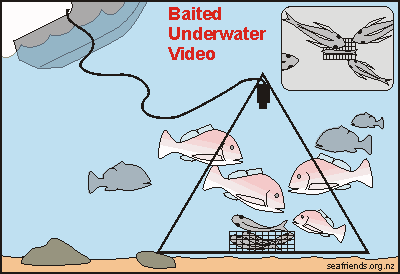 When divers
count fish, their very presence affects their results, by on the one hand
shying some fish away, and on the other hand double-counting those who
follow them. The baited underwater video (BUV) technique is worse
still, in that it attempts to lure fish from far away towards the camera.
One
pilchard tied to the outside of the bait box, even feeds (rewards) the
fishes. In doing so, it under-counts those who are not hungry or not
interested in bait, while over-counting those who are hungry and who have
an acute sense of smell. Also, the presence of fish attracts other fish,
particularly once they rip into the external pilchard. After a standard
time of 30 minutes, the maximum number of fish shown is taken as the fish
count!
When divers
count fish, their very presence affects their results, by on the one hand
shying some fish away, and on the other hand double-counting those who
follow them. The baited underwater video (BUV) technique is worse
still, in that it attempts to lure fish from far away towards the camera.
One
pilchard tied to the outside of the bait box, even feeds (rewards) the
fishes. In doing so, it under-counts those who are not hungry or not
interested in bait, while over-counting those who are hungry and who have
an acute sense of smell. Also, the presence of fish attracts other fish,
particularly once they rip into the external pilchard. After a standard
time of 30 minutes, the maximum number of fish shown is taken as the fish
count!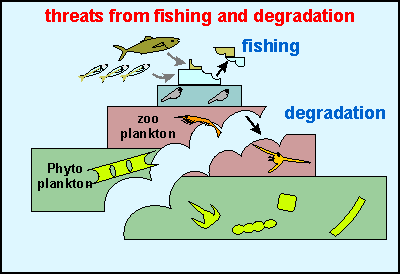 The
environment does not hang together like a net with nodes and strands of
equal importance, but is shaped like a pyramid in which the base is formed
by plant life: algae and plant plankton. The amount and quality of this
base determines how many and which grazers can be found in the next tier.
These in turn determine which and how many primary predators will live
in the next tier, and so on through some five stages to the top level of
tertiary predators of which many are the commercial fish species. Of course
there are influences going down the pyramid but these are very much weaker,
and the furthest levels have the least influence. Thus the very peak (apex)
affected by fishing has a negligible effect on the base formed by plant
life. This also explains that fishing has only a minimal effect on the
marine environment.
The
environment does not hang together like a net with nodes and strands of
equal importance, but is shaped like a pyramid in which the base is formed
by plant life: algae and plant plankton. The amount and quality of this
base determines how many and which grazers can be found in the next tier.
These in turn determine which and how many primary predators will live
in the next tier, and so on through some five stages to the top level of
tertiary predators of which many are the commercial fish species. Of course
there are influences going down the pyramid but these are very much weaker,
and the furthest levels have the least influence. Thus the very peak (apex)
affected by fishing has a negligible effect on the base formed by plant
life. This also explains that fishing has only a minimal effect on the
marine environment.
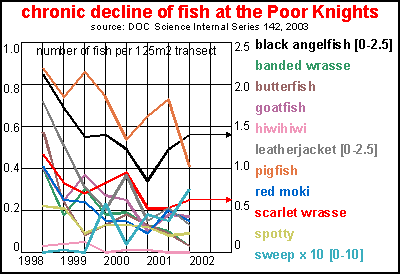 For
many reasons, degradation is not easily seen but scientists recently measured
its effect by accident as shown on the diagram. We have some 17 coastal
marine reserves, and the Poor Knights Islands, located far out in sea on
the edge of the continental shelf, is certainly our best, still with the
cleanest water of all. Yet we observed a sharp decline in the quantity
and quality of fish since the late 1980s, followed by mass mortalities
in 1983, 1992 and 2001 (see degradation
For
many reasons, degradation is not easily seen but scientists recently measured
its effect by accident as shown on the diagram. We have some 17 coastal
marine reserves, and the Poor Knights Islands, located far out in sea on
the edge of the continental shelf, is certainly our best, still with the
cleanest water of all. Yet we observed a sharp decline in the quantity
and quality of fish since the late 1980s, followed by mass mortalities
in 1983, 1992 and 2001 (see degradation 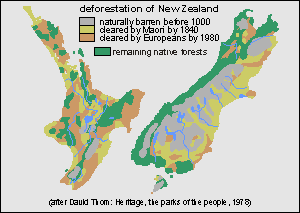 This
map shows how New Zealand forests disappeared in the course of history.
First look at the light-grey areas. They are the natural barrens of New
Zealand, consisting of ice, rock, dry grassland or low shrub. The olive
coloured areas are those laid barren by the early Maori in their hunt for
moas and while practising shifting agriculture. Most of this consisted
of dry scrub land which burnt easily. By the time the Europeans arrived
around 1840, the green and brown areas were still in native forest cover.
With their steel technology of axes and saws, oxen and horses, carts and
trolleys (later motorised) they were able to lay barren the stands of large
trees marked in brown.
This
map shows how New Zealand forests disappeared in the course of history.
First look at the light-grey areas. They are the natural barrens of New
Zealand, consisting of ice, rock, dry grassland or low shrub. The olive
coloured areas are those laid barren by the early Maori in their hunt for
moas and while practising shifting agriculture. Most of this consisted
of dry scrub land which burnt easily. By the time the Europeans arrived
around 1840, the green and brown areas were still in native forest cover.
With their steel technology of axes and saws, oxen and horses, carts and
trolleys (later motorised) they were able to lay barren the stands of large
trees marked in brown. 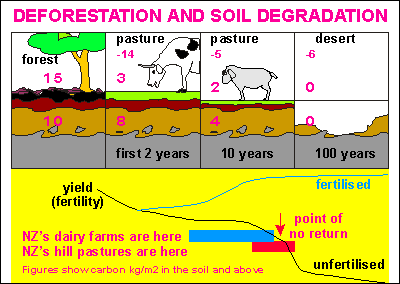 By
contrast, European farmers converted native bush of large trees with deep
soils underneath to pasture and arable land. With their mechanised ploughs
they were able to make substantial changes to soil structure. Under pasture,
the hill country degraded until today it has reached epidemic scale, which
is bound to happen after 50-100 years of use. This diagram shows how soils
degrade after clearfelling the forest. Only fertilisation can halt the
process, but not for hilly land. Once the soil passes the point of no return,
it becomes almost impossible to salvage. Much of our coastline, clearfelled
by possum damage, fits this category.
By
contrast, European farmers converted native bush of large trees with deep
soils underneath to pasture and arable land. With their mechanised ploughs
they were able to make substantial changes to soil structure. Under pasture,
the hill country degraded until today it has reached epidemic scale, which
is bound to happen after 50-100 years of use. This diagram shows how soils
degrade after clearfelling the forest. Only fertilisation can halt the
process, but not for hilly land. Once the soil passes the point of no return,
it becomes almost impossible to salvage. Much of our coastline, clearfelled
by possum damage, fits this category.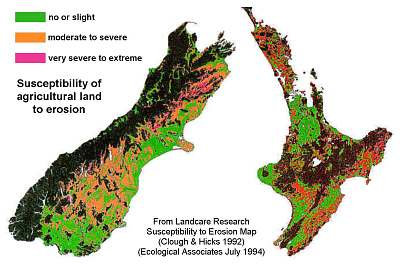 Although
erosion is a natural process, today's rate of erosion exceeds what is sustainable
for our best soils by 3-5 times and for the worst soils by 30 times or
more, and it is worsening rapidly under heavy downpours which are also
a recent event. The mud plumes entering our seas today are very much larger
than they have ever been. Recent estimates of soil loss amount to 300 million
tonnes per annum (about 6 times what is sustainable and over 10 times what
was natural), which is probably an underestimate. The map shows where our
most problematic soils are located. Since digging machines, bulldozers
and scrapers were used to flatten land for building, large areas of soil
are laid entirely bare each year. On such barrens erosion is 6000 times
larger than natural.
Although
erosion is a natural process, today's rate of erosion exceeds what is sustainable
for our best soils by 3-5 times and for the worst soils by 30 times or
more, and it is worsening rapidly under heavy downpours which are also
a recent event. The mud plumes entering our seas today are very much larger
than they have ever been. Recent estimates of soil loss amount to 300 million
tonnes per annum (about 6 times what is sustainable and over 10 times what
was natural), which is probably an underestimate. The map shows where our
most problematic soils are located. Since digging machines, bulldozers
and scrapers were used to flatten land for building, large areas of soil
are laid entirely bare each year. On such barrens erosion is 6000 times
larger than natural.
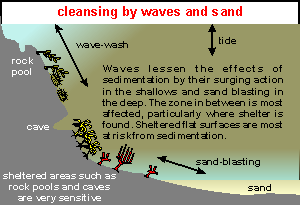 Mud
and diatom strings need calm water before they can settle out. Waves (and
strong currents) prevent this. But even when sediment has accrued over
a period of calm weather, successive large waves have a cleansing effect.
Near the surface it is the sheer force of the water movement which cleanses
the rock and organisms. But also in the deep large waves pick up the sand
and cleanse the substrate and organisms by scouring them as in sand blasting.
In between these zones, the environment is most affected by sedimentation
and its devastating effects. Where shelter is found, such as in deep rock
pools and undersea caves, sediment accumulates easily. It is here that
the first casualties occur.
Mud
and diatom strings need calm water before they can settle out. Waves (and
strong currents) prevent this. But even when sediment has accrued over
a period of calm weather, successive large waves have a cleansing effect.
Near the surface it is the sheer force of the water movement which cleanses
the rock and organisms. But also in the deep large waves pick up the sand
and cleanse the substrate and organisms by scouring them as in sand blasting.
In between these zones, the environment is most affected by sedimentation
and its devastating effects. Where shelter is found, such as in deep rock
pools and undersea caves, sediment accumulates easily. It is here that
the first casualties occur.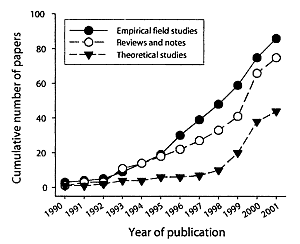 But
the situation is worse still. Some of that Establishment have become vocal
protagonists for the marine reserves lobby, believing so much in their
cause that they have twisted the facts in favour of a rosy picture. It
must be noted that none of these people actually dive, let alone qualify
as marine naturalist. Worse still, this disease has spread worldwide, and
one can now wade through thousands of publications of thousands of researchers,
most of which are based on opinion, seeded with words like marine reserves
can and could and would and may and have potential
to. Lacking all necessary proof, they have resorted to unverifiable
computer models depicting what should or may happen. They
are of course not alone in this kind of optimism. UFOlogy and scientology
thrive similarly. What they have achieved is that a whole discipline in
marine science can no longer be trusted, which is an important message
for the public.
But
the situation is worse still. Some of that Establishment have become vocal
protagonists for the marine reserves lobby, believing so much in their
cause that they have twisted the facts in favour of a rosy picture. It
must be noted that none of these people actually dive, let alone qualify
as marine naturalist. Worse still, this disease has spread worldwide, and
one can now wade through thousands of publications of thousands of researchers,
most of which are based on opinion, seeded with words like marine reserves
can and could and would and may and have potential
to. Lacking all necessary proof, they have resorted to unverifiable
computer models depicting what should or may happen. They
are of course not alone in this kind of optimism. UFOlogy and scientology
thrive similarly. What they have achieved is that a whole discipline in
marine science can no longer be trusted, which is an important message
for the public.
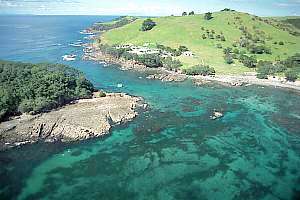 Why
did it happen suddenly? The Goat Island reserve has been stable until
1995/96, when it suddenly happened, at age 18. Next door at Tawharanui
it happened simultaneously and at the same rate, at age 14. Scientists
reasoned that it did not happen at Hahei and Mayor I because these are
much younger (both from 1992, age 4). Is this proof?
Why
did it happen suddenly? The Goat Island reserve has been stable until
1995/96, when it suddenly happened, at age 18. Next door at Tawharanui
it happened simultaneously and at the same rate, at age 14. Scientists
reasoned that it did not happen at Hahei and Mayor I because these are
much younger (both from 1992, age 4). Is this proof?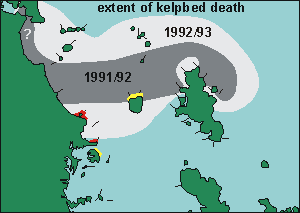 Why
did it also happen outside? Scientists forgot to look at Leigh, Kawau,
Little Barrier, Great Barrier, Mokohinau and the Hen, where the barrens
also disappeared, but these are not marine reserves. On the map the two
marine reserves are shown in red and the nearest areas where the kelp also
invaded the urchin barrens, in yellow. What all these places have in common,
is that they lost their entire kelp forest in 1993.
These places refute
both the null-hypothesis and the age argument. Ironically,
what scientists attributed to the good influence of a reserve (loss
of urchin barrens), was in fact caused by degradation (loss of kelp
forest due to dense plankton blooms, folowed by mass urchin mortalities)!
Why
did it also happen outside? Scientists forgot to look at Leigh, Kawau,
Little Barrier, Great Barrier, Mokohinau and the Hen, where the barrens
also disappeared, but these are not marine reserves. On the map the two
marine reserves are shown in red and the nearest areas where the kelp also
invaded the urchin barrens, in yellow. What all these places have in common,
is that they lost their entire kelp forest in 1993.
These places refute
both the null-hypothesis and the age argument. Ironically,
what scientists attributed to the good influence of a reserve (loss
of urchin barrens), was in fact caused by degradation (loss of kelp
forest due to dense plankton blooms, folowed by mass urchin mortalities)!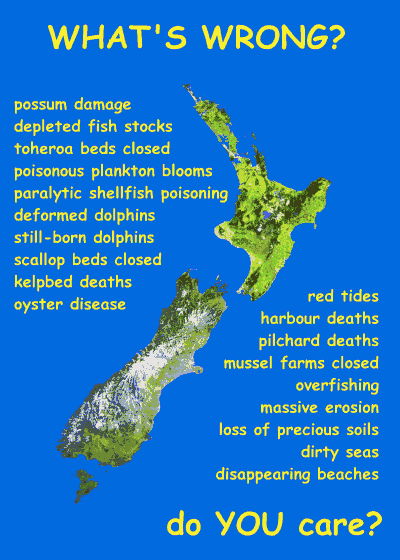 Every
part of our coast has its unique set of problems, but in general the following
can be said:
Every
part of our coast has its unique set of problems, but in general the following
can be said: